
8-Day Northern & Western: Kicker Rock's Hammerheads
7 nights aboard the GRAND OCEAN SPRAY
7 nights aboard the GRAND OCEAN SPRAY

Prefer to talk? + 1 786 509 6338
We answer first thing on the next working day
We answer personally, and we answer ourselves. A Galápagos trip is once in a lifetime, and you want the right advice before you book.
+ 1 786 509 6338We answer first thing on the next working day
Tell us who is traveling and we will check this departure for availability.
Hammerhead sharks patrolling a channel narrow enough to swim through, three booby species sharing one hilltop, a fur seal colony tucked into shaded grottoes - eight days aboard the Grand Ocean Spray cover San Cristobal, Genovesa, and Santiago in the northern and western Galapagos. Punta Pitt opens the trip as the only site where all three booby species nest together, then Kicker Rock rises 148 meters straight from the Pacific, its channel patrolled by hammerhead and Galapagos sharks. Cerro Brujo's cliffs, Darwin Bay's frigatebirds, and Prince Philip's Steps follow, and Puerto Egas shelters its own fur seal colony. Mosquera's sea lions, Punta Cormorant's flamingos, and Post Office Bay's 1793 barrel close the trip.
161 ft · Luxury cruise
Day by day. Click an activity for details.
1 available departures. Prices per guest based on double occupancy.
Single supplement: Sole occupancy of a double cabin usually carries a surcharge of 70 to 100 per cent. On many departures we can offer cabin sharing instead, in which case the supplement is waived entirely. Just mention it in your inquiry.
On top of the cruise price, budget around 200 USD for the national park fee, 20 USD for the transit control card and 400 to 600 USD for the domestic flight from Quito or Guayaquil. International flights to Ecuador come on top of that.
Good all year round. From December to May the water is warmer and the sea calmer, which is ideal for snorkelling. From June to November it is cooler and rougher, but wildlife density in the water is higher because the Humboldt Current brings more food.
Citizens of the EU, the UK, the US and many other countries do not need a visa for stays of up to 90 days. There are no compulsory vaccinations. For recommendations please speak to your doctor or a travel health clinic.
Crossings between the islands can be noticeably choppy, especially at night in the west of the archipelago. Catamarans such as the Endemic sit steadier than single-hull yachts. If you are sensitive, bring motion sickness tablets.
Yes. Either with a single supplement or through cabin sharing, where we pair you with another solo traveller of the same gender. Just mention it in your inquiry.
You send a non-binding inquiry through the website. We check availability directly with the operator and usually come back to you within one working day with a concrete offer. The booking is then handled personally by us, not online.
Select a departure to send your request.

San Cristobal's airport sits at the edge of Puerto Baquerizo Moreno, a five-minute drive from the town center, so this is usually your first taste of the islands rather than a standalone excursion. Sea lions and marine iguanas are known to rest right next to the runway here, an unscripted welcome few airports can match. From the terminal, a short transfer takes you down to the pier for a panga ride out to your ship.
Rising nearly 148 meters straight out of the Pacific, split by a channel narrow enough to swim or boat through, Kicker Rock is the most dramatic silhouette in the islands. Blue-footed boobies, frigatebirds, and sea lions are often seen around the rock face, and below the surface this ranks among the best diving and snorkeling in Galapagos, with hammerhead and Galapagos sharks a real possibility in the channel.
Punta Pitt is the only site in the islands where all three Galapagos booby species nest within view of one another: red-foots in the low trees, Nazca boobies on the open cliff-edge ground, and blue-foots further inland. A steep gully climbs to the breeding grounds, where frigatebirds often circle overhead and swallow-tailed gulls round out the colony.
One of the few places in the islands where human history takes center stage over wildlife. In 1793, a whaling captain installed a wooden barrel here as an informal mailbox, and the tradition has never stopped: you're welcome to leave a postcard without a stamp, and to sort through what's already inside for anything addressed near your own home to hand-deliver in person. After a wet landing on the sandy beach, a short walk brings you to the barrel, then on to a lava tube you can climb down into by ladder. It is one of the most memorable traditions anywhere in the islands.
Reachable only by sea, Black Turtle Cove is a mangrove-lined lagoon on Santa Cruz's north shore, protected as a turtle sanctuary. A slow, quiet dinghy ride carries you between four species of mangrove while sea turtles surface for air around the boat, one of the most reliable sightings in the islands. Look down and you'll often see golden and eagle rays moving beneath the hull, and white-tipped reef sharks resting in the shallows.
Darwin Bay sits inside the flooded caldera of Genovesa, and a wet landing on its white coral-sand beach puts you right in the middle of a working seabird colony. Great frigatebirds display along the shore, males inflating scarlet throat pouches to catch a female's eye, and red-footed boobies nest low in the surrounding trees and shrubs, unusual for a booby. Nazca boobies are just as much a fixture here, while blue-footed boobies are a rarer, luckier sighting. Swallow-tailed gulls and red-billed tropicbirds work the cliffs nearby. If you're a confident swimmer, the bay's calm water is a good place to snorkel or kayak afterward, with a chance of white-tipped reef sharks and sea turtles along the rocky shore.
A quiet landing on Santiago's western coast, best known as a nesting ground for Pacific green sea turtles, who come ashore to lay their eggs between December and June.
A dry landing sets you down on North Seymour's flat, sun-baked terrain, and the trail wastes no time getting to the action: magnificent frigatebirds display from low shrubs right along the path, males inflating their scarlet throat pouches into balloons to catch a female's eye. Blue-footed boobies are a near-constant presence along the same stretch, and during the breeding season you may catch their high-stepping courtship dance just a few feet from the trail, showing off the bright blue feet that give the species its name. Land and marine iguanas share the coastline as the trail loops back toward the water, and sea lions haul out along the shore. Keep an eye on the cliffs above the surf too, where swallow-tailed gulls sometimes perch between flights out to sea.
A tiny, flat islet of white coral sand between North and South Seymour, Mosquera is best known for its resident sea lion colony, sprawled across the beach for much of the day. Shorebirds and lava herons work the shoreline fairly reliably, and sharks and rays are a possibility for anyone snorkeling or diving nearby.
Also known as Witch Hill, Cerro Brujo greets you with towering cliffs before the dinghy even reaches the beach. Once ashore, you can relax alongside the sea lions, snorkel straight from the sand, or walk to a hidden lagoon where shorebirds work the shallows. Blue-footed boobies, swallow-tailed gulls, and marine iguanas are often somewhere along the shoreline and cliffs too.
From the landing, a trail leads to a wide, shallow lagoon where Galapagos flamingos wade through the shallows, filtering shrimp from the mud that gives them their color. Continuing over a low rise brings you to Flour Beach, a nesting ground for green sea turtles between December and June. Just offshore, the eroded remains of an old volcanic cone form Devil's Crown, one of the best snorkeling spots in the islands. White-tipped reef sharks and spotted eagle rays are a near-certain sight inside the ring, and on a good day you might also spot hammerhead sharks, sea lions, or a colorful mix of reef fish weaving through the rocks.
A wooden staircase of 372 steps climbs Bartolome's extinct volcano from a lava-and-concrete dock or sandy beach, depending on conditions. Along the way, red, orange, black, and even green volcanic layers mark the slopes, home to pioneer plants like the island-endemic Tiquilia nesiotica, lava cactus, and scattered Scalesia. With some luck, a lava lizard crosses the trail. At the top, the view over the twin bays and the iconic Pinnacle Rock is the reward for the climb. Back at sea level, a snorkel around the coral reef and submerged lava rocks is a good bet for Galapagos penguins and white-tipped reef sharks, with sea turtles and manta rays turning up now and then too.
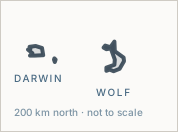
A stone stairway carved into the cliff climbs to a wide plateau holding one of Genovesa's largest seabird colonies. The trail passes through a small Scalesia forest, home to the short-eared owl, one of the few predators on the island, before reaching cliffside colonies where Nazca and red-footed boobies nest side by side, frigatebirds wheel overhead, and thousands of storm petrels dart in and out of cracks in the lava. A small colony of fur seals sometimes gathers near the landing. Red-footed boobies nest in only a handful of places across the archipelago, and this is one of them.
Puerto Egas stands out for its black volcanic sand and a shoreline where land and sea meet in close quarters. Galapagos hawks are often seen along the walk, and at the far end waits a colony of Galapagos fur seals tucked into shaded rock grottoes, one of the more reliable places in the islands to see this endangered species.
Set on the grounds of the Galapagos National Park Service on Santa Cruz, this station was once home to Lonesome George, the last known tortoise of the Pinta subspecies. A series of interpretive buildings walks you through the conservation science underway across the islands, and the surrounding native vegetation is a good place to look for Darwin's finches going about their business.
The return transfer is straightforward: a panga ride from your ship to the pier, then a short bus ride to Baltra's airport, the world's first fully ecological terminal, run on solar and wind power. Land iguanas, reintroduced here after being wiped out decades ago, are sometimes seen right around the grounds on the way to your flight.
Launching October 3, 2026, Grand Ocean Spray is Golden Galapagos's newest luxury catamaran: 16 guests, a dedicated panoramic spa, solar power, and full carbon-neutral operation, running the fleet's standard 3 to 14 night routes.
The sun deck's fully stocked bar, al fresco dining and lounging areas, and premium 8-person whirlpool offer 360-degree island views; a winding staircase connects the crystal-chandeliered main deck dining room to the upper deck, where a dedicated panoramic spa sits toward the stern alongside a covered terrace for wildlife-watching.
The pick for travelers wanting the newest hardware in the fleet, solar power, a dedicated spa deck, and multiple relaxation zones, combined with Golden Galapagos's carbon-neutral commitment. As a new launch, early booking is recommended.