6-Day Western Islands: Albemarle Point's WWII Ruins
5 nights aboard the Galaxy Sirius
5 nights aboard the Galaxy Sirius
WWII radar station ruins slowly swallowed by lava, the largest marine iguanas found anywhere in the islands, critically endangered flightless cormorants nesting nearby - six days aboard the Galaxy Sirius cover Isabela and Fernandina in the western Galapagos. Punta Moreno's lava pools draw flamingos, then Urbina Bay's coral, pushed onto dry land by a 1954 uplift, sits among grazing land iguanas. Punta Espinosa brings the largest marine iguana gathering in the islands, and Dragon Hill's iguanas recover under active restoration. Elizabeth Bay's penguin colony and Tagus Cove's sailor graffiti follow. Albemarle Point's WWII radar ruins, reclaimed by lava, sit beside the largest marine iguanas found anywhere in the Galapagos.
built 2024 · Premium cruise
Day by day. Click an activity for details.
44 available departures. Prices per guest based on double occupancy.
Single supplement: Sole occupancy of a double cabin usually carries a surcharge of 70 to 100 per cent. On many departures we can offer cabin sharing instead, in which case the supplement is waived entirely. Just mention it in your inquiry.
On top of the cruise price, budget around 200 USD for the national park fee, 20 USD for the transit control card and 400 to 600 USD for the domestic flight from Quito or Guayaquil. International flights to Ecuador come on top of that.
Good all year round. From December to May the water is warmer and the sea calmer, which is ideal for snorkelling. From June to November it is cooler and rougher, but wildlife density in the water is higher because the Humboldt Current brings more food.
Citizens of the EU, the UK, the US and many other countries do not need a visa for stays of up to 90 days. There are no compulsory vaccinations. For recommendations please speak to your doctor or a travel health clinic.
Crossings between the islands can be noticeably choppy, especially at night in the west of the archipelago. Catamarans such as the Endemic sit steadier than single-hull yachts. If you are sensitive, bring motion sickness tablets.
Yes. Either with a single supplement or through cabin sharing, where we pair you with another solo traveller of the same gender. Just mention it in your inquiry.
You send a non-binding inquiry through the website. We check availability directly with the operator and usually come back to you within one working day with a concrete offer. The booking is then handled personally by us, not online.
We will check availability with the operator and get back to you personally.
| 30/01/2027 | 04/02/2027 | 4 | US$8,100 | Inquire |
| 27/02/2027 | 04/03/2027 | 4 | US$8,100 | Inquire |
| 13/03/2027 | 18/03/2027 | 9 | US$8,100US$7,940 | Inquire |
| 27/03/2027 | 01/04/2027 | 3 | US$8,100 | Inquire |
| 10/04/2027 | 15/04/2027 | 4 | US$8,100 | Inquire |
| 08/05/2027 | 13/05/2027 | 3 | US$8,100 | Inquire |
| 22/05/2027 | 27/05/2027 | 5 | US$8,100 | Inquire |
| 05/06/2027 | 10/06/2027 | 16 | US$8,100US$7,940 | Inquire |
| 19/06/2027 | 24/06/2027 | 6 | US$8,100 | Inquire |
| 03/07/2027selected | 08/07/2027 | 16 | US$8,100US$7,940 | Inquire |
| 17/07/2027 | 22/07/2027 | 16 | US$8,100US$7,940 | Inquire |
| 31/07/2027 | 05/08/2027 | 16 | US$8,100US$7,940 | Inquire |
| 14/08/2027 | 19/08/2027 | 8 | US$8,100 | Inquire |
| 28/08/2027 | 02/09/2027 | 10 | US$8,100US$7,940 | Inquire |
| 11/09/2027 | 16/09/2027 | 12 | US$8,100US$7,695 | Inquire |
| 25/09/2027 | 30/09/2027 | 16 | US$8,100US$7,695 | Inquire |
| 09/10/2027 | 14/10/2027 | 14 | US$8,100US$7,695 | Inquire |
| 23/10/2027 | 28/10/2027 | 16 | US$8,100US$7,695 | Inquire |
| 06/11/2027 | 11/11/2027 | 14 | US$8,100US$7,695 | Inquire |
| 20/11/2027 | 25/11/2027 | 16 | US$8,100US$7,695 | Inquire |
| 04/12/2027 | 09/12/2027 | 14 | US$8,100US$7,695 | Inquire |
| 18/12/2027 | 23/12/2027 | 10 | US$7,800US$7,410 | Inquire |
| 01/01/2028 | 06/01/2028 | 16 | US$8,500US$8,100 | Inquire |
| 15/01/2028 | 20/01/2028 | 16 | US$8,500US$8,100 | Inquire |
| 29/01/2028 | 03/02/2028 | 16 | US$8,500US$8,100 | Inquire |
| 12/02/2028 | 17/02/2028 | 16 | US$8,500US$8,100 | Inquire |
| 26/02/2028 | 02/03/2028 | 16 | US$8,500US$8,100 | Inquire |
| 11/03/2028 | 16/03/2028 | 16 | US$8,500US$8,100 | Inquire |
| 25/03/2028 | 30/03/2028 | 16 | US$8,500US$8,100 | Inquire |
| 08/04/2028 | 13/04/2028 | 16 | US$8,500US$8,100 | Inquire |
| 22/04/2028 | 27/04/2028 | 16 | US$8,500US$8,100 | Inquire |
| 06/05/2028 | 11/05/2028 | 16 | US$8,500US$8,100 | Inquire |
| 20/05/2028 | 25/05/2028 | 16 | US$8,500US$8,100 | Inquire |
| 03/06/2028 | 08/06/2028 | 2 | US$8,500US$8,100 | Inquire |
| 17/06/2028 | 22/06/2028 | 16 | US$8,500US$8,100 | Inquire |
| 01/07/2028 | 06/07/2028 | 16 | US$8,500US$8,100 | Inquire |
| 29/07/2028 | 03/08/2028 | 16 | US$8,500US$8,100 | Inquire |
| 12/08/2028 | 17/08/2028 | 16 | US$8,500US$8,100 | Inquire |
| 26/08/2028 | 31/08/2028 | 16 | US$8,500US$8,100 | Inquire |
| 09/09/2028 | 14/09/2028 | 16 | US$8,500US$8,100 | Inquire |
| 23/09/2028 | 28/09/2028 | 16 | US$8,500US$8,100 | Inquire |

Most Galapagos itineraries begin here. Baltra's airport is the world's first fully ecological airport, run on solar and wind power and built largely from recycled materials, including old oil pipes repurposed into the terminal structure. Land iguanas, wiped out here by the 1950s and reintroduced through a decades-long breeding program, now number in the hundreds again, some right around the airport grounds. From the terminal, a short bus transfer brings you to the pier for the panga ride out to your ship.
Up in the cool, misty highlands of Santa Cruz, a short walk brings you among wild giant tortoises moving through the undergrowth on their own terms. No fences, no enclosures, just several-hundred-pound reptiles going about their day. This is one of the best places anywhere in the islands for that encounter, and the surrounding vegetation is good habitat for several of Darwin's finches, heard as often as seen.
At first glance Punta Moreno looks like little more than a lava flow at the base of Cerro Azul, but its black surface holds a series of lagoons with a surprising amount of life. Flamingos are a fairly good bet in the pools, and paint-billed crakes, white-cheeked pintails, and common gallinules turn up for those willing to watch the water closely.
At the base of Alcedo Volcano on Isabela, Urbina Bay marks a dramatic geological event: a 1954 uplift left blocks of coral fully exposed on dry land, well above the waterline. A long, level walk leads out to them, passing land iguanas and flightless cormorants along the way, and, on occasion, a giant tortoise.
Fernandina is the only major island in the archipelago with no introduced species, which makes Punta Espinosa one of the most pristine wildlife encounters anywhere in the Galapagos. A wet landing brings you onto black lava draped with the largest gathering of marine iguanas in the islands, alongside Galapagos penguins and flightless cormorants, both drawn here by the cold, nutrient-rich current. Around June, when marine iguana hatchlings emerge, keep an eye out for the Galapagos racer snake hunting along the nesting zone. Snorkeling here is a rare chance to watch marine iguanas feeding underwater, a behavior found almost nowhere else.
Puerto Egas stands out for its black volcanic sand and a shoreline where land and sea meet in close quarters. Galapagos hawks are often seen along the walk, and at the far end waits a colony of Galapagos fur seals tucked into shaded rock grottoes, one of the more reliable places in the islands to see this endangered species.
One of the few visitor sites directly tied to an active conservation program, run jointly by the Charles Darwin Foundation and the Galapagos National Park, working to restore the local land iguana population. From the rocky landing, which doubles as a good snorkeling spot, a trail leads inland past two small saltwater lagoons, sometimes home to flamingos, before circling the hill itself, where land iguanas and their burrows dot the hillside.
There's no landing here. The whole visit happens aboard a zodiac. The route passes the Marielas Islets, home to the largest and most important Galapagos penguin colony in the archipelago, before easing into a cove ringed by red mangroves. Flightless cormorants perch at the water's edge, sea turtles surface nearby, and golden rays glide beneath the boat now and then. It's one of the best places in the islands to watch this much wildlife without ever stepping ashore.
A zodiac ride along Tagus Cove's cliffs is the first stop, tracing walls carved with the graffiti of sailors and whalers going back over a century. Charles Darwin himself anchored here in 1835. Watch the rock for Galapagos penguins and flightless cormorants before you land and set off on a gently climbing trail, roughly 30 minutes each way, to a viewpoint over Darwin Lake, a crater lake saltier than the ocean itself. Along the way, look for land birds that are easy to miss: ground and tree finches, yellow warblers, large-billed flycatchers, and, with a little luck, the tool-using woodpecker finch. Land iguanas and giant tortoises sometimes cross the path as well. Back at the water, most visits close with a dinghy ride or a snorkel along the submerged cliff wall, depending on the day's plan, with another good chance at penguins and cormorants gliding by.
At the remote northern tip of Isabela, Albemarle Point is one of the least-visited spots in the archipelago, reached only by panga. There's no landing here. You'll pass the ruins of a US radar station built during World War II, now slowly being reclaimed by lava and vegetation, before reaching nesting grounds for the critically endangered flightless cormorant, shared with the largest marine iguanas found anywhere in the Galapagos.
A quiet landing on Santiago's western coast, best known as a nesting ground for Pacific green sea turtles, who come ashore to lay their eggs between December and June.
The return transfer is straightforward: a panga ride from your ship to the pier, then a short bus ride to Baltra's airport, the world's first fully ecological terminal, run on solar and wind power. Land iguanas, reintroduced here after being wiped out decades ago, are sometimes seen right around the grounds on the way to your flight.
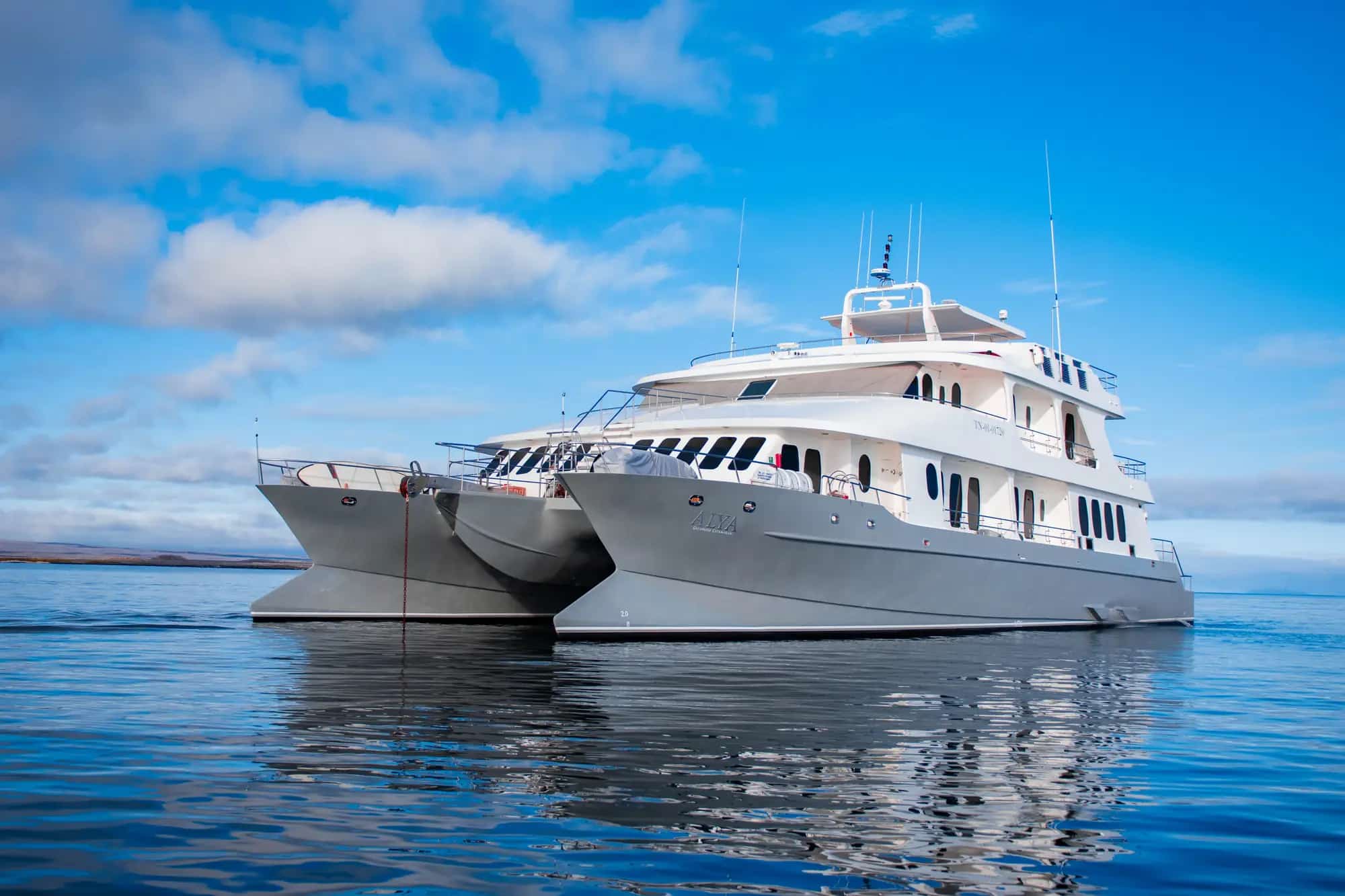
Distinguished by sleek black hulls, Galaxy Sirius is a premium catamaran for an intimate 16 guests, sailing 4 to 5 night Galapagos routes with two bilingual naturalist guides on every departure instead of the usual one. Panoramic cabins, private balconies, and full-charter availability make it a natural pick for travelers wanting a higher-touch experience.
Cabins come with air conditioning, an electronic safe, hair dryer, and private balconies with panoramic windows on most main and upper deck rooms. Onboard, guests unwind in the jacuzzi, browse a small archipelago-inspired boutique, or dine al fresco on local ingredients, with a welcome cocktail and unlimited soft drinks, coffee, and tea included alongside all meals.
Best suited to honeymooners, small private groups, or families booking a full charter, thanks to the extra naturalist guide and private-balcony cabins.
Yes, the whole yacht is available for exclusive private bookings, popular with large families and groups.
No. Drone use is prohibited throughout Galapagos National Park to avoid disturbing wildlife.