8-Day Southern Islands: Punta Pitt's Triple Booby Colony
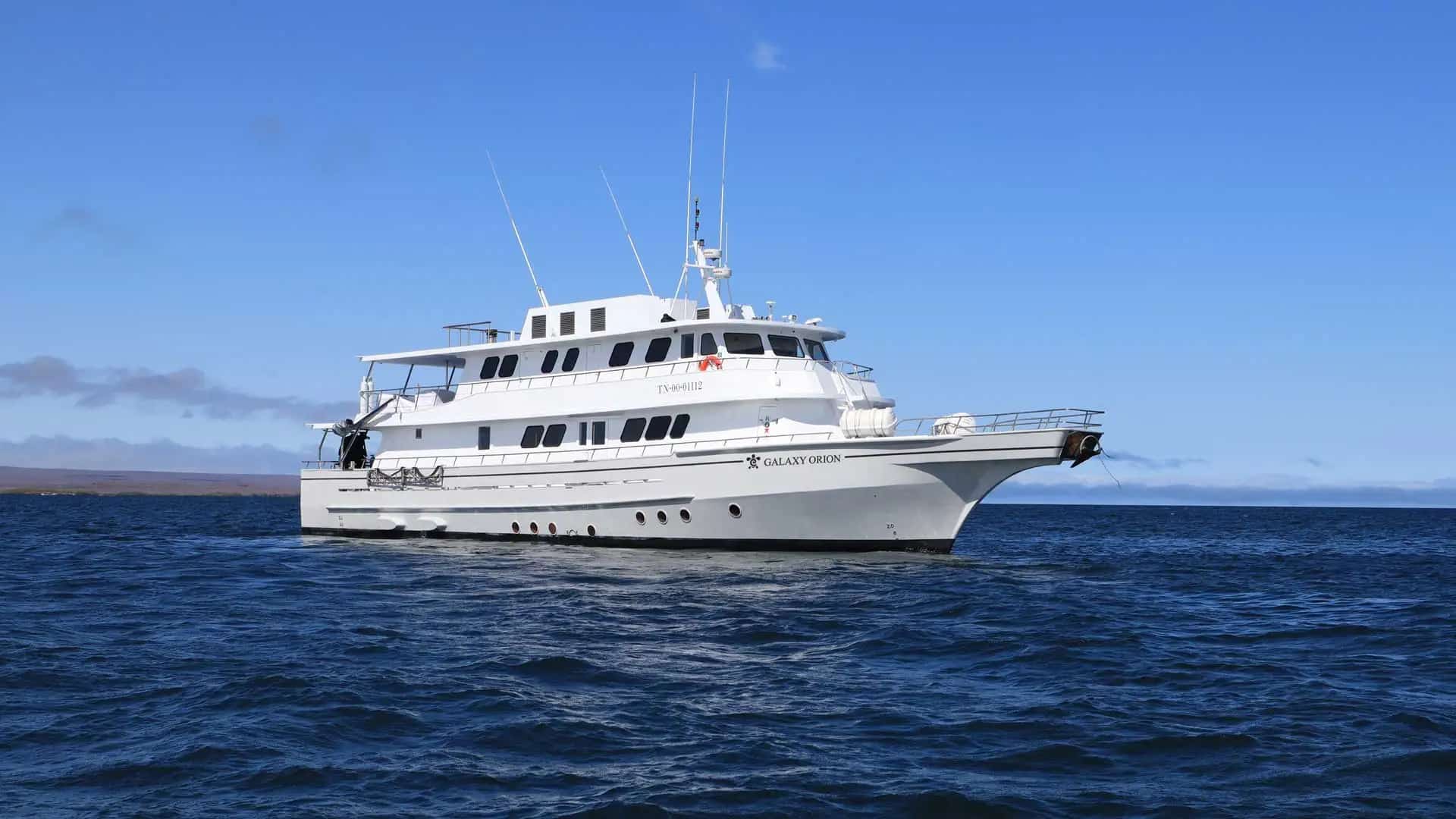
7 nights aboard the Galaxy Orion
7 nights aboard the Galaxy Orion
372 steps to the most photographed rock in the Galapagos, three booby species sharing one hilltop - eight days on the Galaxy Orion cover Santa Cruz, San Cristobal, Espanola, and Floreana in the eastern and southern Galapagos. Bachas Beach opens the week on Santa Cruz, then Bartolome's staircase climbs to that famous view over Pinnacle Rock. Sullivan Bay's cooled lava leads to South Plaza's iguanas and Santa Fe's own endemic iguana. San Cristobal fills two full days: Cerro Brujo's cliffs and sea lions, Punta Pitt, where all three booby species nest together, El Junco's crater lake, and Isla Lobos' namesake colony. Espanola brings Punta Suarez's albatross, the world's only colony, then Gardner Bay's sea lions. Floreana's flamingos and a 1793 mail barrel close the trip.
built 2023 · Tourist Superior cruise
Day by day. Click an activity for details.
5 available departures. Prices per guest based on double occupancy.
Single supplement: Sole occupancy of a double cabin usually carries a surcharge of 70 to 100 per cent. On many departures we can offer cabin sharing instead, in which case the supplement is waived entirely. Just mention it in your inquiry.
On top of the cruise price, budget around 200 USD for the national park fee, 20 USD for the transit control card and 400 to 600 USD for the domestic flight from Quito or Guayaquil. International flights to Ecuador come on top of that.
Good all year round. From December to May the water is warmer and the sea calmer, which is ideal for snorkelling. From June to November it is cooler and rougher, but wildlife density in the water is higher because the Humboldt Current brings more food.
Citizens of the EU, the UK, the US and many other countries do not need a visa for stays of up to 90 days. There are no compulsory vaccinations. For recommendations please speak to your doctor or a travel health clinic.
Crossings between the islands can be noticeably choppy, especially at night in the west of the archipelago. Catamarans such as the Endemic sit steadier than single-hull yachts. If you are sensitive, bring motion sickness tablets.
Yes. Either with a single supplement or through cabin sharing, where we pair you with another solo traveller of the same gender. Just mention it in your inquiry.
You send a non-binding inquiry through the website. We check availability directly with the operator and usually come back to you within one working day with a concrete offer. The booking is then handled personally by us, not online.
We will check availability with the operator and get back to you personally.
| 22/05/2027 | 29/05/2027 | 6 | US$4,600 | Inquire |
| 19/06/2027 | 26/06/2027 | 8 | US$4,600US$4,280 | Inquire |

Most Galapagos itineraries begin here. Baltra's airport is the world's first fully ecological airport, run on solar and wind power and built largely from recycled materials, including old oil pipes repurposed into the terminal structure. Land iguanas, wiped out here by the 1950s and reintroduced through a decades-long breeding program, now number in the hundreds again, some right around the airport grounds. From the terminal, a short bus transfer brings you to the pier for the panga ride out to your ship.
A relaxed, sandy stop on Santa Cruz's north shore. A lagoon just behind the beach occasionally draws flamingos and other shorebirds, and the beach itself is one of the archipelago's main sea turtle nesting grounds, most active between December and June. It's an easy visit, as much about the swim as the wildlife.
A wooden staircase of 372 steps climbs Bartolome's extinct volcano from a lava-and-concrete dock or sandy beach, depending on conditions. Along the way, red, orange, black, and even green volcanic layers mark the slopes, home to pioneer plants like the island-endemic Tiquilia nesiotica, lava cactus, and scattered Scalesia. With some luck, a lava lizard crosses the trail. At the top, the view over the twin bays and the iconic Pinnacle Rock is the reward for the climb. Back at sea level, a snorkel around the coral reef and submerged lava rocks is a good bet for Galapagos penguins and white-tipped reef sharks, with sea turtles and manta rays turning up now and then too.
A short landing puts you immediately among sea lions and the endemic Plaza land iguana, smaller and more golden than its relatives elsewhere. Watch closely and you might spot a rare hybrid, the result of an occasional cross between a marine and a land iguana found only here. The trail crosses a carpet of succulent Sesuvium, red for part of the year, studded with Opuntia cactus. Along the cliffs, swallow-tailed gulls nest on the ledges beside red-billed tropicbirds, and frigatebirds circle overhead as the loop returns to the landing.
Also known as Witch Hill, Cerro Brujo greets you with towering cliffs before the dinghy even reaches the beach. Once ashore, you can relax alongside the sea lions, snorkel straight from the sand, or walk to a hidden lagoon where shorebirds work the shallows. Blue-footed boobies, swallow-tailed gulls, and marine iguanas are often somewhere along the shoreline and cliffs too.
Not to be confused with Cerro Brujo, a coastal site on San Cristobal's shoreline, the San Cristobal Highlands are the island's green, misty interior, reached by road through the farming community of El Progreso on the way to El Junco lagoon and the La Galapaguera tortoise reserve. Darwin's finches and other highland birdlife are common companions along the drive.
A dry landing among the rocks puts you right at the start of one of the richest walks in the islands. The trail follows dramatic cliffs where blowholes send spray high into the air with every swell, and along the way marine iguanas bask on the black rock. Between December and March, the males here turn a striking red and green for the breeding season. Punta Suarez is the only place on Earth where waved albatrosses nest, and between April and December you'll find the colony in full swing, their courtship displays peaking in October. Blue-footed and Nazca boobies nest along the same stretch of cliff, red-billed tropicbirds circle overhead, and the endemic Espanola mockingbird, famously bold, often comes right up to visitors. Keep an eye out too for the Galapagos hawk and the Galapagos dove working the scrub beside the trail.
One of the few places in the islands where human history takes center stage over wildlife. In 1793, a whaling captain installed a wooden barrel here as an informal mailbox, and the tradition has never stopped: you're welcome to leave a postcard without a stamp, and to sort through what's already inside for anything addressed near your own home to hand-deliver in person. After a wet landing on the sandy beach, a short walk brings you to the barrel, then on to a lava tube you can climb down into by ladder. It is one of the most memorable traditions anywhere in the islands.
Set on the grounds of the Galapagos National Park Service on Santa Cruz, this station was once home to Lonesome George, the last known tortoise of the Pinta subspecies. A series of interpretive buildings walks you through the conservation science underway across the islands, and the surrounding native vegetation is a good place to look for Darwin's finches going about their business.
A geology stop first and foremost. A wet landing on a white coral-sand beach leads out onto a pahoehoe lava field that flowed less than a hundred years ago, its surface still holding the ropy, swirled texture it cooled into, a favorite for photographers. Tiny pioneer plants are just beginning to colonize the cracks in the rock. Bring your camera for the landscape rather than your binoculars here.
Formed by geological uplift rather than volcanic activity, Santa Fe is unusually flat for a Galapagos island, and it's the only place on Earth with its own endemic subspecies of land iguana. After landing in clear, turquoise water, a walk through a forest of giant, tree-sized Opuntia cactus leads to iguanas basking beneath them. The Galapagos dove is a reliable sight along the trail, and with some luck you may also spot the Galapagos snake or the Galapagos hawk.
Punta Pitt is the only site in the islands where all three Galapagos booby species nest within view of one another: red-foots in the low trees, Nazca boobies on the open cliff-edge ground, and blue-foots further inland. A steep gully climbs to the breeding grounds, where frigatebirds often circle overhead and swallow-tailed gulls round out the colony.
A short crossing from Puerto Baquerizo Moreno on San Cristobal, Isla Lobos takes its name from the sea lion colony that calls it home, and doubles as a seasonal nesting ground for blue-footed boobies. Frigatebirds have begun nesting here in recent years too, and fur seals turn up now and then. The walk covers roughly 850 meters of mixed rocky and sandy trail.
A short landing on one of the most beautiful beaches in the islands brings you into a resident colony of Galapagos sea lions, sprawled across the white sand. Between August and November you may also spot pups nursing nearby. This is one of the only places to see the Espanola mockingbird, found nowhere else on Earth and famously unbothered by visitors. After time on the beach, a relaxed snorkel just offshore is a good way to close out the visit, with spotted eagle rays often gliding beneath the surface.
From the landing, a trail leads to a wide, shallow lagoon where Galapagos flamingos wade through the shallows, filtering shrimp from the mud that gives them their color. Continuing over a low rise brings you to Flour Beach, a nesting ground for green sea turtles between December and June. Just offshore, the eroded remains of an old volcanic cone form Devil's Crown, one of the best snorkeling spots in the islands. White-tipped reef sharks and spotted eagle rays are a near-certain sight inside the ring, and on a good day you might also spot hammerhead sharks, sea lions, or a colorful mix of reef fish weaving through the rocks.
The return transfer is straightforward: a panga ride from your ship to the pier, then a short bus ride to Baltra's airport, the world's first fully ecological terminal, run on solar and wind power. Land iguanas, reintroduced here after being wiped out decades ago, are sometimes seen right around the grounds on the way to your flight.
Galaxy Orion is a renovated expedition yacht for up to 14 guests, built for travelers who want genuine comfort at a friendly price, with four itineraries spanning 3 to 7 nights. Tailor-made cabins and cozy social areas suit families wanting privacy without a big price tag.
The dining room offers a gastronomic experience built on local ingredients, and cabins include air conditioning, hair dryers, and eco-friendly toiletries, with panoramic-view windows on the main and upper decks.
A solid match for budget-conscious travelers and larger families or groups; Orion is also available for full private charter.
No, paddleboarding isn't included on this vessel, unlike most of the Galaxy fleet. Snorkeling, kayaking, panga rides, and hiking are included.