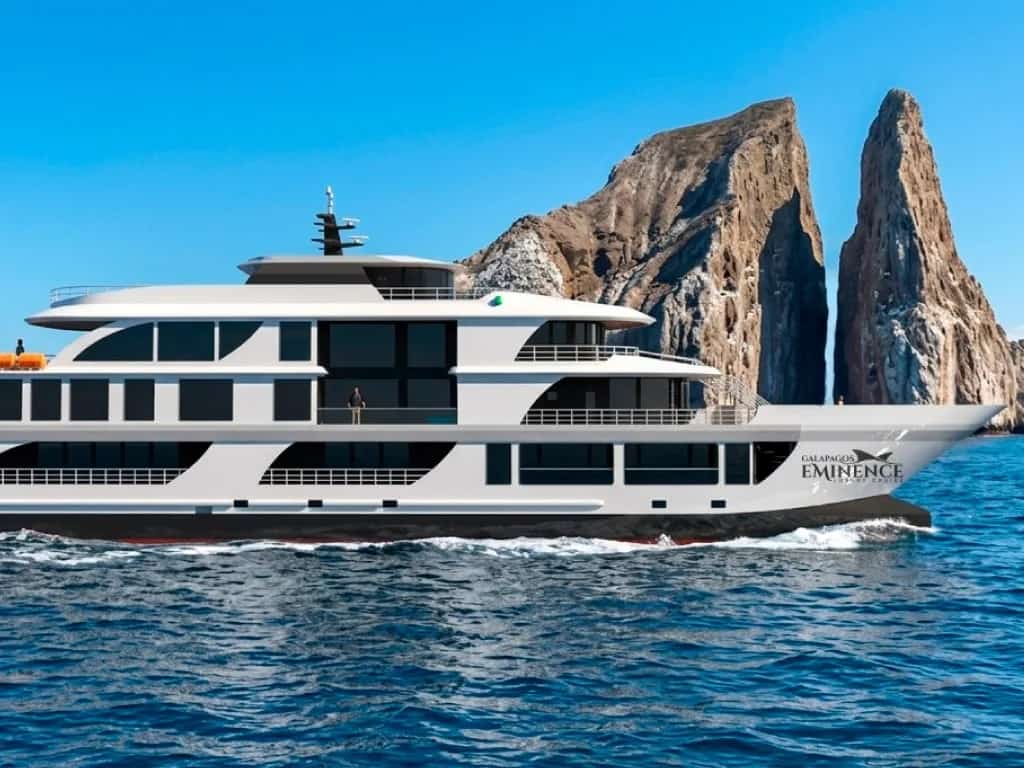
8-Day Western Islands: Elizabeth Bay's Mangrove Cove
7 nights aboard the EMINENCE
8-Day Western Islands: Elizabeth Bay's Mangrove Cove
Trip highlights
- Whitetip reef sharks rest together in Las Tintoreras' narrow crevice
- Sierra Negra's caldera spans 10 km, among the largest on Earth
- Elizabeth Bay shelters the archipelago's largest penguin colony
- Punta Espinosa hosts the largest marine iguana gathering around
- Bartolome's 372 wooden steps climb to the famous Pinnacle Rock view
Why book with us
- Availability updated daily - Departures and prices come straight from the operators' own systems, so a cabin shown free is free.
- Galápagos only - We arrange Galápagos cruises exclusively and know every vessel.
- Personal advice - One dedicated contact from your first question to your return.
- Travel that gives back - Part of every booking goes into protecting the national park.
Whitetip reef sharks resting in a crystalline crevice, the largest marine iguana gathering in the islands, a lava field that cooled less than a hundred years ago - eight days aboard the Eminence cover Isabela, Fernandina, and Santiago in the western Galapagos. Las Tintoreras and Sierra Negra's 10-kilometer caldera open the Isabela leg, then Punta Moreno's lava lagoons and Elizabeth Bay, where a red mangrove cove lies past the archipelago's largest penguin colony. Punta Espinosa on Fernandina, the only major island with no introduced species, brings flightless cormorants and penguins. Puerto Egas' fur seal grottoes, Bartolome's 372 steps, and Sullivan Bay's young lava follow on the Santiago side. Dragon Hill's land iguanas and North Seymour's frigatebirds close the trip.
EMINENCE
199 ft · Luxury cruise
- Category
- Luxury
- Onboard leadership
- 1 naturalist guide; 2 naturalist guides for bookings over 12 passengers
- Guests
- 16
- Itineraries
- 3 to 7 nights, across four routes
- Cabin types
- 3
The ship
Launching April 2027, Galapagos Eminence is Golden Galapagos's new flagship: the largest, most advanced catamaran in the fleet, carrying 16 guests across nine suites that include two multi-level Loft suites with private jacuzzis and a dedicated Wellness Restore Area with a spa, infrared sauna, and panoramic gym.
Comfort and cuisine
Every suite is climate-controlled, and the two Loft suites (80 m²) and two Panorama Suites (65 m², with 90-degree views) each come with a personal jacuzzi. An interior panoramic elevator connects the decks, while the Epicure Cuisine program pairs local ingredients with al fresco dining options and a dedicated bar.
On board
Amenities
- Air conditioning
- Jacuzzi
- Bar
- Spa
- Gym
- Solar power
- Sauna
- Elevator
Activities
- Kayaking
- Snorkeling
- Guided hikes
- Panga rides
The pick for travelers wanting the newest, most spacious ship in the Galapagos luxury-catamaran market, with genuine wellness facilities on board rather than just a jacuzzi. As a pre-launch vessel, specifics are subject to change ahead of the April 2027 maiden voyage.
Cabins
Itinerary
Day by day. Click an activity for details.
Map

MorningBaltra Airport (Arrival) · BaltraAirport or transfer
Most Galapagos itineraries begin here. Baltra's airport is the world's first fully ecological airport, run on solar and wind power and built largely from recycled materials, including old oil pipes repurposed into the terminal structure. Land iguanas, wiped out here by the 1950s and reintroduced through a decades-long breeding program, now number in the hundreds again, some right around the airport grounds. From the terminal, a short bus transfer brings you to the pier for the panga ride out to your ship.
AfternoonCharles Darwin Station · Santa CruzVisitor centre
Set on the grounds of the Galapagos National Park Service on Santa Cruz, this station was once home to Lonesome George, the last known tortoise of the Pinta subspecies. A series of interpretive buildings walks you through the conservation science underway across the islands, and the surrounding native vegetation is a good place to look for Darwin's finches going about their business.
MorningLas Tintoreras · IsabelaLandingSnorkelling
A short dinghy ride from Isabela leads to a cluster of small islets ringing a calm, turquoise bay. It connects to a narrow, crystalline crevice where whitetip reef sharks, the tintoreras the site is named for, rest together in daylight, one of the most reliable sightings anywhere in the archipelago. Sea lions, sea turtles, marine iguanas, and rays share the wider bay too, and marine iguanas nest along the islet's edge.
MorningSierra Negra · IsabelaHiking
Sierra Negra's caldera stretches 10 km north to south and 9 km east to west, one of the largest volcanic calderas on Earth. The more commonly walked route to Volcan Chico crosses relatively recent lava flows with sweeping views toward the volcanoes of Isabela and neighboring Fernandina; a longer trek reaches a system of active fumaroles known as the Sulfur Mine. This is a geology-and-scenery visit, and wildlife isn't the focus here.
AfternoonIsabela Interpretation Center · IsabelaVisitor centre
Also known as the Arnaldo Tupiza Tortoise Breeding Center, this facility near Puerto Villamil centers on giant tortoise conservation, with eggs incubated in a hatchery and young tortoises raised in supervised corrals before release. Around the grounds, keep an eye out for vegetarian finches, small tree-finches, Galapagos lava lizards, and smooth-billed anis alongside the tortoises the center exists to protect.
MorningPunta Moreno · IsabelaLandingPanga ride
At first glance Punta Moreno looks like little more than a lava flow at the base of Cerro Azul, but its black surface holds a series of lagoons with a surprising amount of life. Flamingos are a fairly good bet in the pools, and paint-billed crakes, white-cheeked pintails, and common gallinules turn up for those willing to watch the water closely.
AfternoonElizabeth Bay · IsabelaPanga ride
There's no landing here. The whole visit happens aboard a zodiac. The route passes the Marielas Islets, home to the largest and most important Galapagos penguin colony in the archipelago, before easing into a cove ringed by red mangroves. Flightless cormorants perch at the water's edge, sea turtles surface nearby, and golden rays glide beneath the boat now and then. It's one of the best places in the islands to watch this much wildlife without ever stepping ashore.
MorningPunta Espinosa · FernandinaLanding
Fernandina is the only major island in the archipelago with no introduced species, which makes Punta Espinosa one of the most pristine wildlife encounters anywhere in the Galapagos. A wet landing brings you onto black lava draped with the largest gathering of marine iguanas in the islands, alongside Galapagos penguins and flightless cormorants, both drawn here by the cold, nutrient-rich current. Around June, when marine iguana hatchlings emerge, keep an eye out for the Galapagos racer snake hunting along the nesting zone. Snorkeling here is a rare chance to watch marine iguanas feeding underwater, a behavior found almost nowhere else.
AfternoonPunta Vicente Roca · IsabelaSnorkellingPanga ride
There's no landing at Punta Vicente Roca: this dramatic, eroded caldera on Isabela's coast is explored entirely by snorkel, dinghy, or kayak. The cold Cromwell Current runs through here, and it's what keeps the water so alive: blue-footed boobies nest reliably along the cliffs, and in the water you can expect Galapagos penguins and, between July and November, ocean sunfish rising to cleaning stations in the cold upwelling. Sperm whales pass through on rare occasions, and giant manta rays are a possibility during the same cooler months.
MorningPuerto Egas · SantiagoLandingSnorkelling
Puerto Egas stands out for its black volcanic sand and a shoreline where land and sea meet in close quarters. Galapagos hawks are often seen along the walk, and at the far end waits a colony of Galapagos fur seals tucked into shaded rock grottoes, one of the more reliable places in the islands to see this endangered species.
AfternoonBuccaneer Cove · SantiagoSnorkellingPanga ride
One of seven marine dive sites along Santiago's coast, Buccaneer Cove regularly turns up fur seals moving among striking underwater rock formations shaped by centuries of surf. Sea lions, sea turtles, rays, and sharks, including the Galapagos bullhead shark found specifically at this site, are all possible too.
AfternoonEspumilla Beach · SantiagoLanding
A quiet landing on Santiago's western coast, best known as a nesting ground for Pacific green sea turtles, who come ashore to lay their eggs between December and June.
MorningBartolomé Summit · Bartolomé
A wooden staircase of 372 steps climbs Bartolome's extinct volcano from a lava-and-concrete dock or sandy beach, depending on conditions. Along the way, red, orange, black, and even green volcanic layers mark the slopes, home to pioneer plants like the island-endemic Tiquilia nesiotica, lava cactus, and scattered Scalesia. With some luck, a lava lizard crosses the trail. At the top, the view over the twin bays and the iconic Pinnacle Rock is the reward for the climb. Back at sea level, a snorkel around the coral reef and submerged lava rocks is a good bet for Galapagos penguins and white-tipped reef sharks, with sea turtles and manta rays turning up now and then too.
AfternoonSullivan Bay · SantiagoLanding
A geology stop first and foremost. A wet landing on a white coral-sand beach leads out onto a pahoehoe lava field that flowed less than a hundred years ago, its surface still holding the ropy, swirled texture it cooled into, a favorite for photographers. Tiny pioneer plants are just beginning to colonize the cracks in the rock. Bring your camera for the landscape rather than your binoculars here.
MorningChinese Hat · Chinese HatLandingSnorkelling
Chinese Hat, or Sombrero Chino, is a small islet of delicate lava and spatter cones just off Santiago's southeastern coast. A narrow channel of turquoise water between the islet and the Santiago shoreline makes for excellent snorkeling, where sharks, sea lions, and rays are regularly reported, and a Galapagos penguin occasionally turns up too.
AfternoonDragon Hill · Santa CruzLanding
One of the few visitor sites directly tied to an active conservation program, run jointly by the Charles Darwin Foundation and the Galapagos National Park, working to restore the local land iguana population. From the rocky landing, which doubles as a good snorkeling spot, a trail leads inland past two small saltwater lagoons, sometimes home to flamingos, before circling the hill itself, where land iguanas and their burrows dot the hillside.
MorningNorth Seymour Trail · North SeymourLanding
A dry landing sets you down on North Seymour's flat, sun-baked terrain, and the trail wastes no time getting to the action: magnificent frigatebirds display from low shrubs right along the path, males inflating their scarlet throat pouches into balloons to catch a female's eye. Blue-footed boobies are a near-constant presence along the same stretch, and during the breeding season you may catch their high-stepping courtship dance just a few feet from the trail, showing off the bright blue feet that give the species its name. Land and marine iguanas share the coastline as the trail loops back toward the water, and sea lions haul out along the shore. Keep an eye on the cliffs above the surf too, where swallow-tailed gulls sometimes perch between flights out to sea.
AfternoonBaltra Airport (Departure) · BaltraAirport or transfer
The return transfer is straightforward: a panga ride from your ship to the pier, then a short bus ride to Baltra's airport, the world's first fully ecological terminal, run on solar and wind power. Land iguanas, reintroduced here after being wiped out decades ago, are sometimes seen right around the grounds on the way to your flight.
Dates & Prices
33 available departures. Prices per guest based on double occupancy.
Single supplement: Sole occupancy of a double cabin usually carries a surcharge of 70 to 100 per cent. On many departures we can offer cabin sharing instead, in which case the supplement is waived entirely. Just mention it in your inquiry.
What's included
Included in the price
- ✓All meals on board
- ✓Two certified national park naturalist guides
- ✓All excursions and landings listed in the itinerary
- ✓Snorkelling gear and wetsuit
- ✓Kayaks and stand-up paddleboards on board
- ✓Coffee, tea and water at any time
Not included
- ✕International flights to Ecuador
- ✕National park fee, currently 200 USD per person
- ✕Transit control card, currently 20 USD per person
- ✕Alcoholic drinks
- ✕Tips for crew and guides
- ✕Travel insurance
FAQs
What does a Galápagos cruise cost in total?
On top of the cruise price, budget around 200 USD for the national park fee, 20 USD for the transit control card and 400 to 600 USD for the domestic flight from Quito or Guayaquil. International flights to Ecuador come on top of that.
When is the best time to visit Galápagos?
Good all year round. From December to May the water is warmer and the sea calmer, which is ideal for snorkelling. From June to November it is cooler and rougher, but wildlife density in the water is higher because the Humboldt Current brings more food.
Do I need vaccinations or a visa?
Citizens of the EU, the UK, the US and many other countries do not need a visa for stays of up to 90 days. There are no compulsory vaccinations. For recommendations please speak to your doctor or a travel health clinic.
How rough is it on board?
Crossings between the islands can be noticeably choppy, especially at night in the west of the archipelago. Catamarans such as the Endemic sit steadier than single-hull yachts. If you are sensitive, bring motion sickness tablets.
Can I book as a solo traveller?
Yes. Either with a single supplement or through cabin sharing, where we pair you with another solo traveller of the same gender. Just mention it in your inquiry.
How does booking with you work?
You send a non-binding inquiry through the website. We check availability directly with the operator and usually come back to you within one working day with a concrete offer. The booking is then handled personally by us, not online.

Prefer to talk? + 1 786 509 6338
We answer first thing on the next working day
We answer personally, and we answer ourselves. A Galápagos trip is once in a lifetime, and you want the right advice before you book.
+ 1 786 509 6338We answer first thing on the next working day
Talk to us
Tell us who is traveling and we will check this departure for availability.