Archipel I: Route BA
14 nights aboard the Archipel I
14 nights aboard the Archipel I
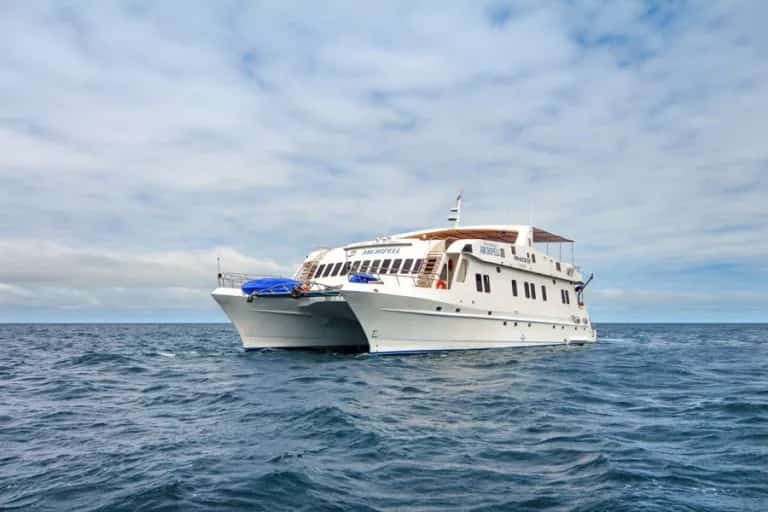
built 2005 · 89 ft · Tourist Superior cruise
Day by day. Click an activity for details.
17 available departures. Prices per guest based on double occupancy.
Single supplement: Sole occupancy of a double cabin usually carries a surcharge of 70 to 100 per cent. On many departures we can offer cabin sharing instead, in which case the supplement is waived entirely. Just mention it in your inquiry.
On top of the cruise price, budget around 200 USD for the national park fee, 20 USD for the transit control card and 400 to 600 USD for the domestic flight from Quito or Guayaquil. International flights to Ecuador come on top of that.
Good all year round. From December to May the water is warmer and the sea calmer, which is ideal for snorkelling. From June to November it is cooler and rougher, but wildlife density in the water is higher because the Humboldt Current brings more food.
Citizens of the EU, the UK, the US and many other countries do not need a visa for stays of up to 90 days. There are no compulsory vaccinations. For recommendations please speak to your doctor or a travel health clinic.
Crossings between the islands can be noticeably choppy, especially at night in the west of the archipelago. Catamarans such as the Endemic sit steadier than single-hull yachts. If you are sensitive, bring motion sickness tablets.
Yes. Either with a single supplement or through cabin sharing, where we pair you with another solo traveller of the same gender. Just mention it in your inquiry.
You send a non-binding inquiry through the website. We check availability directly with the operator and usually come back to you within one working day with a concrete offer. The booking is then handled personally by us, not online.
We will check availability with the operator and get back to you personally.
| 31/01/2028 |
| 14 |
| US$11,190 |
| Inquire |
| 31/01/2028 | 14/02/2028 | 12 | US$11,190 | Inquire |
| 14/02/2028 | 28/02/2028 | 16 | US$11,190 | Inquire |
| 13/03/2028 | 27/03/2028 | 16 | US$11,190 | Inquire |
| 24/04/2028 | 08/05/2028 | 14 | US$11,190 | Inquire |
| 08/05/2028 | 22/05/2028 | 16 | US$11,190 | Inquire |
| 22/05/2028selected | 05/06/2028 | 16 | US$11,190 | Inquire |
| 05/06/2028 | 19/06/2028 | 14 | US$11,190 | Inquire |
| 19/06/2028 | 03/07/2028 | 10 | US$11,190 | Inquire |
| 03/07/2028 | 17/07/2028 | 16 | US$11,190 | Inquire |
| 17/07/2028 | 31/07/2028 | 16 | US$11,190 | Inquire |
| 31/07/2028 | 14/08/2028 | 16 | US$11,190 | Inquire |
| 14/08/2028 | 28/08/2028 | 16 | US$11,190 | Inquire |
| 11/09/2028 | 25/09/2028 | 16 | US$11,190 | Inquire |

Most Galapagos itineraries begin here. Baltra's airport is the world's first fully ecological airport, run on solar and wind power and built largely from recycled materials, including old oil pipes repurposed into the terminal structure. Land iguanas, wiped out here by the 1950s and reintroduced through a decades-long breeding program, now number in the hundreds again, some right around the airport grounds. From the terminal, a short bus transfer brings you to the pier for the panga ride out to your ship.
A stone stairway carved into the cliff climbs to a wide plateau holding one of Genovesa's largest seabird colonies. The trail passes through a small Scalesia forest, home to the short-eared owl, one of the few predators on the island, before reaching cliffside colonies where Nazca and red-footed boobies nest side by side, frigatebirds wheel overhead, and thousands of storm petrels dart in and out of cracks in the lava. A small colony of fur seals sometimes gathers near the landing. Red-footed boobies nest in only a handful of places across the archipelago, and this is one of them.
A wooden staircase of 372 steps climbs Bartolome's extinct volcano from a lava-and-concrete dock or sandy beach, depending on conditions. Along the way, red, orange, black, and even green volcanic layers mark the slopes, home to pioneer plants like the island-endemic Tiquilia nesiotica, lava cactus, and scattered Scalesia. With some luck, a lava lizard crosses the trail. At the top, the view over the twin bays and the iconic Pinnacle Rock is the reward for the climb. Back at sea level, a snorkel around the coral reef and submerged lava rocks is a good bet for Galapagos penguins and white-tipped reef sharks, with sea turtles and manta rays turning up now and then too.
Despite the name, Los Gemelos aren't volcanic craters. They're twin sinkholes, formed when empty underground magma chambers collapsed, set in the misty highlands of Santa Cruz and ringed by dense, endemic Scalesia forest. A trail loops around both rims through some of the lushest vegetation in the islands, one of the better places in the archipelago to spot a short-eared owl hunting in daylight, and, with patience, the increasingly rare vermilion flycatcher.
From the landing, a trail leads to a wide, shallow lagoon where Galapagos flamingos wade through the shallows, filtering shrimp from the mud that gives them their color. Continuing over a low rise brings you to Flour Beach, a nesting ground for green sea turtles between December and June. Just offshore, the eroded remains of an old volcanic cone form Devil's Crown, one of the best snorkeling spots in the islands. White-tipped reef sharks and spotted eagle rays are a near-certain sight inside the ring, and on a good day you might also spot hammerhead sharks, sea lions, or a colorful mix of reef fish weaving through the rocks.
A short landing on one of the most beautiful beaches in the islands brings you into a resident colony of Galapagos sea lions, sprawled across the white sand. Between August and November you may also spot pups nursing nearby. This is one of the only places to see the Espanola mockingbird, found nowhere else on Earth and famously unbothered by visitors. After time on the beach, a relaxed snorkel just offshore is a good way to close out the visit, with spotted eagle rays often gliding beneath the surface.
Punta Pitt is the only site in the islands where all three Galapagos booby species nest within view of one another: red-foots in the low trees, Nazca boobies on the open cliff-edge ground, and blue-foots further inland. A steep gully climbs to the breeding grounds, where frigatebirds often circle overhead and swallow-tailed gulls round out the colony.
A short crossing from Puerto Baquerizo Moreno on San Cristobal, Isla Lobos takes its name from the sea lion colony that calls it home, and doubles as a seasonal nesting ground for blue-footed boobies. Frigatebirds have begun nesting here in recent years too, and fur seals turn up now and then. The walk covers roughly 850 meters of mixed rocky and sandy trail.
Formed by geological uplift rather than volcanic activity, Santa Fe is unusually flat for a Galapagos island, and it's the only place on Earth with its own endemic subspecies of land iguana. After landing in clear, turquoise water, a walk through a forest of giant, tree-sized Opuntia cactus leads to iguanas basking beneath them. The Galapagos dove is a reliable sight along the trail, and with some luck you may also spot the Galapagos snake or the Galapagos hawk.
A dry landing sets you down on North Seymour's flat, sun-baked terrain, and the trail wastes no time getting to the action: magnificent frigatebirds display from low shrubs right along the path, males inflating their scarlet throat pouches into balloons to catch a female's eye. Blue-footed boobies are a near-constant presence along the same stretch, and during the breeding season you may catch their high-stepping courtship dance just a few feet from the trail, showing off the bright blue feet that give the species its name. Land and marine iguanas share the coastline as the trail loops back toward the water, and sea lions haul out along the shore. Keep an eye on the cliffs above the surf too, where swallow-tailed gulls sometimes perch between flights out to sea.
Despite the name, Los Gemelos aren't volcanic craters. They're twin sinkholes, formed when empty underground magma chambers collapsed, set in the misty highlands of Santa Cruz and ringed by dense, endemic Scalesia forest. A trail loops around both rims through some of the lushest vegetation in the islands, one of the better places in the archipelago to spot a short-eared owl hunting in daylight, and, with patience, the increasingly rare vermilion flycatcher.
At first glance Punta Moreno looks like little more than a lava flow at the base of Cerro Azul, but its black surface holds a series of lagoons with a surprising amount of life. Flamingos are a fairly good bet in the pools, and paint-billed crakes, white-cheeked pintails, and common gallinules turn up for those willing to watch the water closely.
Fernandina is the only major island in the archipelago with no introduced species, which makes Punta Espinosa one of the most pristine wildlife encounters anywhere in the Galapagos. A wet landing brings you onto black lava draped with the largest gathering of marine iguanas in the islands, alongside Galapagos penguins and flightless cormorants, both drawn here by the cold, nutrient-rich current. Around June, when marine iguana hatchlings emerge, keep an eye out for the Galapagos racer snake hunting along the nesting zone. Snorkeling here is a rare chance to watch marine iguanas feeding underwater, a behavior found almost nowhere else.
Puerto Egas stands out for its black volcanic sand and a shoreline where land and sea meet in close quarters. Galapagos hawks are often seen along the walk, and at the far end waits a colony of Galapagos fur seals tucked into shaded rock grottoes, one of the more reliable places in the islands to see this endangered species.
Reachable only by sea, Black Turtle Cove is a mangrove-lined lagoon on Santa Cruz's north shore, protected as a turtle sanctuary. A slow, quiet dinghy ride carries you between four species of mangrove while sea turtles surface for air around the boat, one of the most reliable sightings in the islands. Look down and you'll often see golden and eagle rays moving beneath the hull, and white-tipped reef sharks resting in the shallows.
A relaxed, sandy stop on Santa Cruz's north shore. A lagoon just behind the beach occasionally draws flamingos and other shorebirds, and the beach itself is one of the archipelago's main sea turtle nesting grounds, most active between December and June. It's an easy visit, as much about the swim as the wildlife.
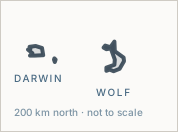
Darwin Bay sits inside the flooded caldera of Genovesa, and a wet landing on its white coral-sand beach puts you right in the middle of a working seabird colony. Great frigatebirds display along the shore, males inflating scarlet throat pouches to catch a female's eye, and red-footed boobies nest low in the surrounding trees and shrubs, unusual for a booby. Nazca boobies are just as much a fixture here, while blue-footed boobies are a rarer, luckier sighting. Swallow-tailed gulls and red-billed tropicbirds work the cliffs nearby. If you're a confident swimmer, the bay's calm water is a good place to snorkel or kayak afterward, with a chance of white-tipped reef sharks and sea turtles along the rocky shore.
A geology stop first and foremost. A wet landing on a white coral-sand beach leads out onto a pahoehoe lava field that flowed less than a hundred years ago, its surface still holding the ropy, swirled texture it cooled into, a favorite for photographers. Tiny pioneer plants are just beginning to colonize the cracks in the rock. Bring your camera for the landscape rather than your binoculars here.
Set on the grounds of the Galapagos National Park Service on Santa Cruz, this station was once home to Lonesome George, the last known tortoise of the Pinta subspecies. A series of interpretive buildings walks you through the conservation science underway across the islands, and the surrounding native vegetation is a good place to look for Darwin's finches going about their business.
One of the few places in the islands where human history takes center stage over wildlife. In 1793, a whaling captain installed a wooden barrel here as an informal mailbox, and the tradition has never stopped: you're welcome to leave a postcard without a stamp, and to sort through what's already inside for anything addressed near your own home to hand-deliver in person. After a wet landing on the sandy beach, a short walk brings you to the barrel, then on to a lava tube you can climb down into by ladder. It is one of the most memorable traditions anywhere in the islands.
A dry landing among the rocks puts you right at the start of one of the richest walks in the islands. The trail follows dramatic cliffs where blowholes send spray high into the air with every swell, and along the way marine iguanas bask on the black rock. Between December and March, the males here turn a striking red and green for the breeding season. Punta Suarez is the only place on Earth where waved albatrosses nest, and between April and December you'll find the colony in full swing, their courtship displays peaking in October. Blue-footed and Nazca boobies nest along the same stretch of cliff, red-billed tropicbirds circle overhead, and the endemic Espanola mockingbird, famously bold, often comes right up to visitors. Keep an eye out too for the Galapagos hawk and the Galapagos dove working the scrub beside the trail.
Also known as Witch Hill, Cerro Brujo greets you with towering cliffs before the dinghy even reaches the beach. Once ashore, you can relax alongside the sea lions, snorkel straight from the sand, or walk to a hidden lagoon where shorebirds work the shallows. Blue-footed boobies, swallow-tailed gulls, and marine iguanas are often somewhere along the shoreline and cliffs too.
The Galapagos National Park's Interpretation Center on San Cristobal, open since 1998, walks you through the islands' volcanic origins, the evolution of their wildlife, and the conservation work protecting them today, organized chronologically across a series of exhibits. It's a good first stop for context that makes everything you see afterward click into place, a walk-through, education-focused visit rather than a wildlife stop.
A short landing puts you immediately among sea lions and the endemic Plaza land iguana, smaller and more golden than its relatives elsewhere. Watch closely and you might spot a rare hybrid, the result of an occasional cross between a marine and a land iguana found only here. The trail crosses a carpet of succulent Sesuvium, red for part of the year, studded with Opuntia cactus. Along the cliffs, swallow-tailed gulls nest on the ledges beside red-billed tropicbirds, and frigatebirds circle overhead as the loop returns to the landing.
Chinese Hat, or Sombrero Chino, is a small islet of delicate lava and spatter cones just off Santiago's southeastern coast. A narrow channel of turquoise water between the islet and the Santiago shoreline makes for excellent snorkeling, where sharks, sea lions, and rays are regularly reported, and a Galapagos penguin occasionally turns up too.
Set on the grounds of the Galapagos National Park Service on Santa Cruz, this station was once home to Lonesome George, the last known tortoise of the Pinta subspecies. A series of interpretive buildings walks you through the conservation science underway across the islands, and the surrounding native vegetation is a good place to look for Darwin's finches going about their business.
At the base of Alcedo Volcano on Isabela, Urbina Bay marks a dramatic geological event: a 1954 uplift left blocks of coral fully exposed on dry land, well above the waterline. A long, level walk leads out to them, passing land iguanas and flightless cormorants along the way, and, on occasion, a giant tortoise.
There's no landing at Punta Vicente Roca: this dramatic, eroded caldera on Isabela's coast is explored entirely by snorkel, dinghy, or kayak. The cold Cromwell Current runs through here, and it's what keeps the water so alive: blue-footed boobies nest reliably along the cliffs, and in the water you can expect Galapagos penguins and, between July and November, ocean sunfish rising to cleaning stations in the cold upwelling. Sperm whales pass through on rare occasions, and giant manta rays are a possibility during the same cooler months.
A panga brings you ashore onto one of the most distinctive beaches in the islands, with sand tinted deep red by its high iron content, with Rabida's rugged cliffs rising behind it. Sea lions are usually stretched out along the shoreline, and it's a good spot to watch for the endemic Galapagos dove working the sand nearby. From the beach, a short trail winds through palo santo forest and cactus scrub, climbing gently to an overlook with sweeping views across the bay, a nice place to pause and take in the color of the landscape before heading back down. If you'd rather stay on the water, snorkeling right off the beach is an easy, relaxed way to spend the visit, with good odds of company from the resident sea lions.
The return transfer is straightforward: a panga ride from your ship to the pier, then a short bus ride to Baltra's airport, the world's first fully ecological terminal, run on solar and wind power. Land iguanas, reintroduced here after being wiped out decades ago, are sometimes seen right around the grounds on the way to your flight.
Catamaran Archipel I is a Tourist Superior catamaran for 16 guests, offering flexible 4, 5, and 8 day Galapagos itineraries across two distinct routes covering the south-western and northern archipelago.
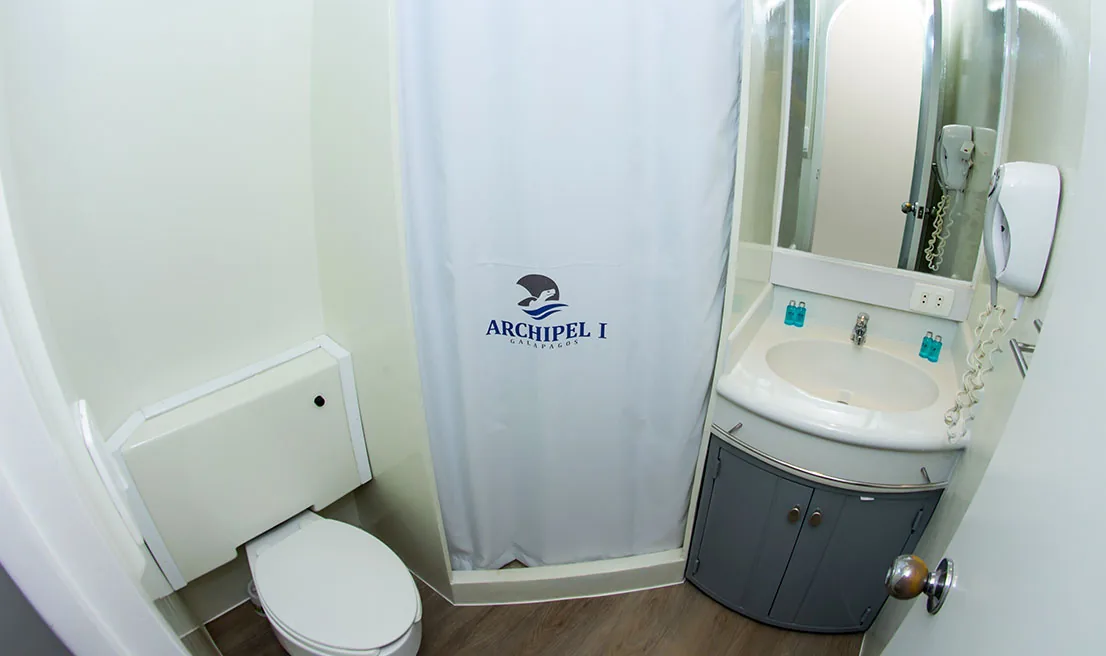
The sun deck solarium offers loungers with island views, and the main-deck lounge combines a bar and dining area. Cabins include private hot-water bathrooms, biodegradable soap and shampoo, and air conditioning.
A solid Tourist Superior pick for travelers who want route flexibility, six itinerary-length combinations in total, without paying for premium-tier finishes. Note that kayaking isn't included on this vessel, unlike some others in the Oniric fleet.