8-Day Western Islands: Tagus Cove's Sailor Graffiti
7 nights aboard the Endemic
7 nights aboard the Endemic
Cliffs carved with sailors' graffiti dating back over a century, one of the largest volcanic calderas on Earth, coral reef blocks pushed onto dry land by a 1954 earthquake - eight days aboard the Endemic cover Isabela, Santiago, and Genovesa in the western Galapagos. Darwin Bay opens the trip inside Genovesa's caldera, frigatebirds inflating scarlet pouches along the shore. Sullivan Bay's lava field still holds the ropy texture it cooled into less than a hundred years ago. Sierra Negra's caldera stretches 10 km across, one of the largest on the planet, and Urbina Bay's coral sits among grazing land iguanas. Tagus Cove's cliffs still carry graffiti from sailors and whalers, Darwin himself among them in 1835. Espumilla Beach's turtles and Mosquera's sea lions close the week.
built 2018 · 115 ft · Premium cruise
Day by day. Click an activity for details.
12 available departures. Prices per guest based on double occupancy.
Single supplement: Sole occupancy of a double cabin usually carries a surcharge of 70 to 100 per cent. On many departures we can offer cabin sharing instead, in which case the supplement is waived entirely. Just mention it in your inquiry.
On top of the cruise price, budget around 200 USD for the national park fee, 20 USD for the transit control card and 400 to 600 USD for the domestic flight from Quito or Guayaquil. International flights to Ecuador come on top of that.
Good all year round. From December to May the water is warmer and the sea calmer, which is ideal for snorkelling. From June to November it is cooler and rougher, but wildlife density in the water is higher because the Humboldt Current brings more food.
Citizens of the EU, the UK, the US and many other countries do not need a visa for stays of up to 90 days. There are no compulsory vaccinations. For recommendations please speak to your doctor or a travel health clinic.
Crossings between the islands can be noticeably choppy, especially at night in the west of the archipelago. Catamarans such as the Endemic sit steadier than single-hull yachts. If you are sensitive, bring motion sickness tablets.
Yes. Either with a single supplement or through cabin sharing, where we pair you with another solo traveller of the same gender. Just mention it in your inquiry.
You send a non-binding inquiry through the website. We check availability directly with the operator and usually come back to you within one working day with a concrete offer. The booking is then handled personally by us, not online.
We will check availability with the operator and get back to you personally.
| 31/10/2027 |
| 07/11/2027 |
| 14 |
| US$10,490US$8,992 |
| Inquire |
| 28/11/2027 | 05/12/2027 | 10 | US$10,490US$8,992 | Inquire |
| 20/02/2028 | 27/02/2028 | 14 | US$10,990 | Inquire |
| 16/04/2028 | 23/04/2028 | 12 | US$10,990 | Inquire |
| 14/05/2028 | 21/05/2028 | 10 | US$10,990 | Inquire |
| 11/06/2028 | 18/06/2028 | 16 | US$10,990 | Inquire |
| 09/07/2028 | 16/07/2028 | 16 | US$10,990 | Inquire |
| 06/08/2028 | 13/08/2028 | 16 | US$10,990 | Inquire |
| 03/09/2028 | 10/09/2028 | 16 | US$10,990 | Inquire |
Most Galapagos itineraries begin here. Baltra's airport is the world's first fully ecological airport, run on solar and wind power and built largely from recycled materials, including old oil pipes repurposed into the terminal structure. Land iguanas, wiped out here by the 1950s and reintroduced through a decades-long breeding program, now number in the hundreds again, some right around the airport grounds. From the terminal, a short bus transfer brings you to the pier for the panga ride out to your ship.
A relaxed, sandy stop on Santa Cruz's north shore. A lagoon just behind the beach occasionally draws flamingos and other shorebirds, and the beach itself is one of the archipelago's main sea turtle nesting grounds, most active between December and June. It's an easy visit, as much about the swim as the wildlife.
Darwin Bay sits inside the flooded caldera of Genovesa, and a wet landing on its white coral-sand beach puts you right in the middle of a working seabird colony. Great frigatebirds display along the shore, males inflating scarlet throat pouches to catch a female's eye, and red-footed boobies nest low in the surrounding trees and shrubs, unusual for a booby. Nazca boobies are just as much a fixture here, while blue-footed boobies are a rarer, luckier sighting. Swallow-tailed gulls and red-billed tropicbirds work the cliffs nearby. If you're a confident swimmer, the bay's calm water is a good place to snorkel or kayak afterward, with a chance of white-tipped reef sharks and sea turtles along the rocky shore.
Up in the cool, misty highlands of Santa Cruz, a short walk brings you among wild giant tortoises moving through the undergrowth on their own terms. No fences, no enclosures, just several-hundred-pound reptiles going about their day. This is one of the best places anywhere in the islands for that encounter, and the surrounding vegetation is good habitat for several of Darwin's finches, heard as often as seen.
Sierra Negra's caldera stretches 10 km north to south and 9 km east to west, one of the largest volcanic calderas on Earth. The more commonly walked route to Volcan Chico crosses relatively recent lava flows with sweeping views toward the volcanoes of Isabela and neighboring Fernandina; a longer trek reaches a system of active fumaroles known as the Sulfur Mine. This is a geology-and-scenery visit, and wildlife isn't the focus here.
There's no landing here. The whole visit happens aboard a zodiac. The route passes the Marielas Islets, home to the largest and most important Galapagos penguin colony in the archipelago, before easing into a cove ringed by red mangroves. Flightless cormorants perch at the water's edge, sea turtles surface nearby, and golden rays glide beneath the boat now and then. It's one of the best places in the islands to watch this much wildlife without ever stepping ashore.
A zodiac ride along Tagus Cove's cliffs is the first stop, tracing walls carved with the graffiti of sailors and whalers going back over a century. Charles Darwin himself anchored here in 1835. Watch the rock for Galapagos penguins and flightless cormorants before you land and set off on a gently climbing trail, roughly 30 minutes each way, to a viewpoint over Darwin Lake, a crater lake saltier than the ocean itself. Along the way, look for land birds that are easy to miss: ground and tree finches, yellow warblers, large-billed flycatchers, and, with a little luck, the tool-using woodpecker finch. Land iguanas and giant tortoises sometimes cross the path as well. Back at the water, most visits close with a dinghy ride or a snorkel along the submerged cliff wall, depending on the day's plan, with another good chance at penguins and cormorants gliding by.
A quiet landing on Santiago's western coast, best known as a nesting ground for Pacific green sea turtles, who come ashore to lay their eggs between December and June.
A tiny, flat islet of white coral sand between North and South Seymour, Mosquera is best known for its resident sea lion colony, sprawled across the beach for much of the day. Shorebirds and lava herons work the shoreline fairly reliably, and sharks and rays are a possibility for anyone snorkeling or diving nearby.
A stone stairway carved into the cliff climbs to a wide plateau holding one of Genovesa's largest seabird colonies. The trail passes through a small Scalesia forest, home to the short-eared owl, one of the few predators on the island, before reaching cliffside colonies where Nazca and red-footed boobies nest side by side, frigatebirds wheel overhead, and thousands of storm petrels dart in and out of cracks in the lava. A small colony of fur seals sometimes gathers near the landing. Red-footed boobies nest in only a handful of places across the archipelago, and this is one of them.
A geology stop first and foremost. A wet landing on a white coral-sand beach leads out onto a pahoehoe lava field that flowed less than a hundred years ago, its surface still holding the ropy, swirled texture it cooled into, a favorite for photographers. Tiny pioneer plants are just beginning to colonize the cracks in the rock. Bring your camera for the landscape rather than your binoculars here.
Also known as the Arnaldo Tupiza Tortoise Breeding Center, this facility near Puerto Villamil centers on giant tortoise conservation, with eggs incubated in a hatchery and young tortoises raised in supervised corrals before release. Around the grounds, keep an eye out for vegetarian finches, small tree-finches, Galapagos lava lizards, and smooth-billed anis alongside the tortoises the center exists to protect.
At the base of Alcedo Volcano on Isabela, Urbina Bay marks a dramatic geological event: a 1954 uplift left blocks of coral fully exposed on dry land, well above the waterline. A long, level walk leads out to them, passing land iguanas and flightless cormorants along the way, and, on occasion, a giant tortoise.
Fernandina is the only major island in the archipelago with no introduced species, which makes Punta Espinosa one of the most pristine wildlife encounters anywhere in the Galapagos. A wet landing brings you onto black lava draped with the largest gathering of marine iguanas in the islands, alongside Galapagos penguins and flightless cormorants, both drawn here by the cold, nutrient-rich current. Around June, when marine iguana hatchlings emerge, keep an eye out for the Galapagos racer snake hunting along the nesting zone. Snorkeling here is a rare chance to watch marine iguanas feeding underwater, a behavior found almost nowhere else.
A panga brings you ashore onto one of the most distinctive beaches in the islands, with sand tinted deep red by its high iron content, with Rabida's rugged cliffs rising behind it. Sea lions are usually stretched out along the shoreline, and it's a good spot to watch for the endemic Galapagos dove working the sand nearby. From the beach, a short trail winds through palo santo forest and cactus scrub, climbing gently to an overlook with sweeping views across the bay, a nice place to pause and take in the color of the landscape before heading back down. If you'd rather stay on the water, snorkeling right off the beach is an easy, relaxed way to spend the visit, with good odds of company from the resident sea lions.
The return transfer is straightforward: a panga ride from your ship to the pier, then a short bus ride to Baltra's airport, the world's first fully ecological terminal, run on solar and wind power. Land iguanas, reintroduced here after being wiped out decades ago, are sometimes seen right around the grounds on the way to your flight.
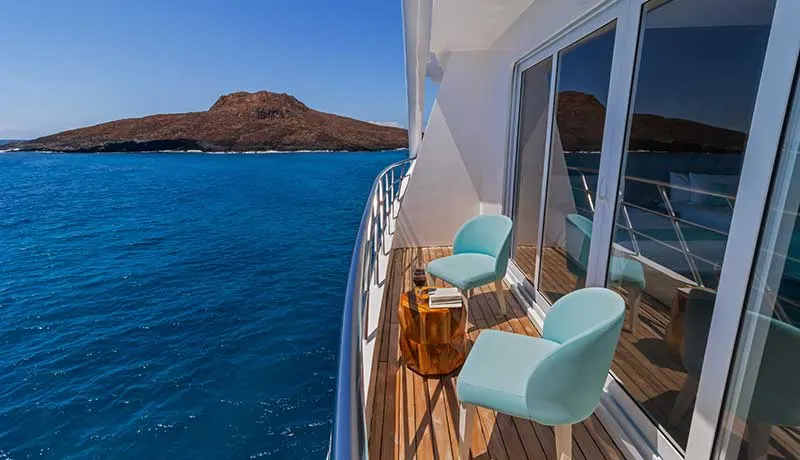
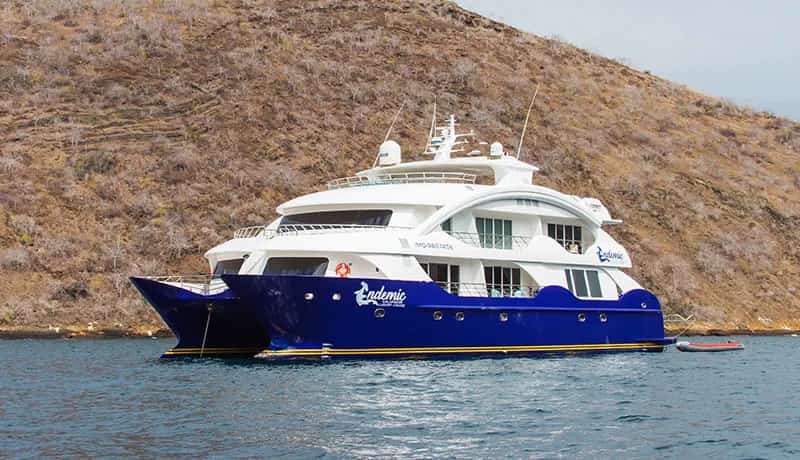
Endemic is a premium catamaran whose curved hull design echoes the islands themselves, carrying 16 guests through 3 to 14 night Galapagos itineraries in panoramic Golden Suites with floor-to-ceiling sliding doors and private balconies.
The semi-covered sky deck balances sun and shade, while the interior lounge offers 180-degree panoramic views, a cozy salon, and a fully stocked bar. Each Golden Suite has personalized marine air conditioning control. The Epicure Cuisine program pairs elegant, ocean-based dishes with the freshest available ingredients.
Ideal for travelers who want maximum route flexibility, from a quick 3-night glimpse to a 14-night deep-dive immersion.