Santa Fé Land Iguana: Facts and Where to See It
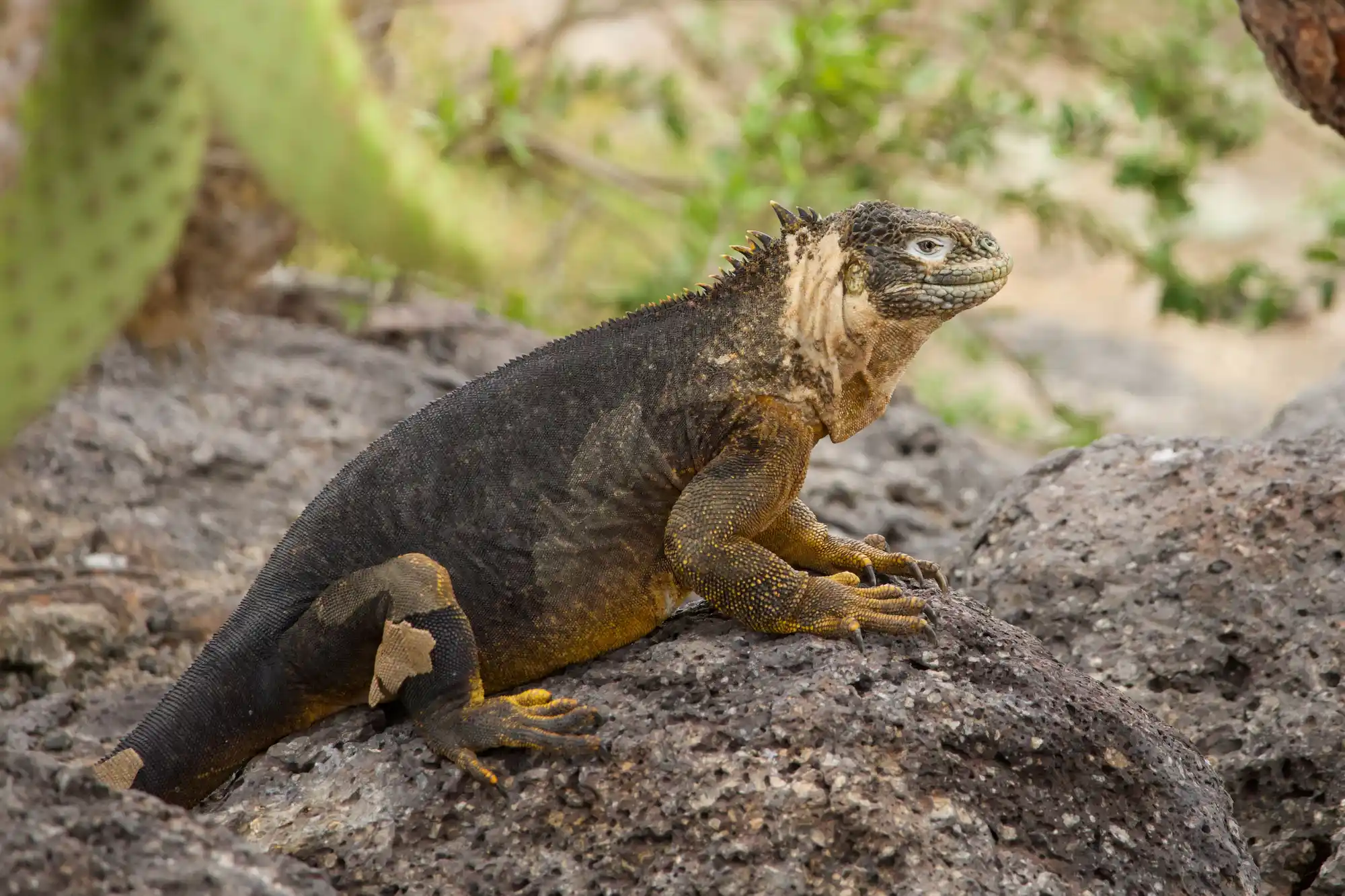
The Santa Fé land iguana (Conolophus pallidus) lives on one island only, Santa Fé, and nowhere else in the world. It is paler than the Galápagos land iguana, which gives it its scientific name, and reaches up to 0.9 metres and 11 kg. Naturalist guides' sighting records rate it Likely at 1 visitor site, Santa Fé Bay, in every month of the year.
Good to know
| Scientific name | Conolophus pallidus |
|---|---|
| Group | Reptiles |
| Endemic | Santa Fé only |
| Size | Up to 0.9 m |
| Weight | Up to 11 kg |
| Diet | 80 percent Opuntia cactus; also insects and carrion |
| Eggs | Up to 20, hatching after nearly four months |
| IUCN status | Vulnerable |
| On Santa Fé | All year |
- Galapagos Conservation Trust, Santa Fe land iguana species page (all rows)
Paler, with a longer snout
Next to the Galápagos land iguana, the Santa Fé species is paler, with a longer, more tapered snout and more pronounced spines along the back. Like its relatives it is mainly a plant eater: 80 percent of its diet is Opuntia cactus, topped up with insects and carrion.
- Territories. In the mating season males defend territories of up to 20 square metres by bobbing their heads and fighting intruders.
- Many mates. A successful male may mate with up to seven females.
- Long incubation. Each female lays up to 20 eggs, which take nearly four months to hatch.
- Galapagos Conservation Trust (colour, snout, spines, diet, territories, mating, eggs)
One island, one population
Santa Fé is uninhabited by people and free of invasive predators, which has kept the iguana safe so far. But because the whole species lives on one small island, a drought or the arrival of an introduced animal could hit all of it at once. The island is protected as part of the Galápagos National Park. For the iguanas, the Opuntia cactus is the key plant: it supplies most of their food.
- Galapagos Conservation Trust (uninhabited, no invasive predators, vulnerability, national park, diet)
Where to see Santa Fé land iguanas
Guide sighting records list it at 1 site: Santa Fé Bay on Santa Fé, rated Likely. The visit combines a landing and trail with snorkelling in the bay. A route that includes Santa Fé is the only way to see this species.
- Our guide sighting data
Likely
- Santa Fé Bay, Santa Fé.Landing, snorkelling. Seen all year.Likely
How you see them: landing at 1 site, snorkelling at 1 site.
When to see them
Santa Fé land iguanas can be seen all year round. In the next twelve months, 327 departures stop at Santa Fé Bay.
- Galapagos Conservation Trust
- our guide sighting and departure data
- 19
- departures in November 2026
Show the November 2026 departures - 24
- departures in December 2026
Show the December 2026 departures - 30
- departures in January 2027
Show the January 2027 departures - 22
- departures in February 2027
Show the February 2027 departures - 232
- departures in the other 8 months
Choose a month in the list - 327
- departures in the next twelve months stop where they are seen
Show all departures
Is the Santa Fé land iguana endangered?
It is listed as Vulnerable, mainly because of its tiny range. Since 2025, all Galápagos iguanas are on CITES Appendix I, which bans international commercial trade. Park rules keep visitors on the trail and at least 2 metres (6 feet) from wildlife, and make each visitor responsible for not bringing food, plants or animals into the islands, which matters most on an island without invasive species.
- Galapagos Conservation Trust (status, CITES 2025)
- Galápagos National Park Rules
Mistakes to avoid
- Expecting it elsewhere. It lives on Santa Fé only.
- Confusing it with the Galápagos land iguana. Look for the paler colour and longer snout.
- Leaving food on the beach. Nothing brought ashore should stay on the island.
Frequently asked questions
Where can I see the Santa Fé land iguana?
Only on Santa Fé. The guide records rate Santa Fé Bay as Likely; the visit there combines a landing and trail with a snorkel in the bay.
- Galapagos Conservation Trust
- our guide sighting data
Where does the Santa Fé land iguana live?
Only on Santa Fé, one small island that is free of invasive predators but exposed to drought or new invaders.
What is a predator of iguanas?
On Santa Fé there are no invasive predators. Elsewhere in Galápagos, introduced cats, dogs, pigs and rats eat land iguana eggs and young.
- Galapagos Conservation Trust, Santa Fe and Galápagos land iguana pages
How is the Santa Fé land iguana different from other land iguanas?
It is paler, with a longer, more tapered snout and more pronounced spines along its back, and it lives only on Santa Fé.
What does the Santa Fé land iguana eat?
Mostly Opuntia cactus, about 80 percent of its diet, plus insects and carrion.
Availability and prices updated
Departures that take you to them
Every Galápagos cruise in this list stops at least once at a site where our guides see the Santa Fé Land Iguana. The best chances come first, and each departure shows the site and the day. Found one that suits you? Ask us about it. There is no booking and no payment: we check the departure and reply.
Next departures with a good chance
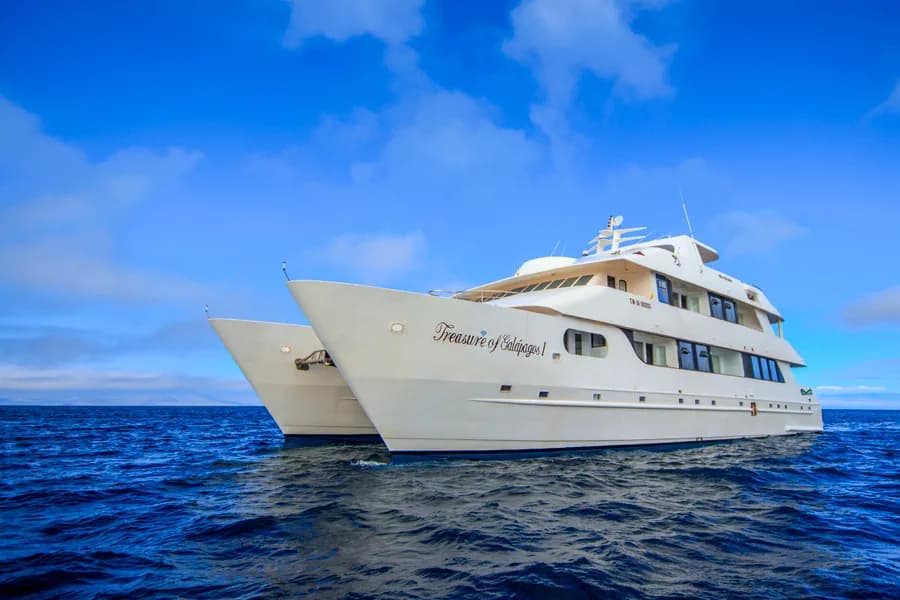
November 10, 2026 · Treasure, 5-Day Southern Islands: Los Gemelos' Daylight Owl
Likely: Santa Fé Bay, day 4. 16 spots
from US$4,150 per guest
Check availability
November 15, 2026 · Monique, 5-Day Southern & Western: Kicker Rock's Swim Channel
Likely: Santa Fé Bay, day 2. 1 spot
Check availability
November 17, 2026 · Galaxy Sirius, 5-Day Southern Islands: Isla Lobos' Sea Lion Colony
Likely: Santa Fé Bay, day 4. 1 spot
from US$5,415 per guest
Check availability
1,083 departures
On every departure
Included
All meals on board · Two certified national park naturalist guides · All excursions and landings listed in the itinerary · Snorkelling gear and wetsuit · Kayaks and stand-up paddleboards on board · Coffee, tea and water at any time
How you see them
Landing at 1 site · Snorkelling at 1 site
Best chance
Santa Fé Bay