Balloonfish in Galápagos: Facts and Where to See It
The balloonfish (Diodon holocanthus), also called the long-spine porcupinefish, is a pale fish with dark blotches and long spines, up to 50 cm long. When threatened it swallows water or air and swells up until its spines stand out. It lives in warm seas around the world, and in Galápagos naturalist guides' sighting records place it at 1 snorkelling site.
Good to know
| Scientific name | Diodon holocanthus |
|---|---|
| Other names | Long-spine porcupinefish, freckled porcupinefish, porcupine puffer |
| Group | Fish, porcupinefish family (Diodontidae) |
| Endemic to Galápagos | No; tropical seas worldwide |
| Size | Up to 50 cm |
| Diet | Molluscs, sea urchins, hermit crabs, snails, crabs |
| Active | Mainly at night |
| IUCN status | Least Concern |
| In Galápagos | At 1 site (guide sighting records) |
- Wikipedia, Long-spine porcupinefish (names, family, range, size, diet, night activity, status)
How the balloonfish blows up
Porcupinefish have two lines of defence. First, they can inflate their bodies by swallowing water or air, becoming almost twice as tall. That leaves only predators with much larger mouths able to swallow them. Second, their sharp spines, which normally lie flat, radiate outwards when the fish is inflated.
- Look. The balloonfish is pale with large black blotches and smaller black spots; the spots become fewer as it ages.
- Spines. It has many long spines with two roots each, especially on the head, and can fold them down.
- Beak. Its upper and lower teeth are fused into a beak like a parrot's, which, with plates on the roof of the mouth, crushes shells and sea urchins.
- Wikipedia, Porcupinefish (inflation, spines, beak)
- Wikipedia, Long-spine porcupinefish (colour, spines, plates)
Where the balloonfish lives
Balloonfish live in tropical and subtropical seas around the world: over muddy bottoms, in estuaries and lagoons, and on coral and rocky reefs. Their active phase is at night, when they feed on shelled prey such as molluscs and sea urchins. Charles Darwin mentioned a porcupinefish in his account of the voyage of the Beagle.
- Wikipedia, Long-spine porcupinefish (habitats, night activity)
- Wikipedia, Porcupinefish (Darwin)
Where to see balloonfish in Galápagos
Guide sighting records list one site: Devil's Crown, a snorkelling site off Floreana, rated Rare. Scan the rocky bottom and the ledges slowly; a spotted fish holding still is easy to overlook.
- Our guide sighting data
- Wikipedia (night activity)
Rare
- Devil's Crown, Floreana.Snorkelling. Seen all year.Rare
How you see them: snorkelling at 1 site.
When to see them
The guide records list the balloonfish at Devil's Crown in every month. In the next twelve months, 42 departures stop at the site.
- Our guide sighting and departure data
- 2
- departures in November 2026
Show the November 2026 departures - 2
- departures in December 2026
Show the December 2026 departures - 2
- departures in January 2027
Show the January 2027 departures - 1
- departure in February 2027
Show the February 2027 departures - 35
- departures in the other 8 months
Choose a month in the list - 42
- departures in the next twelve months stop where they are seen
Show all departures
Is the balloonfish endangered?
No, it is listed as Least Concern and lives in warm seas worldwide. In Galápagos, park rules ask visitors to keep at least 2 metres (6 feet) from wildlife.
- Wikipedia, Long-spine porcupinefish (status, range)
- Galápagos National Park Rules
Mistakes to avoid
- Trying to make it puff up. Keep your distance and let it be.
- Handling it. The spines are sharp, and some porcupinefish carry a strong toxin in their organs.
- Calling it a pufferfish. Close relatives, but a different family.
- Wikipedia, Porcupinefish (spines, tetrodotoxin, family)
- Galápagos National Park Rules
Frequently asked questions
Are balloon fish and puffer fish the same?
Not quite. The balloonfish is a porcupinefish (family Diodontidae). Porcupinefish are sometimes called pufferfish, but the name usually means the closely related family Tetraodontidae. Both belong to the same order, and both can inflate.
- Wikipedia, Porcupinefish
What does a balloon fish eat?
Molluscs, sea urchins, hermit crabs, snails and crabs, which it crushes with its beak-like teeth, mainly at night.
- Wikipedia, Long-spine porcupinefish
Where can I find balloon fish?
In tropical and subtropical seas worldwide, on reefs, in lagoons and over muddy bottoms. In Galápagos, our guides record it at Devil's Crown off Floreana, rated Rare.
- Wikipedia, Long-spine porcupinefish
- our guide sighting data
Is the balloonfish poisonous?
Some porcupinefish carry tetrodotoxin in internal organs such as the liver and ovaries. Do not touch or handle one.
- Wikipedia, Porcupinefish
Why does a balloonfish puff up?
To defend itself. By swallowing water or air it nearly doubles in height, so fewer predators can swallow it, and its spines stand out.
- Wikipedia, Porcupinefish
How big does a balloonfish get?
Adults may reach 50 cm in length. When inflated, a porcupinefish becomes almost twice as tall.
- Wikipedia, Long-spine porcupinefish
- Wikipedia, Porcupinefish
What does a balloonfish look like?
It is pale with large black blotches and smaller black spots, and has many long spines, especially on its head, which it can fold down.
- Wikipedia, Long-spine porcupinefish
Availability and prices updated
Departures that take you to them
Every Galápagos cruise in this list stops at least once at a site where our guides see the Balloonfish. The best chances come first, and each departure shows the site and the day. Found one that suits you? Ask us about it. There is no booking and no payment: we check the departure and reply.
Next departures with a good chance
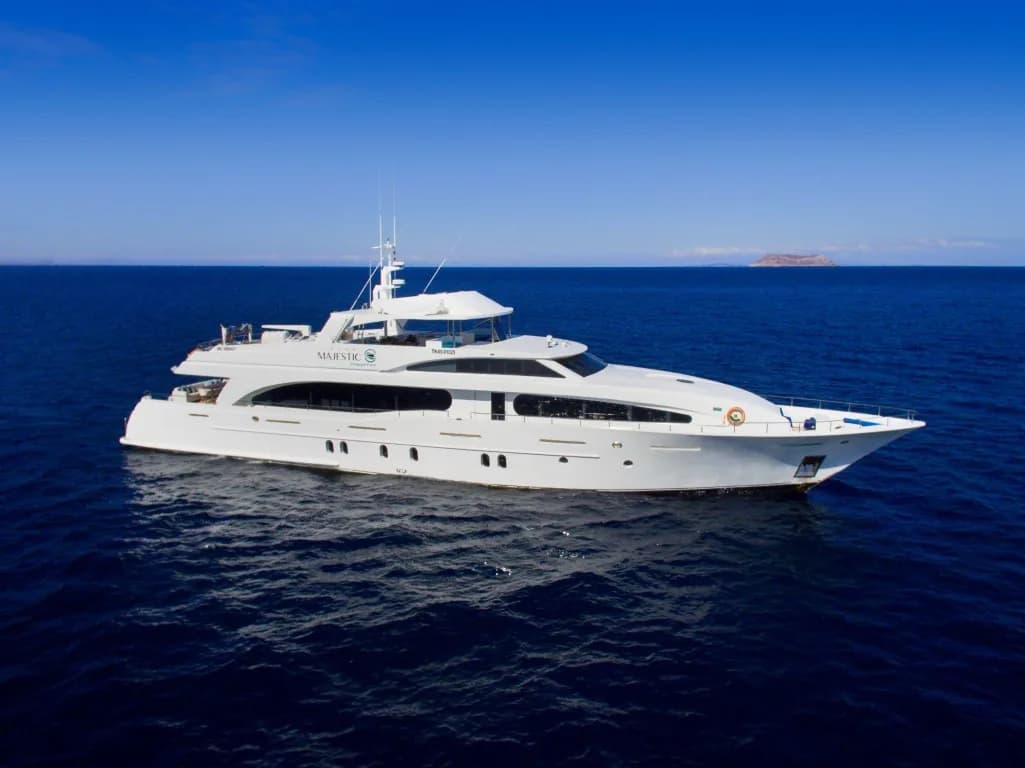
November 30, 2026 · Grand Majestic, 4-Day Southern Islands: El Junco's Freshwater Crater
Rare: Devil's Crown, day 3. 4 spots
from US$3,145 per guest
Check availabilityNovember 30, 2026 · Grand Majestic, 8-Day Southern & Northern: Espanola's Albatross Cliffs
Rare: Devil's Crown, day 3. 2 spots
from US$7,045 per guest
Check availability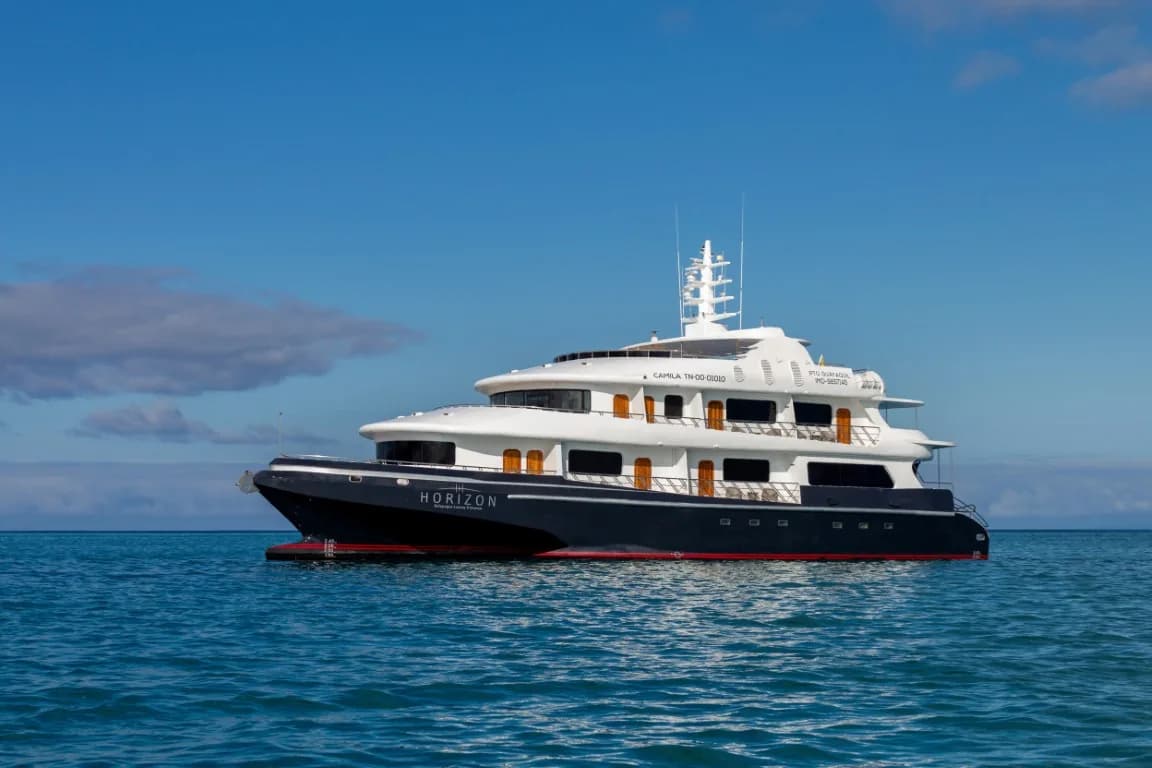
December 12, 2026 · Galapagos Horizon, 8-Day Western & Southern: Devil's Crown's Sunken Cone
Rare: Devil's Crown, day 6. 2 spots
from US$9,445 per guest
Check availability
120 departures
On every departure
Included
All meals on board · Two certified national park naturalist guides · All excursions and landings listed in the itinerary · Snorkelling gear and wetsuit · Kayaks and stand-up paddleboards on board · Coffee, tea and water at any time
How you see them
Snorkelling at 1 site