Blue-Footed Booby in Galápagos: Facts and Where to See It
The blue-footed booby (Sula nebouxii) is a seabird of the eastern Pacific, 81 to 86 cm long and known for its bright blue feet. It breeds from the Gulf of California south to Peru and on Galápagos, where it is present in all 12 months of the year. Naturalist guides' sighting records place it at 11 visitor sites on 8 islands.
Good to know
| Scientific name | Sula nebouxii |
|---|---|
| Group | Birds |
| Endemic to Galápagos | No |
| Blue-footed booby size | 81 to 86 cm long (32 to 34 inches) |
| Wingspan | Around 1.5 m (5 feet) |
| Weight | About 1.5 kg (3.25 pounds) |
| Lifespan in the wild | About 17 years on average |
| IUCN status | Least Concern, last assessed 2021 [VERIFY: BirdLife DataZone, "Year of last assessment"] |
| Population trend | Decreasing |
| World population | More than 90,000 mature birds |
| In Galápagos | All year, at 11 visitor sites on 8 islands (guide sighting records) |
- National Geographic (size, weight, lifespan)
- NHPBS NatureWorks and Animal Diversity Web (wingspan)
- BirdLife International DataZone for the IUCN Red List (status, trend, population)
Why are blue-footed booby feet blue?
A blue-footed booby's feet get their colour from two sources: the collagen structure of the skin and carotenoid pigments from the fresh fish it eats. Because the pigment comes from food, the colour reports how well fed and healthy a bird is at that moment. In the 2006 study by Velando and colleagues, it changed within 48 hours.
- Diet. Males deprived of food in the study had duller feet within 48 hours. Re-fed with fresh fish, the same males turned a brighter blue again.
- A signal of health. The researchers call foot colour an "honest signal of current condition". A hungry or sick bird cannot fake bright feet.
- Female choice. The bluer the feet, the more attractive the male. When the researchers dulled males' feet with make-up, their partners laid smaller second eggs [VERIFY: Velando et al. 2006, abstract].
- Velando, Beamonte-Barrientos and Torres 2006, Oecologia 149:535 to 542, doi 10.1007/s00442-006-0457-5
Courtship dance, nests and chicks
The blue-footed booby dance
The blue-footed booby mating dance is the male's display of his feet to a female, always in the same 3 steps:
- The male struts in front of the female, raising one blue foot and then the other.
- Both birds stretch their necks and point their bills to the sky.
- The male spreads his wings and whistles.
In the guide sighting records, the dance appears from June to August on the trail at North Seymour, which makes that trail in those 3 months the place to plan for it.
- NHPBS NatureWorks (the display)
- our guide sighting data (site and months)
Eggs and chicks
The female lays 2 to 3 eggs in a simple nest on the ground. Both parents take turns warming the eggs with their webbed feet, and hatching takes about 45 days. The chicks take fish from the parents' bills and stay with them for about two months. In Galápagos, breeding has been poor for years: Anchundia, Huyvaert and Anderson found few pairs nesting and linked this to a lack of sardines in the birds' diet.
- NHPBS NatureWorks and Animal Diversity Web (eggs, chicks)
- Anchundia, Huyvaert and Anderson 2014, Avian Conservation and Ecology 9(1):6 (breeding in Galápagos)
Where the blue-footed booby lives and what it eats
Blue-footed booby habitat is the sea and the dry islands of the eastern Pacific, from the Gulf of California south to Peru and on Galápagos. The bird nests on open ground there and fishes in the nearby waters. Its diet is fish, and in Galápagos sardines and herring matter most for successful breeding.
To catch fish, it folds back its long wings and plunges into the water from as high as 80 feet, about 24 metres, according to National Geographic. In the Galápagos colonies, Anchundia, Huyvaert and Anderson found sardines and herring mostly missing from the diet, and poor breeding appears to be linked to it. At Punta Vicente Roca on Isabela, a Likely site visited by panga ride, the water around the boat is where a dive may happen.
- NHPBS NatureWorks (range)
- National Geographic (dive height)
- Anchundia, Huyvaert and Anderson 2014 (sardines and breeding)
Where to see blue-footed boobies in Galápagos
Guide sighting records list blue-footed boobies at 11 visitor sites on 8 islands. 5 of them are rated Likely, with sightings on most visits: the North Seymour trail, Punta Suárez on Española, Punta Vicente Roca on Isabela, and Punta Pitt and Isla Lobos on San Cristóbal. The other 6 sites are rated Rare.
Likely means naturalist guides record them on most visits there. The ratings come from the guides' own visit records. [CHECK: the current page defines only "Likely". Add a definition of "Rare" only if the owner confirms one.]
Courtship dance, June to August
North Seymour Trail
Likely
- North Seymour Trail, North Seymour.Landing. Courtship dance, June to August.Likely
- Isla Lobos, San Cristóbal.Landing, snorkelling. Seen all year.Likely
- Punta Pitt, San Cristóbal.Landing. Seen all year.Likely
- Punta Suárez, Española.Landing. Seen all year.Likely
- Punta Vicente Roca, Isabela.Panga ride, snorkelling. Seen all year.Likely
Rare
- Cerro Brujo, San Cristóbal.Beach. Seen all year.Rare
- Darwin Bay, Genovesa.Landing, snorkelling. Seen all year.Rare
- Kicker Rock (León Dormido), San Cristóbal.Snorkelling, diving. Seen all year.Rare
- Mosquera Islet, Mosquera.Beach, snorkelling. Seen all year.Rare
- Pinnacle Rock, Bartolomé.Snorkelling. Seen all year.Rare
- Punta Carrión, Santa Cruz.Panga ride, snorkelling. Seen all year.Rare
How you see them: snorkelling at 7 sites, landing at 5 sites, panga ride at 2 sites, beach at 2 sites, diving at 1 site.
When to see them
Blue-footed boobies are in Galápagos in all 12 months, so no month of the year rules them out. The courtship dance falls in June to August, and a route that lands on North Seymour covers it. In the next twelve months, 312 departures in those 3 months stop at a site where they are seen. July sits in the middle of the dance season: Galápagos in July.
- 100
- departures in June 2027
Show the June 2027 departures - 107
- departures in July 2027
Show the July 2027 departures - 105
- departures in August 2027
Show the August 2027 departures - 572
- departures in the other 9 months
Choose a month in the list - 884
- departures in the next twelve months stop where they are seen
Show all departures
Is the blue-footed booby endangered?
No. The blue-footed booby is listed as Least Concern on the IUCN Red List, with more than 90,000 mature birds worldwide. The global trend is decreasing, though, and the Galápagos population has fallen sharply: a survey in 2012 counted about 6,400 adults, against a rough estimate of 20,000 in the 1960s.
In Galápagos. According to National Geographic, the Galápagos population includes about half of all breeding pairs, so what happens on these islands matters for the whole species. The researchers behind the 2012 survey found few pairs breeding and linked this to diet: sardines and herring, the fish behind successful breeding, were mostly missing. The link is suggested, not proven, and the authors question the methods of both counts. Galápagos National Park rules set a distance of at least 2 metres (6 feet) from the birds, even when they come closer, and keep every visitor on the marked trails with a naturalist guide.
- BirdLife International DataZone for the IUCN Red List (status, trend, population)
- Anchundia, Huyvaert and Anderson 2014, Avian Conservation and Ecology 9(1):6, ace-eco.org/vol9/iss1/art6 (Galápagos count, diet)
- National Geographic (breeding pairs)
- Galápagos Conservancy, Galápagos National Park Rules, galapagos.org/travel/park-rules (distance, trails)
Mistakes to avoid when planning to see them
- Not checking the route. Not every route stops at one of the 5 Likely sites, so the itinerary decides the odds.
- Expecting the dance at any time. Guide sighting records place it in June to August, on North Seymour.
- Planning around a Rare site. 6 of the 11 sites are rated Rare, so a sighting at one of them is a bonus, not a plan.
- Getting too close. Park rules set at least 2 metres between visitors and wildlife, and that includes nesting birds that seem calm.
- our guide sighting data
- Galápagos Conservancy, Galápagos National Park Rules
Frequently asked questions
Are blue-footed boobies friendly to humans?
Not in the way a pet is, but they show very little fear of people. The Galapagos Conservation Trust names this fearlessness as one reason for their name. Galápagos National Park rules still set at least two metres between visitors and the birds, even when the birds come closer, and require marked trails and a naturalist guide on every walk.
Why are blue-footed boobies called boobies?
The name comes from the Spanish word "bobo", meaning foolish or clown. According to the Galapagos Conservation Trust, it refers to the clumsy way the birds move on land, and to their fearlessness of people, which once made them easy to catch. "Booby" has been used in English for a foolish person since the 1590s.
What kind of bird in Ecuador has blue feet?
The blue-footed booby. It breeds from the Gulf of California south to Peru, and the Galápagos Islands of Ecuador hold about half of all its breeding pairs. Two relatives live on the islands too, both without blue feet: the Nazca booby and the red-footed booby.
Where can I find a blue-footed booby?
In Galápagos, North Seymour is one of the best places, with large colonies also on Española, Isabela, Fernandina, Floreana and other islands south of the equator. Guide sighting records place them at 11 visitor sites on 8 islands, in every month of the year, and 884 departures in the next twelve months stop at one of these sites. More on each site: where to see them.
- Galapagos Conservation Trust
- our own sighting and departure data
Availability and prices updated
Departures that take you to them
Every Galápagos cruise in this list stops at least once at a site where our guides see Blue-footed Boobies. The best chances come first, and each departure shows the site and the day. Found one that suits you? Ask us about it. There is no booking and no payment: we check the departure and reply.
Next departures with a good chance
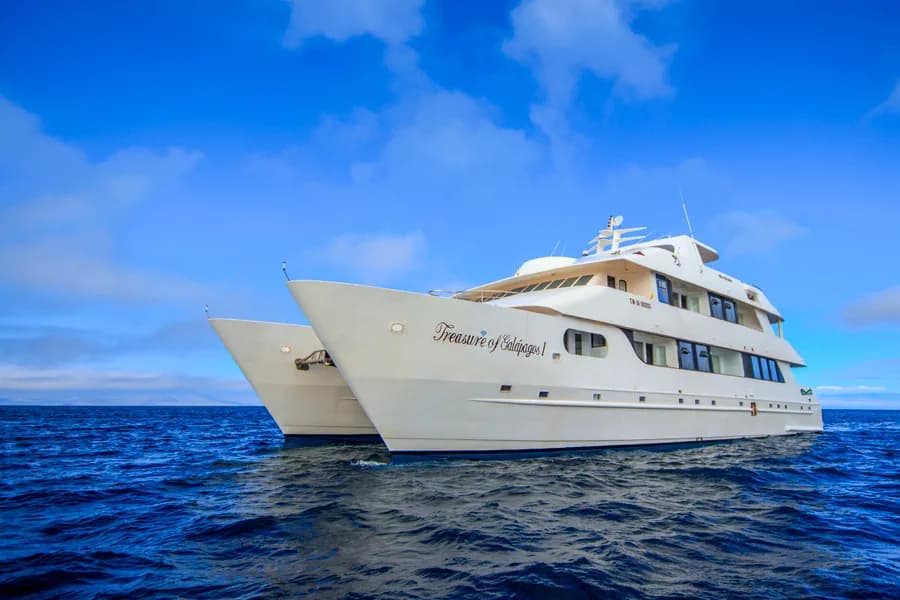
November 10, 2026 · Treasure, 5-Day Southern Islands: Los Gemelos' Daylight Owl
Likely: Punta Suárez, day 2. 16 spots
from US$4,150 per guest
Check availability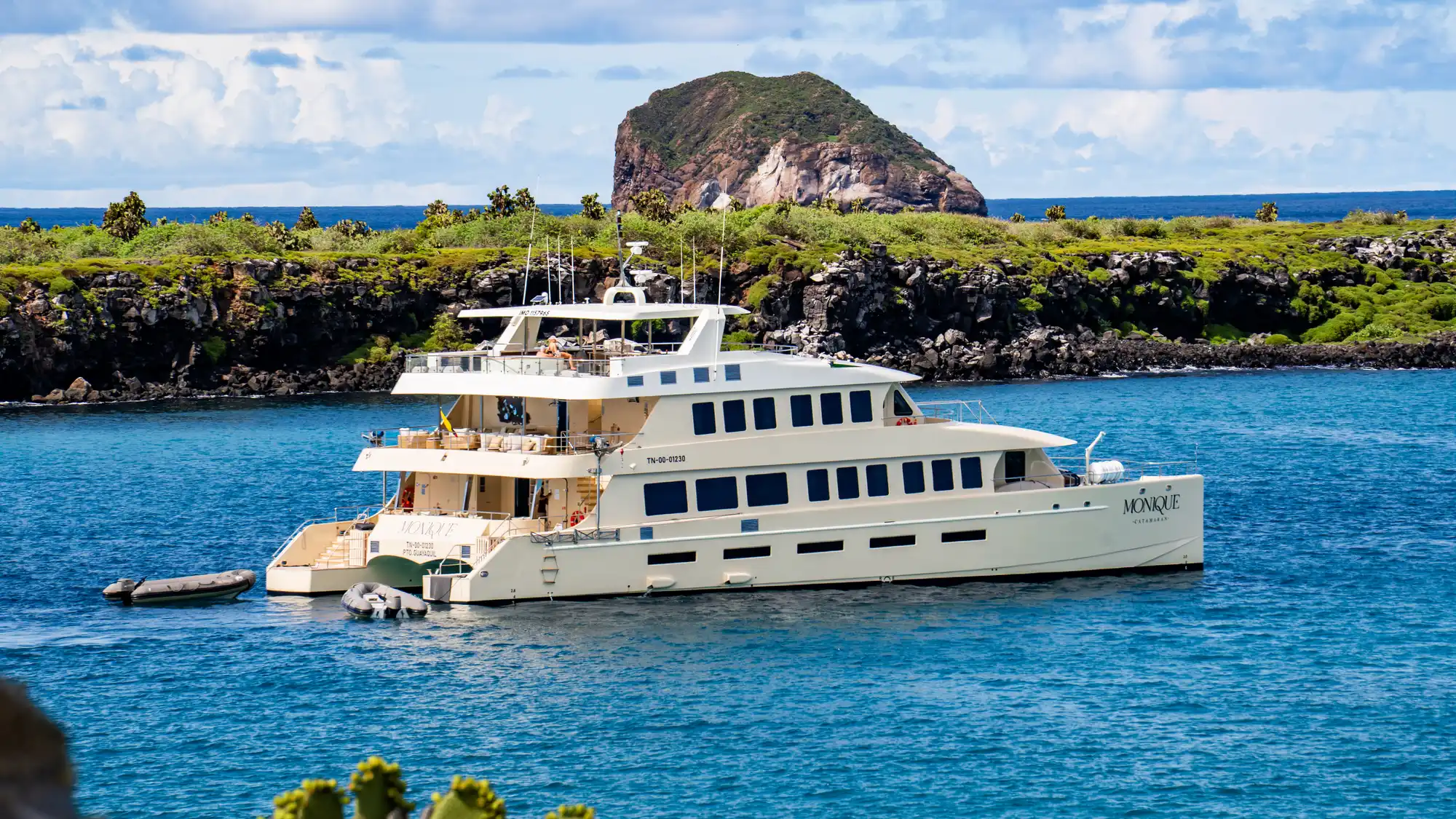
November 12, 2026 · Monique, 4-Day Southern Islands: Santa Cruz's Wild Tortoises
Likely: Punta Suárez, day 3. 6 spots
from US$3,352 per guest
Check availability
November 12, 2026 · Tribute, 7-Day Western Islands: Fernandina's Marine Iguanas
Likely: Punta Vicente Roca, day 4. 5 spots
from US$7,916 per guest
Check availability
2,640 departures
On every departure
Included
All meals on board · Two certified national park naturalist guides · All excursions and landings listed in the itinerary · Snorkelling gear and wetsuit · Kayaks and stand-up paddleboards on board · Coffee, tea and water at any time
How you see them
Snorkelling at 7 sites · Landing at 5 sites · Panga ride at 2 sites · Beach at 2 sites · Diving at 1 site
Best chance
Courtship dance from June to August on North Seymour Trail.