Brown Pelican in Galápagos: Facts and Where to See It
The brown pelican (Pelecanus occidentalis) is a large seabird with an oversized bill and a dark body, and one of only two pelicans that dive head first for fish. In Galápagos it is a common sight along the coasts, in harbours and over the surf. Naturalist guides note it as present across the archipelago and list it at 8 visitor sites on 5 islands.
Good to know
| Scientific name | Pelecanus occidentalis |
|---|---|
| Group | Seabirds |
| Endemic to Galápagos | No |
| Diet | Fish |
| Hunting | Plunge-diving from the air |
| Oldest on record | 43 years |
| IUCN status | Least Concern |
| In Galápagos | All year, across the archipelago (guide sighting records) |
- Cornell Lab of Ornithology, All About Birds, Brown Pelican (diet, hunting, age record, conservation)
- our guide sighting data
How a pelican dives
Brown pelicans fish by plunge-diving from high up and using the force of the impact to stun small fish before scooping them into the pouch. Only two pelican species feed this way, and the brown pelican is one of them.
- A twist on the way down. In a dive the pelican tucks its head and turns its body to the left, probably to protect the windpipe and gullet, which run down the right side of the neck.
- Draining the pouch. After a dive it lets the water run out of its bill before swallowing, and gulls use that moment to steal the fish, sometimes while standing on the pelican's head.
- Thieves too. Pelicans follow fishing boats and hang around piers for scraps.
- Cornell Lab of Ornithology, All About Birds (plunge-dive, two species, twist, gulls, fishing boats)
Where the brown pelican lives and nests
Brown pelicans live along ocean coasts, gliding in lines above the surf and resting on rocks, mangroves and harbour walls. They incubate their eggs with the skin of their feet, in effect standing on them to keep them warm. In Galápagos, the guide records note them in mangrove lagoons such as Black Turtle Cove and Elizabeth Bay, and on rocky coasts and beaches from South Plaza to Punta Vicente Roca.
- Cornell Lab of Ornithology, All About Birds (habitat, incubation)
- our guide sighting data (sites)
Where to see brown pelicans in Galápagos
The guide sighting records note brown pelicans as present across the archipelago, so most coastal visits offer a chance. Of the 8 sites listed by name, 2 are rated Possible: the mangrove lagoons of Elizabeth Bay on Isabela and Black Turtle Cove on Santa Cruz, both visited by panga. The others, among them South Plaza, Cerro Brujo and Punta Cormorant, are rated Rare as specific sightings.
- Our guide sighting data
Possible
- Black Turtle Cove, Santa Cruz.Panga ride. Seen all year.Possible
- Elizabeth Bay, Isabela.Panga ride. Seen all year.Possible
Rare
- Baroness Lookout, Floreana.Landing. Seen all year.Rare
- Cerro Brujo, San Cristóbal.Beach. Seen all year.Rare
- Isabela Wetlands, Isabela.Landing. Seen all year.Rare
- Punta Cormorant, Floreana.Landing. Seen all year.Rare
- Punta Vicente Roca, Isabela.Panga ride, snorkelling. Seen all year.Rare
- South Plaza Trail, South Plaza.Landing. Seen all year.Rare
How you see them: landing at 4 sites, panga ride at 3 sites, beach at 1 site, snorkelling at 1 site.
When to see them
Brown pelicans are in Galápagos all year. In the next twelve months, 876 departures stop at a site where they are recorded.
- Our guide sighting and departure data
- 39
- departures in November 2026
Show the November 2026 departures - 57
- departures in December 2026
Show the December 2026 departures - 61
- departures in January 2027
Show the January 2027 departures - 59
- departures in February 2027
Show the February 2027 departures - 660
- departures in the other 8 months
Choose a month in the list - 876
- departures in the next twelve months stop where they are seen
Show all departures
Is the brown pelican endangered?
No. Brown pelicans are fairly common today and listed as of low concern. That was not always so: in the mid-twentieth century, the pesticide DDT made their eggshells so thin that they cracked under the weight of the incubating parent. After nearly vanishing from North America in the 1960s and 1970s, the species made a full comeback once the pesticide was regulated, an excellent example of a species recovering from pesticide pollution. In Galápagos, park rules keep visitors at least 2 metres (6 feet) from wildlife and forbid feeding.
- Cornell Lab of Ornithology, All About Birds (status, DDT, recovery)
- Galápagos National Park Rules
Mistakes to avoid
- Missing the dive. Watch pelicans that circle high over the water; the dive follows quickly.
- Feeding them. Pelicans beg near fishing boats, but park rules forbid feeding wildlife.
- Getting too close on the rocks. Keep the 2-metre distance, also with birds that seem used to people.
- Cornell Lab of Ornithology
- Galápagos National Park Rules
Frequently asked questions
How rare are brown pelicans?
Not rare today. The Cornell Lab of Ornithology calls them fairly common, after a full recovery from the pesticide DDT, which had brought them close to disappearing from North America in the 1960s and 1970s. In Galápagos they are present along the coasts all year.
- Cornell Lab of Ornithology, All About Birds
- our guide sighting data
What is an interesting fact about the brown pelican?
It twists as it dives. A brown pelican tucks its head and rotates its body to the left on the way down, probably to protect the windpipe and gullet on the right side of its neck. And gulls often steal fish straight from its pouch, sometimes standing on its head to do so.
- Cornell Lab of Ornithology, All About Birds
What are the most common birds to see in the Galapagos Islands?
Along the coasts, brown pelicans are among the most common, noted by the guides across the whole archipelago, along with blue-footed boobies and frigatebirds. Inland, small birds such as the yellow warbler and Darwin's finches are widespread.
- Our guide sighting data
How long do brown pelicans live?
The oldest brown pelican on record was 43 years old, according to the Cornell Lab of Ornithology.
- Cornell Lab of Ornithology, All About Birds
Availability and prices updated
Departures that take you to them
Every Galápagos cruise in this list stops at least once at a site where our guides see the Brown Pelican. The best chances come first, and each departure shows the site and the day. Found one that suits you? Ask us about it. There is no booking and no payment: we check the departure and reply.
Next departures with a good chance

November 12, 2026 · Galaxy Sirius, 6-Day Western & Northern: Rabida's Red Sand Beach
Possible: Black Turtle Cove, day 1. 6 spots
from US$5,680 per guest
Check availability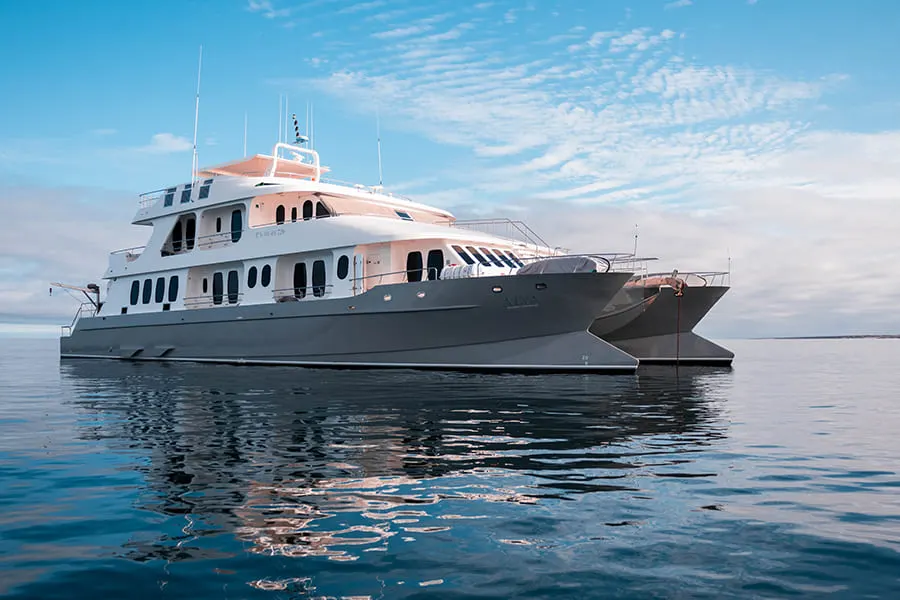
November 19, 2026 · Alya, 5-Day Northern & Western: Bartolome's Endemic Plant
Possible: Black Turtle Cove, day 1. 8 spots
from US$4,140 per guest
Check availabilityNovember 26, 2026 · Galaxy Sirius, 6-Day Western & Northern: Rabida's Red Sand Beach
Possible: Black Turtle Cove, day 1. 9 spots
from US$5,680 per guest
Check availability
2,615 departures
On every departure
Included
All meals on board · Two certified national park naturalist guides · All excursions and landings listed in the itinerary · Snorkelling gear and wetsuit · Kayaks and stand-up paddleboards on board · Coffee, tea and water at any time
How you see them
Landing at 4 sites · Panga ride at 3 sites · Beach at 1 site · Snorkelling at 1 site