Darwin's Finches in Galápagos: Facts and Where to See Them
Darwin's finches are 17 species of small land birds found only in Galápagos, famous for how their beaks evolved to fit different foods. They descend from a single ancestor, thought to be related to the dull-coloured grassquit of mainland South America. Naturalist guides note finches across the archipelago and list them at 7 visitor sites on 4 islands, in every month of the year.
Good to know
| Scientific name | Subfamily Geospizinae (Geospiza, Camarhynchus and others) |
|---|---|
| Group | Land birds |
| Endemic to Galápagos | Yes, 17 species |
| Closest known relative | The dull-coloured grassquit of South America |
| Diet | Seeds, insects and other foods, by species |
| IUCN status | From Least Concern to Critically Endangered, by species |
| In Galápagos | All year, across the islands (guide sighting records) |
- Galapagos Conservation Trust, Darwin's finches species page (species, relative, diet, all year)
- Galapagos Conservation Trust, mangrove finch and medium tree finch pages (Critically Endangered species)
- our species data
Beaks that tell the story
Darwin's finches are all similar in shape, size and colour. What sets them apart is the beak: over time, the species evolved beaks suited to different foods, from large seeds to invertebrates, which let each species take a different niche on the islands. That pattern, a single ancestor splitting into many species shaped by what they eat, is what made them famous as an example of evolution.
- Many species, one look. Shape, size and colour are much alike across all 17.
- Different food, different beak. Beaks range from heavy seed-crackers to fine insect-pickers.
- Rare specialists. The mangrove finch, with around 100 birds, is the rarest bird in Galápagos.
Telling the species apart in the field is hard; island and beak shape are the main clues.
- Galapagos Conservation Trust (similar look, beaks, niches, mangrove finch)
Where Darwin's finches live
Different finches live on different islands and in different zones, from the dry coastal scrub to the humid highlands and the mangroves. The ancestors are thought to have arrived from mainland South America, and the closest known living relative is the dull-coloured grassquit. On almost any landing, small dark finches hop around the trail, and the guides can usually name the species from the island and the beak.
- Galapagos Conservation Trust (islands, ancestor)
- our guide sighting data (present everywhere)
Where to see Darwin's finches in Galápagos
The guide sighting records note finches as present across the archipelago, so every route offers them. Of the 7 sites listed by name, the Santa Cruz Highlands are rated Possible, and Tagus Cove, Post Office Bay, Punta Cormorant, Rábida Beach, the Charles Darwin Station and the Isabela Interpretation Center are rated Rare as specific sightings. On Floreana, the small ground finch has been released again since 2024 as part of the island's restoration.
- Our guide sighting data
- Galapagos Conservation Trust (small ground finch released on Floreana, February 2024)
Possible
- Santa Cruz Highlands, Santa Cruz.Landing. Seen all year.Possible
Rare
- Charles Darwin Station, Santa Cruz.Seen all year.Rare
- Isabela Interpretation Center, Isabela.Seen all year.Rare
- Post Office Bay, Floreana.Landing. Seen all year.Rare
- Punta Cormorant, Floreana.Landing. Seen all year.Rare
- Rábida Beach, Rábida.Landing, snorkelling. Seen all year.Rare
- Tagus Cove, Isabela.Panga ride, hiking. Seen all year.Rare
How you see them: landing at 4 sites, snorkelling at 1 site, panga ride at 1 site, hiking at 1 site.
When to see them
Darwin's finches can be seen all year round. In the next twelve months, 856 departures stop at a site where they are recorded.
- Galapagos Conservation Trust (all year)
- our guide sighting and departure data
- 37
- departures in November 2026
Show the November 2026 departures - 57
- departures in December 2026
Show the December 2026 departures - 61
- departures in January 2027
Show the January 2027 departures - 59
- departures in February 2027
Show the February 2027 departures - 642
- departures in the other 8 months
Choose a month in the list - 856
- departures in the next twelve months stop where they are seen
Show all departures
Are Darwin's finches endangered?
Some are. The threats are introduced predators and diseases, habitat loss and above all the avian vampire fly Philornis downsi, an invasive fly whose larvae feed on nestlings. The mangrove finch, with about 100 birds, and the medium tree finch of Floreana are Critically Endangered.
Recovery. On Floreana, one of the largest restoration projects ever tried on an inhabited island aims to remove invasive predators, and research continues into reducing the vampire fly. Park rules forbid feeding birds, which matters for finches that hop close to visitors.
- Galapagos Conservation Trust (threats, vampire fly, mangrove finch, medium tree finch, Floreana, research)
- Galápagos National Park Rules
Mistakes to avoid
- Trying to name every finch. Even experts use island and beak shape; ask the guide.
- Feeding them. Park rules forbid it, however close they come.
- Overlooking the highlands. The Santa Cruz Highlands are the one Possible site in the guide records.
- Galapagos Conservation Trust
- our guide sighting data
- Galápagos National Park Rules
Frequently asked questions
What are Darwin's finches known for?
For their beaks. The 17 species evolved beaks suited to different foods, from large seeds to insects, which let them live side by side in different niches. They became a classic example of how one ancestor can give rise to many species.
What is Darwin's finches' theory?
The finches are linked to Darwin's theory of evolution by natural selection: related species from one ancestor that differ mainly in beaks shaped by the food on their islands. They are named after Charles Darwin, whose visit to Galápagos in 1835 helped inspire the theory.
- Galapagos Conservation Trust (name, beaks)
- National Geographic (Darwin's 1835 visit)
Do Darwin's finches still exist?
Yes. All 17 species still live in Galápagos and can be seen all year, though some, such as the mangrove finch and the medium tree finch, are Critically Endangered.
Where can I see Darwin's finches?
On almost every landing in Galápagos. The guide records note them across the archipelago; the Santa Cruz Highlands are rated Possible as a specific site.
- Our guide sighting data
Availability and prices updated
Departures that take you to them
Every Galápagos cruise in this list stops at least once at a site where our guides see the Darwin's Finches. The best chances come first, and each departure shows the site and the day. Found one that suits you? Ask us about it. There is no booking and no payment: we check the departure and reply.
Next departures with a good chance

November 18, 2026 · Galaxy Stella, 5-Day Northern Islands: Kicker Rock's Shark Channel
Possible: Santa Cruz Highlands, day 4. 4 spots
from US$4,080 per guest
Check availability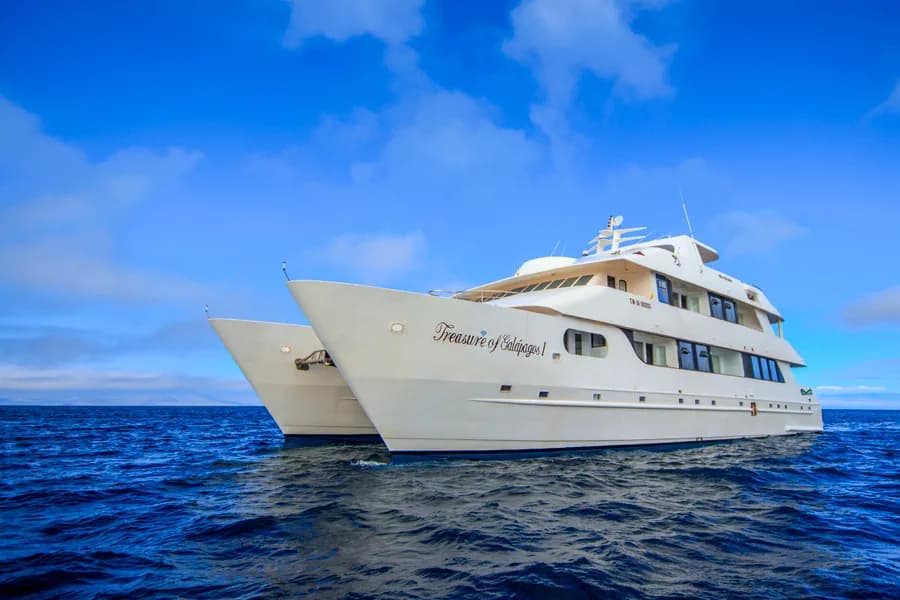
November 20, 2026 · Treasure, 5-Day Northern & Western: Punta Pitt's Triple Boobies
Possible: Santa Cruz Highlands, day 1. 1 spot
from US$4,150 per guest
Check availability
November 23, 2026 · Solaris, 5-Day Northern Islands: South Plaza's Hybrid Iguana
Possible: Santa Cruz Highlands, day 1. 4 spots
from US$3,735 per guest
Check availability
2,575 departures
On every departure
Included
All meals on board · Two certified national park naturalist guides · All excursions and landings listed in the itinerary · Snorkelling gear and wetsuit · Kayaks and stand-up paddleboards on board · Coffee, tea and water at any time
How you see them
Landing at 4 sites · Snorkelling at 1 site · Panga ride at 1 site · Hiking at 1 site