Floreana Mockingbird: Facts and Where to See It
The Floreana mockingbird (Mimus trifasciatus) was the first mockingbird Darwin described, on the Beagle voyage in 1835, when it was common across Floreana. Fifty years later it was gone from the island. Today a few hundred survive on two tiny islets offshore, Champion and Gardner-by-Floreana. Naturalist guides' sighting records place it at 1 site, seen from the panga only.
Good to know
| Scientific name | Mimus trifasciatus |
|---|---|
| Group | Land birds |
| Endemic to Galápagos | Yes |
| Size | About 25 cm |
| Range | Champion (0.1 km²) and Gardner-by-Floreana (0.8 km²) |
| Population | Several hundred |
| Diet | Mainly ground insects; also nectar, pollen, fruit, crabs, lizards |
| IUCN status | Endangered (since 2017, before that Critically Endangered) |
| In Galápagos | All year |
- Galapagos Conservation Trust, Floreana mockingbird species page (all rows)
Darwin's mockingbird
Darwin described this mockingbird first and then found three more species in Galápagos. His observations of the differences between them, all derived from a common ancestor, became part of his evidence for evolution by natural selection.
- Look. Almost identical to the Galápagos mockingbird, but with red-brown eyes and dark patches on the sides of the breast, a long graduated tail with pale tips and a longish curved bill.
- No mimicry. Unlike other mockingbirds, it does not imitate other birds.
- Bold gangs. Groups of 2 to 10 are territorial and so curious that, according to researchers camping on the islets, the birds find them first. Young birds help raise the next brood.
- Galapagos Conservation Trust (Darwin, evolution, look, mimicry, groups, cooperative breeding)
Why it vanished from Floreana
Cats and black rats are thought to be behind its loss from Floreana, together with the disappearance of the prickly pear cactus it used for nesting and food. On the two islets, numbers rise and fall sharply with extreme weather. A population study of the Champion birds gave them less than a 50 percent chance of surviving there another 100 years, and genetic diversity may already be dangerously low.
- Galapagos Conservation Trust (causes, cactus, fluctuations, viability analysis, genetic diversity)
Where to see the Floreana mockingbird
Guide sighting records list it at 1 site: Champion Islet off Floreana, rated Rare and seen from the panga only, as landing on the islet is not part of the visit. Visits there combine a panga ride along the shore with snorkelling.
- Our guide sighting data
Rare
- Champion Islet, Floreana.Panga ride, snorkelling. Seen all year.Rare
How you see them: panga ride at 1 site, snorkelling at 1 site.
When to see them
Floreana mockingbirds live on their islets all year. In the next twelve months, 33 departures stop at Champion Islet.
- Galapagos Conservation Trust
- our guide sighting and departure data
- 2
- departures in December 2026
Show the December 2026 departures - 1
- departure in April 2027
Show the April 2027 departures - 1
- departure in May 2027
Show the May 2027 departures - 3
- departures in June 2027
Show the June 2027 departures - 26
- departures in the other 8 months
Choose a month in the list - 33
- departures in the next twelve months stop where they are seen
Show all departures
Bringing it back to Floreana
The species has been listed as Endangered since 2017. El Niño and La Niña bring long dry spells that hit the adults, and avian pox and the invasive Philornis fly add to the losses. The Restoring Floreana programme aims to remove invasive species from the main island and eventually reintroduce the Floreana mockingbird there, supported by research into what the birds need to survive.
- Galapagos Conservation Trust (status, threats, Restoring Floreana, research)
Mistakes to avoid
- Expecting to walk among them. They are watched from the panga.
- Confusing them with other mockingbirds. Only Champion and Gardner-by-Floreana have this species.
- Counting on a sighting. The guide records rate the site Rare.
- Our guide sighting data
- Galapagos Conservation Trust
Frequently asked questions
What does the Floreana mockingbird eat?
Mostly insects from the ground, but it is an opportunist: flying insects, fruit, nectar, pollen, centipedes, crabs, lizards and even food regurgitated by boobies.
What is special about the Floreana mockingbird?
It was the first mockingbird Darwin described, in 1835, and the differences between it and the other Galápagos mockingbirds became part of his evidence for natural selection. Today it survives only on two islets off Floreana.
How many Floreana mockingbirds are left?
Several hundred, on Champion and Gardner-by-Floreana. Numbers swing sharply with extreme weather.
Why did the Floreana mockingbird disappear from Floreana?
Introduced cats and black rats, and the loss of the prickly pear cactus it used for nesting and food. It vanished from the island within about 50 years of Darwin's visit.
Can you see the Floreana mockingbird?
Only from a panga at Champion Islet; the guide records rate it Rare there.
- Our guide sighting data
Availability and prices updated
Departures that take you to them
Every Galápagos cruise in this list stops at least once at a site where our guides see the Floreana Mockingbird. The best chances come first, and each departure shows the site and the day. Found one that suits you? Ask us about it. There is no booking and no payment: we check the departure and reply.
Next departures with a good chance
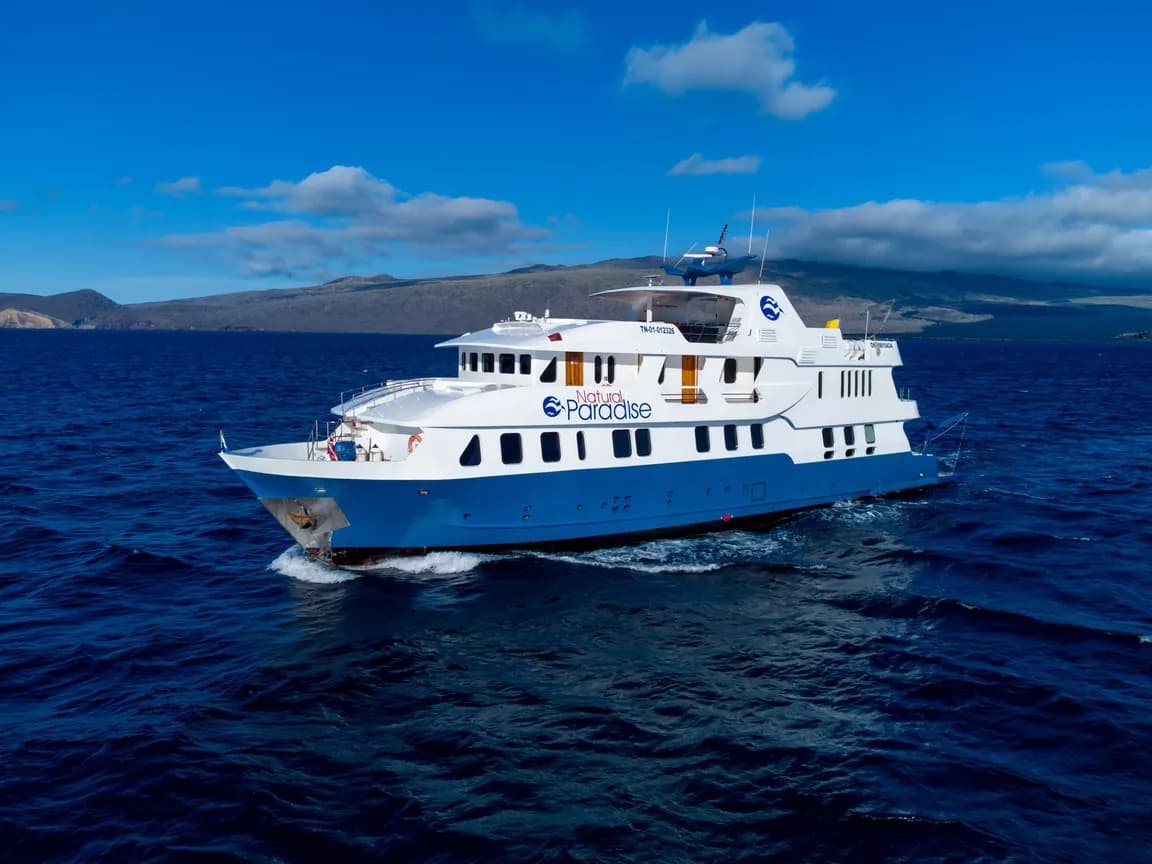
December 1, 2026 · Natural Paradise, 8-Day Western & Southern: Champion Islet's Mockingbird
Rare: Champion Islet, day 6. 2 spots
from US$7,145 per guest
Check availabilityDecember 15, 2026 · Natural Paradise, 8-Day Western & Southern: Champion Islet's Mockingbird
Rare: Champion Islet, day 6. 2 spots
from US$7,145 per guest
Check availability
April 28, 2027 · Eminence, 4-Day Southern Islands: Floreana's Baroness Lookout
Rare: Champion Islet, day 3. 4 spots
from US$8,890 per guest
Check availability
65 departures
On every departure
Included
All meals on board · Two certified national park naturalist guides · All excursions and landings listed in the itinerary · Snorkelling gear and wetsuit · Kayaks and stand-up paddleboards on board · Coffee, tea and water at any time
How you see them
Panga ride at 1 site · Snorkelling at 1 site