Galápagos Fur Seal: Facts and Where to See It
The Galápagos fur seal (Arctocephalus galapagoensis) is the smallest of the eared seals, about 1.3 to 1.5 metres long, with a thick greyish-brown coat and large eyes for hunting at night. It is found only in Galápagos and rests by day in shaded rock grottoes, where visitors rarely look. Naturalist guides' sighting records place it at 7 visitor sites on 5 islands, in every month of the year.
Good to know
| Scientific name | Arctocephalus galapagoensis |
|---|---|
| Group | Marine mammals |
| Endemic to Galápagos | Yes |
| Size | About 1.3 m (females) to 1.5 m (males) |
| Weight | About 27 kg (females) to 64 kg (males) |
| Lifespan | About 10 years |
| Diet | Fish and squid, hunted at night |
| Population | 3,093 counted in 2018 |
| IUCN status | Endangered |
| In Galápagos | All year; pups best seen in October |
- Galapagos Conservation Trust, Galápagos fur seal species page (size, weight, lifespan, diet, status, pups)
- Páez-Rosas and colleagues 2021, Scientific Reports 11:8785 (2018 count)
Fur seal or sea lion?
Both are eared seals and look alike, but the fur seal is smaller, with a broader, shorter head, bulging eyes and ears that stick out further. Its front flippers are larger, for climbing over rough rock, and its coat is much thicker. The sea lion lies on open beaches; the fur seal prefers rocky, shaded places, which is why visitors see it less, even though the two populations are of a similar size according to the Galapagos Conservation Trust.
- Night hunter. Large eyes let it hunt in the dark and watch for sharks. It usually dives 10 to 50 metres for fish and squid close to shore.
- Moon-shy. It hunts less at full moon, probably because it is more visible to sharks and its prey moves deeper.
- Galapagos Conservation Trust (differences, habitat, population comparison, eyes, diving, diet, moon)
Colonies and pups
Fur seals live in large colonies that females divide into territories in the breeding season, mid-August to mid-November. Each mother has one pup and stays with it for a week before leaving to feed, then comes back for a few days at a time to suckle it. Mothers and pups know each other by smell and by call, and a female nurses only her own pup, often driving off others. The Galápagos fur seal has the lowest reproductive rate reported in any seal.
- Galapagos Conservation Trust (colonies, season, pup care, recognition, reproductive rate)
Where to see Galápagos fur seals
Guide sighting records list fur seals at 7 sites. 1 is rated Likely: the rock grottoes at Puerto Egas (James Bay) on Santiago. Buccaneer Cove, Post Office Bay and Punta Vicente Roca are rated Possible, and Isla Lobos and two sites on Genovesa, Darwin Bay and Prince Philip's Steps, Rare. The Galapagos Conservation Trust names James Bay and Darwin Bay as the easiest places to see them.
- Our guide sighting data
- Galapagos Conservation Trust
Likely
- Puerto Egas, Santiago.Landing, snorkelling. Seen all year.Likely
Possible
- Buccaneer Cove, Santiago.Panga ride, snorkelling. Seen all year.Possible
- Post Office Bay, Floreana.Landing. Seen all year.Possible
- Punta Vicente Roca, Isabela.Panga ride, snorkelling. Seen all year.Possible
Rare
- Darwin Bay, Genovesa.Landing, snorkelling. Seen all year.Rare
- Isla Lobos, San Cristóbal.Landing, snorkelling. Seen all year.Rare
- Prince Philip's Steps, Genovesa.Landing. Seen all year.Rare
How you see them: landing at 5 sites, snorkelling at 5 sites, panga ride at 2 sites.
When to see them
Fur seals can be seen all year round. October is the best month for pups. In the next twelve months, 865 departures stop at a site where they are seen.
- Galapagos Conservation Trust
- our guide sighting and departure data
- 37
- departures in November 2026
Show the November 2026 departures - 55
- departures in December 2026
Show the December 2026 departures - 62
- departures in January 2027
Show the January 2027 departures - 57
- departures in February 2027
Show the February 2027 departures - 654
- departures in the other 8 months
Choose a month in the list - 865
- departures in the next twelve months stop where they are seen
Show all departures
Is the Galápagos fur seal endangered?
Yes, it is listed as Endangered. Hunted almost to extinction for its fur in the early 20th century, it has been protected since 1934 and within the national park since 1959. El Niño is now the main threat: in 1982 and 1983 almost all young fur seals died, with about 30 percent of adult females and nearly all large territorial males. A census in 2014 to 2018 counted 3,093 fur seals in 2018, after a 38 percent drop in the El Niño year 2015, and the authors estimate that numbers have halved since 1978. Feral dogs and plastic add to the risk.
- Galapagos Conservation Trust (hunting, 1934, 1959, El Niño 1982 to 1983, dogs, plastic)
- Páez-Rosas and colleagues 2021 (2018 count, 2015 drop, decline since 1978)
Mistakes to avoid
- Looking on the open beach. Fur seals rest in shade, in grottoes and crevices.
- Confusing them with sea lions. Look for the smaller, broader head and the thick coat.
- Climbing into the grottoes. Stay on the trail; park rules ask for at least 2 metres of distance.
Frequently asked questions
How many Galapagos fur seals are left?
A census counted 3,093 in 2018, growing about 3 percent a year after a 38 percent fall in the El Niño year 2015. The authors estimate that the population has roughly halved since 1978.
- Páez-Rosas and colleagues 2021, Scientific Reports
Are Galapagos fur seals sea lions?
No, but they are close relatives: both are eared seals. The fur seal is smaller, with a broader head, bigger eyes and a much thicker coat, and prefers shaded rocks to open beaches.
Are Galapagos fur seals aggressive?
Not towards visitors who keep their distance. Mothers defend their own pups and drive away strange ones, and colonies are divided into territories in the breeding season. Park rules ask for at least 2 metres of distance.
Where can I see Galapagos fur seals?
In the shaded rock grottoes at Puerto Egas (James Bay) on Santiago, rated Likely by the guides, and at Darwin Bay on Genovesa.
- Our guide sighting data
- Galapagos Conservation Trust
Availability and prices updated
Departures that take you to them
Every Galápagos cruise in this list stops at least once at a site where our guides see the Galápagos Fur Seal. The best chances come first, and each departure shows the site and the day. Found one that suits you? Ask us about it. There is no booking and no payment: we check the departure and reply.
Next departures with a good chance
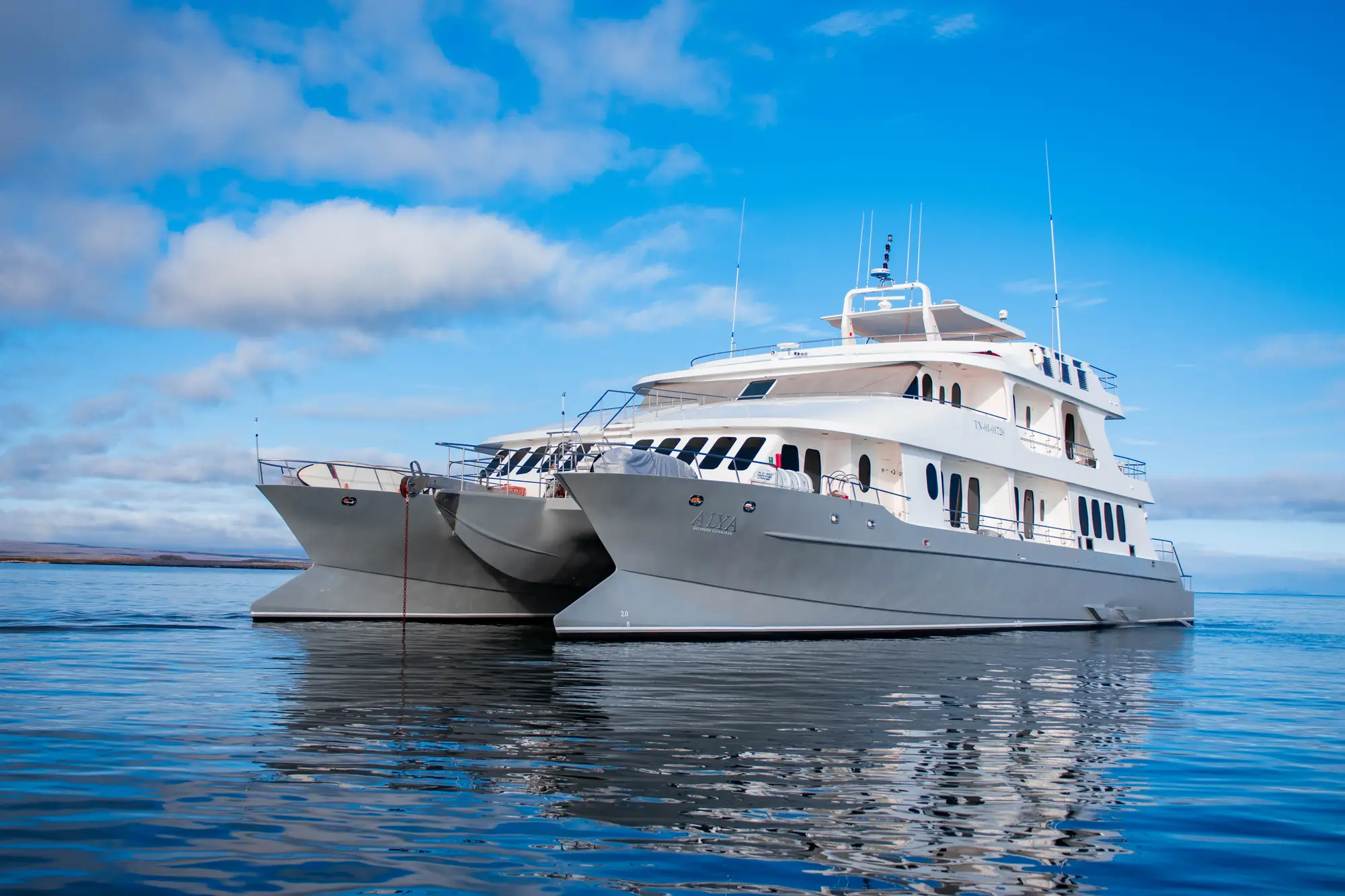
December 19, 2026 · Galaxy Sirius, 6-Day Western Islands: Albemarle Point's WWII Ruins
Likely: Puerto Egas, day 5. 6 spots
from US$7,100 per guest
Check availabilityJanuary 30, 2027 · Galaxy Sirius, 6-Day Western Islands: Albemarle Point's WWII Ruins
Likely: Puerto Egas, day 5. 2 spots
from US$8,100 per guest
Check availabilityFebruary 27, 2027 · Galaxy Sirius, 6-Day Western Islands: Albemarle Point's WWII Ruins
Likely: Puerto Egas, day 5. 2 spots
from US$8,100 per guest
Check availability
2,588 departures
On every departure
Included
All meals on board · Two certified national park naturalist guides · All excursions and landings listed in the itinerary · Snorkelling gear and wetsuit · Kayaks and stand-up paddleboards on board · Coffee, tea and water at any time
How you see them
Landing at 5 sites · Snorkelling at 5 sites · Panga ride at 2 sites
Best chance
Puerto Egas