Galápagos Petrel: Facts and Where to See It
The Galápagos petrel (Pterodroma phaeopygia) is a Critically Endangered seabird found only in Galápagos, about 43 cm long with a 91 cm wingspan. It spends most of its life at sea, foraging as far as Central and South America, and comes ashore to nest in burrows in the humid highlands from late April. Naturalist guides' sighting records list it at 1 site, usually only out at sea.
Good to know
| Scientific name | Pterodroma phaeopygia |
|---|---|
| Group | Seabirds |
| Endemic to Galápagos | Yes |
| Size | About 43 cm; wingspan about 91 cm |
| Diet | Squid, fish, crustaceans |
| Breeding | Late April to October, in highland burrows |
| Population | About 8,500 pairs (estimate) |
| IUCN status | Critically Endangered |
| In Galápagos | Offshore all year |
- Galapagos Conservation Trust, Galápagos petrel species page (all rows)
A seabird that nests in the highlands
Galápagos petrels look very like Hawaiian petrels, especially at sea: medium-sized with long wings, grey-black above, white forehead, pink legs with black webbing, a short hooked bill with tube nostrils that meet on top, and a white wedge-shaped tail.
- Faithful. Pairs return to the same nest site and partner each year.
- Burrows. On the rocky slopes of the highlands, 300 to 900 metres above sea level, they nest in burrows or natural cavities.
- Shared shifts. The male takes the first incubation shift so the female can recover; chicks hatch after about two months and are fed by both parents.
- Galapagos Conservation Trust (look, fidelity, burrows, altitude, incubation, chicks)
Where the Galápagos petrel lives
At sea, petrels forage mostly around the east and north of the archipelago and range as far as western Central America and northern South America. In the breeding season they nest in the highlands of Santa Cruz, Floreana, Santiago, San Cristóbal and Isabela.
- Galapagos Conservation Trust (foraging range, breeding islands)
Where to see Galápagos petrels
Guide sighting records list the petrel at 1 site: the Santa Cruz Highlands, rated Rare and noted as usually seen only out at sea. The likeliest view is from the boat between islands, low over the waves.
- Our guide sighting data
Rare
- Santa Cruz Highlands, Santa Cruz.Landing. Seen all year.Rare
How you see them: landing at 1 site.
When to see them
Petrels forage offshore all year; the breeding season runs from late April to October. In the next twelve months, 453 departures stop at the site where they are recorded.
- Galapagos Conservation Trust
- our guide sighting and departure data
- 24
- departures in November 2026
Show the November 2026 departures - 28
- departures in December 2026
Show the December 2026 departures - 33
- departures in January 2027
Show the January 2027 departures - 37
- departures in February 2027
Show the February 2027 departures - 331
- departures in the other 8 months
Choose a month in the list - 453
- departures in the next twelve months stop where they are seen
Show all departures
Is the Galápagos petrel endangered?
Yes, it is listed as Critically Endangered. The population is thought to have fallen by up to 80 percent since the 1980s. Rats eat eggs and chicks, and feral dogs, cats and pigs take adults; livestock trample and graze nest sites, and land is cleared for farming. El Niño affects nesting and food, and the natural predators, the Galápagos hawk and the short-eared owl, take adults.
Recovery. Invasive animals are controlled and the national park monitors nests. A survey on Santa Cruz in 2016 found petrels back at nest sites unused for decades, and the population is now estimated at 8,500 pairs. The Floreana restoration will also help.
- Galapagos Conservation Trust (status, decline, threats, predators, recovery, 2016 survey, Floreana)
Mistakes to avoid
- Searching on land. Nests are in burrows on remote highland slopes; look at sea.
- Confusing it with other seabirds. Look for the white forehead and white wedge-shaped tail.
- Counting on a sighting. The guide records rate it Rare.
- Galapagos Conservation Trust
- our guide sighting data
Frequently asked questions
What are some interesting facts about petrels?
The Galápagos petrel nests in burrows 300 to 900 metres up in the highlands, returns to the same site and partner each year, and forages as far away as Central and South America. Like all petrels, it has tube-shaped nostrils on top of its bill.
How many Galápagos petrels are left?
About 8,500 pairs, according to a recent estimate, after a fall of up to 80 percent since the 1980s.
Where do Galápagos petrels nest?
In burrows and cavities in the humid highlands of Santa Cruz, Floreana, Santiago, San Cristóbal and Isabela, from late April to October.
What does the Galápagos petrel look like?
A medium-sized petrel with long wings, grey-black above, a white forehead, pink legs with black webbing, a short hooked bill with tube nostrils and a white wedge-shaped tail.
Availability and prices updated
Departures that take you to them
Every Galápagos cruise in this list stops at least once at a site where our guides see the Galápagos Petrel. The best chances come first, and each departure shows the site and the day. Found one that suits you? Ask us about it. There is no booking and no payment: we check the departure and reply.
Next departures with a good chance
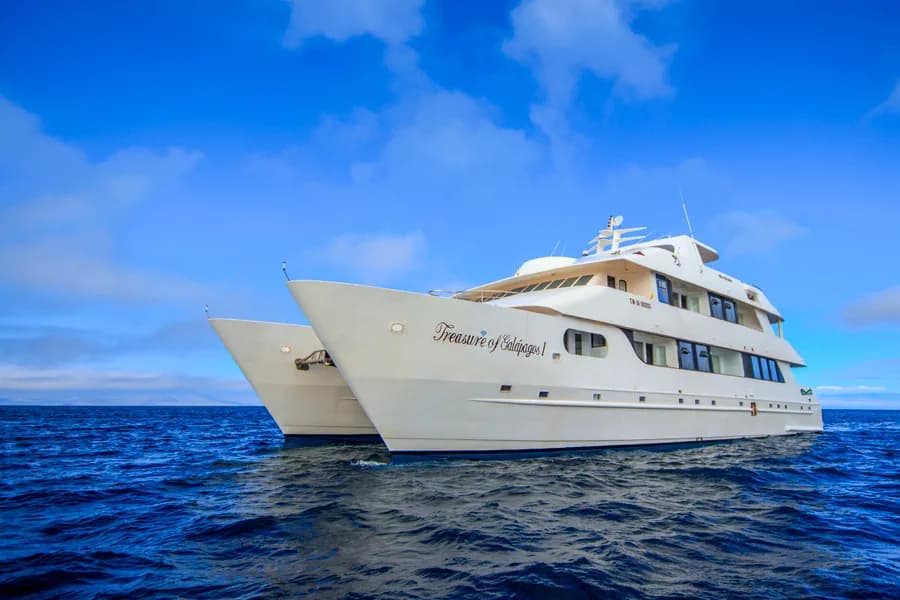
November 10, 2026 · Treasure, 5-Day Southern Islands: Los Gemelos' Daylight Owl
Rare: Santa Cruz Highlands, day 4. 16 spots
from US$4,150 per guest
Check availability
November 12, 2026 · Monique, 4-Day Southern Islands: Santa Cruz's Wild Tortoises
Rare: Santa Cruz Highlands, day 1. 6 spots
from US$3,352 per guest
Check availability
November 12, 2026 · Galaxy Sirius, 6-Day Western & Northern: Rabida's Red Sand Beach
Rare: Santa Cruz Highlands, day 3. 6 spots
from US$5,680 per guest
Check availability
1,302 departures
On every departure
Included
All meals on board · Two certified national park naturalist guides · All excursions and landings listed in the itinerary · Snorkelling gear and wetsuit · Kayaks and stand-up paddleboards on board · Coffee, tea and water at any time
How you see them
Landing at 1 site