Galápagos Sea Lion: Facts and Where to See It
The Galápagos sea lion (Zalophus wollebaeki) is the most abundant marine mammal in the archipelago, often asleep on the beaches or swimming close to shore. Males reach up to 2.5 metres and 400 kg, four times the weight of a female, and the species breeds almost only in Galápagos. Naturalist guides' sighting records place it at 17 visitor sites on 12 islands, in every month of the year.
Good to know
| Scientific name | Zalophus wollebaeki |
|---|---|
| Group | Marine mammals |
| Endemic | Breeds almost only in Galápagos; a few colonies on Isla de la Plata off Ecuador |
| Galápagos sea lion size | Females 1.5 to 2 m, males 2 to 2.5 m |
| Weight | Females 80 to 110 kg, males 250 to 400 kg |
| Lifespan | 15 to 20 years |
| Diet | Fish, mainly sardines |
| IUCN status | Endangered |
| Population | 17,000 to 24,000 (2018 estimate) |
| In Galápagos | All year, at 17 visitor sites on 12 islands (guide sighting records) |
- Galapagos Conservation Trust, Galápagos sea lion species page (size, weight, lifespan, range, diet)
- Páez-Rosas and colleagues 2021, Scientific Reports 11:8785 (status, population)
Sea lion or seal?
Sea lions belong to the eared seals, and the small ear flaps on the side of the head are the first clue. Galápagos has two of them, the Galápagos sea lion and the smaller Galápagos fur seal. Unlike true seals, a sea lion can turn its hind flippers forward under its body, so on land it does not crawl but walks, and on rocky ground it can gallop faster than a person runs.
- Bulls and cows. Males weigh up to four times as much as females and have a bump on the forehead.
- Colour. Brown or grey fur, females lighter than males, newborn pups chestnut brown.
- Divers. Their streamlined body takes them down to almost 600 metres, and they can stay underwater for more than ten minutes, hunting sardines above all.
- Galapagos Conservation Trust (eared seals, flippers, gallop, males, colour, diving, sardines)
Beaches, bulls and pups
Territories on the beach
A bull does not keep a fixed harem. He holds a stretch of beach where females live, and the more dominant he is, the more beach he holds and the more females live on it. Bulls defend their stretch aggressively against rivals and interlopers. Males without a territory gather in bachelor colonies away from the females. The mating season usually runs from July to December, though it differs from island to island.
- Galapagos Conservation Trust (territories, bachelor colonies, mating season)
One pup a year
A female has a single pup. For the first week, mother and pup stay together and learn each other's call, which is how they find each other again in a crowded colony. Then the mother fishes by day and suckles the pup in the evening. At about five weeks the pup sheds its first coat and starts to feed in the shallows, but it depends on its mother for a whole year and is weaned at 11 to 12 months. The guide records place pups at Gardner Bay on Española from August to November.
- Galapagos Conservation Trust (pup, call, suckling, moult, weaning)
- our guide sighting data (Gardner Bay, months)
Where the Galápagos sea lion lives and what it eats
Galápagos sea lion habitat is the coastline of the whole archipelago: sand beaches and lava shelves for resting, and the shallow sea nearby for feeding. In 2014 to 2018, researchers counted them at 32 breeding sites on 13 islands. Their diet is fish, with sardines as the main prey, and the sea lions rarely leave the islands.
- Galapagos Conservation Trust (coastline, sardines, rarely migrating)
- Páez-Rosas and colleagues 2021 (32 rookeries, 13 islands)
Where to see Galápagos sea lions
Guide sighting records list Galápagos sea lions at 17 visitor sites on 12 islands, and the guides note them as present along the coasts of the whole archipelago. 4 sites are rated Likely, with sightings on most visits, among them the large colonies of Mosquera Islet, Gardner Bay on Española and South Plaza. 5 are rated Possible, including Isla Lobos on San Cristóbal, Santa Fé Bay and North Seymour. The rest are rated Rare, among them snorkelling sites such as Devil's Crown and Kicker Rock.
- Our guide sighting data
Pups, August to November
Gardner Bay
Likely
- Gardner Bay, Española.Beach, snorkelling. Pups, August to November.Likely
- Bartolomé Summit, Bartolomé.Seen all year.Likely
- Mosquera Islet, Mosquera.Beach, snorkelling. Seen all year.Likely
- South Plaza Trail, South Plaza.Landing. Seen all year.Likely
Possible
- Cerro Brujo, San Cristóbal.Beach. Seen all year.Possible
- Isla Lobos, San Cristóbal.Landing, snorkelling. Seen all year.Possible
- North Seymour Trail, North Seymour.Landing. Seen all year.Possible
- Punta Vicente Roca, Isabela.Panga ride, snorkelling. Seen all year.Possible
- Santa Fé Bay, Santa Fé.Landing, snorkelling. Seen all year.Possible
Rare
- Buccaneer Cove, Santiago.Panga ride, snorkelling. Seen all year.Rare
- Chinese Hat, Chinese Hat.Landing, snorkelling. Seen all year.Rare
- Devil's Crown, Floreana.Snorkelling. Seen all year.Rare
- Elizabeth Bay, Isabela.Panga ride. Seen all year.Rare
- Kicker Rock (León Dormido), San Cristóbal.Snorkelling, diving. Seen all year.Rare
- Las Tintoreras, Isabela.Landing, snorkelling. Seen all year.Rare
- Post Office Bay, Floreana.Landing. Seen all year.Rare
- Rábida Beach, Rábida.Landing, snorkelling. Seen all year.Rare
How you see them: snorkelling at 11 sites, landing at 8 sites, beach at 3 sites, panga ride at 3 sites, diving at 1 site.
When to see them
Galápagos sea lions stay in the islands all year, so every month works. Pups are the seasonal sight: the guide records place them at Gardner Bay from August to November, and the peak of births falls in October, when researchers carry out their yearly counts. In the next twelve months, 918 departures stop at a site where they are seen.
- Galapagos Conservation Trust (all year)
- Páez-Rosas and colleagues 2021 (peak of pup births in October)
- our guide sighting and departure data
- 40
- departures in November 2026
Show the November 2026 departures - 108
- departures in August 2027
Show the August 2027 departures - 62
- departures in September 2027
Show the September 2027 departures - 111
- departures in October 2027
Show the October 2027 departures - 597
- departures in the other 8 months
Choose a month in the list - 918
- departures in the next twelve months stop where they are seen
Show all departures
Is the Galápagos sea lion endangered?
Yes. The IUCN lists the Galápagos sea lion as Endangered. In 1978 the population was estimated at about 40,000; the 2001 census found about 16,000, a fall of around half. A study by Páez-Rosas and colleagues estimated 17,000 to 24,000 in 2018, growing about 1 percent a year, after a drop of 23.8 percent in the El Niño year 2015.
What threatens them. El Niño warms the sea and the fish disappear, and pups suffer most. Sharks and killer whales are natural predators; domestic dogs carry diseases into colonies, and sea lions have been found tangled in plastic. Galápagos National Park rules keep visitors at least 2 metres (6 feet) from wildlife, even when a curious young sea lion comes closer.
- Páez-Rosas and colleagues 2021, Scientific Reports 11:8785 (status, population figures, 2015 decline)
- Galapagos Conservation Trust (threats, plastic)
- Galápagos Conservancy, Galápagos National Park Rules (distance)
Mistakes to avoid when planning to see them
- Ignoring the bull. A bull defends his stretch of beach aggressively. Keep clear of him and give him room.
- Touching a pup. A pup alone on the beach is waiting for its mother, who finds it by its call. Leave it be.
- Expecting pups every month. The guide records place them at Gardner Bay from August to November.
- Getting too close. Park rules set at least 2 metres between visitors and wildlife, on the beach and in the water.
- Galapagos Conservation Trust (bulls, pups)
- our guide sighting data
- Galápagos Conservancy, Galápagos National Park Rules
Frequently asked questions
Are Galapagos sea lions friendly?
They are curious rather than friendly. The Galapagos Conservation Trust describes them as generally inquisitive, and they spend much of their time resting on beaches or playing. Bulls defend their stretch of beach aggressively against rivals, though, and park rules keep visitors at least 2 metres from all wildlife.
Why is the Galapagos sea lion endangered?
Mainly because of El Niño, which warms the sea and makes the fish they depend on collapse; in 2015 alone the population fell by 23.8 percent. Diseases from domestic dogs and plastic in the sea add to the pressure. Since 1978 the population has roughly halved.
- Páez-Rosas and colleagues 2021, Scientific Reports
- Galapagos Conservation Trust
Which Galapagos island has sea lions?
Nearly all of them. Sea lions live along the coastline of the whole archipelago, and researchers count breeding colonies on 13 islands. The guide sighting records rate Mosquera Islet, Gardner Bay on Española and South Plaza as Likely, and Isla Lobos on San Cristóbal, rated Possible, has a large colony.
- Galapagos Conservation Trust
- Páez-Rosas and colleagues 2021
- our guide sighting data
How many Galapagos sea lions are left in the world?
Between 17,000 and 24,000, according to the estimate for 2018 by Páez-Rosas and colleagues. The population was about 40,000 in 1978 and about 16,000 in 2001, and it has grown slowly since the El Niño of 2015.
- Páez-Rosas and colleagues 2021, Scientific Reports
Availability and prices updated
Departures that take you to them
Every Galápagos cruise in this list stops at least once at a site where our guides see the Galápagos Sea Lion. The best chances come first, and each departure shows the site and the day. Found one that suits you? Ask us about it. There is no booking and no payment: we check the departure and reply.
Next departures with a good chance
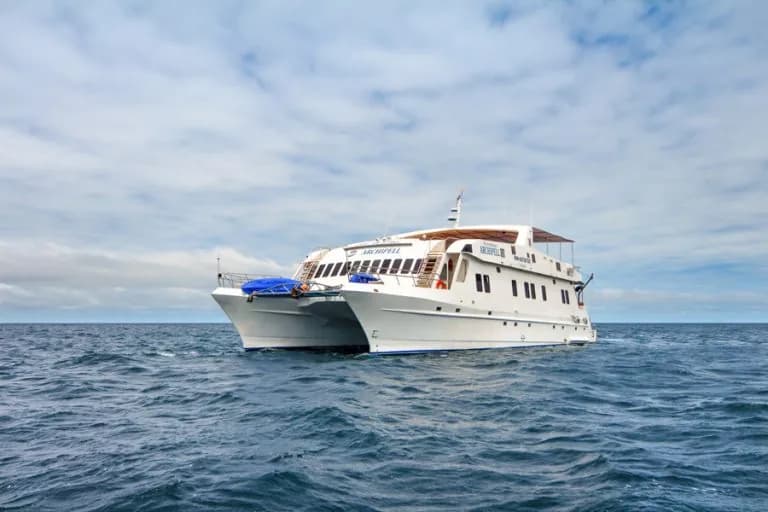
January 4, 2027 · Archipel I, 4-Day Northern & Western: Sullivan Bay's Fresh Lava
Likely: Bartolomé Summit, day 3. 2 spots
from US$2,450 per guest
Check availabilityJanuary 18, 2027 · Archipel I, 4-Day Northern & Western: Sullivan Bay's Fresh Lava
Likely: Bartolomé Summit, day 3. 2 spots
from US$2,205 per guest
Check availabilityFebruary 15, 2027 · Archipel I, 4-Day Northern & Western: Sullivan Bay's Fresh Lava
Likely: Bartolomé Summit, day 3. 1 spot
from US$2,450 per guest
Check availability
2,721 departures
On every departure
Included
All meals on board · Two certified national park naturalist guides · All excursions and landings listed in the itinerary · Snorkelling gear and wetsuit · Kayaks and stand-up paddleboards on board · Coffee, tea and water at any time
How you see them
Snorkelling at 11 sites · Landing at 8 sites · Beach at 3 sites · Panga ride at 3 sites · Diving at 1 site
Best chance
Pups from August to November on Gardner Bay.