Galápagos Green Sea Turtle: Facts and Where to See It
The Galápagos green turtle (Chelonia mydas agassizii) is the only sea turtle that nests in Galápagos and the one seen most often, on snorkels and from pangas all over the archipelago. Adults measure about 84 cm on average and up to 1.3 metres, and live around 80 years. Naturalist guides' sighting records place them at 12 visitor sites on 7 islands, in every month of the year.
Good to know
| Scientific name | Chelonia mydas agassizii |
|---|---|
| Group | Reptiles |
| Endemic to Galápagos | No |
| Size | About 84 cm on average, up to 1.3 m |
| Weight | About 65 kg on average, up to 136 kg |
| Lifespan | About 80 years |
| Diet | Adults mainly plants; young turtles almost anything |
| Maturity | At 26 to 40 years |
| IUCN status | Endangered |
| In Galápagos | All year, at 12 visitor sites on 7 islands (guide sighting records) |
- Galapagos Conservation Trust, Galápagos green turtle species page (all rows)
Nesting beaches and the race to the sea
Mating happens in the warmer months, and from December to March pregnant females wait off the shore for night to fall. A female crawls up the beach past the high-tide mark, digs a nest with her back flippers, lays 50 to 200 eggs and returns to the sea before sunrise. Some come back several times in one season.
- Incubation. The eggs lie in the warm sand for 45 to 55 days. Hotter nests produce more females.
- The race. A clutch tends to hatch at the same moment, which gives each hatchling a better chance. Cormorants, gulls, frigatebirds, crabs and hawks wait on the beach, and sharks and frigatebirds at sea.
- A long wait. The few that survive need 26 to 40 years to reach maturity.
The guide sighting records place nesting from December to June on the beaches of Espumilla on Santiago, Bachas on Santa Cruz and Punta Cormorant on Floreana, and from December to March at Bartolomé.
- Galapagos Conservation Trust (mating, nesting, eggs, incubation, sex, predators, maturity)
- our guide sighting data (beaches and months)
Where the green turtle lives and what it eats
Green turtles live in the coastal waters of the whole archipelago and in tropical and subtropical seas around the Pacific islands. Two features tell them apart from other sea turtles: a serrated lower jaw and a single pair of scales over the eyes. Adults feed mainly on plants such as algae, while young turtles eat almost anything they find.
In Black Turtle Cove on Santa Cruz, a mangrove lagoon visited by panga, turtles rest and mate in the calm water between the roots, and the guide records rate it Likely all year.
- Galapagos Conservation Trust (range, jaw, scales, diet)
- our guide sighting data (Black Turtle Cove)
Where to see green sea turtles in Galápagos
Guide sighting records list green turtles at 12 visitor sites on 7 islands, and the guides note them in the water around the whole archipelago. 2 sites are rated Likely: Black Turtle Cove on Santa Cruz, where they rest among the mangroves, and Pinnacle Rock on Bartolomé, where snorkellers swim with them. 6 are rated Possible, among them the nesting beaches of Espumilla, Bachas and Punta Cormorant and the snorkel at Darwin Bay on Genovesa.
- Our guide sighting data
Nesting on the beach, December
Espumilla Beach
Likely
- Black Turtle Cove, Santa Cruz.Panga ride. Seen all year.Likely
- Pinnacle Rock, Bartolomé.Snorkelling. Seen all year.Likely
Possible
- Bachas Beach, Santa Cruz.Beach. Nesting on the beach, December.Possible
- Bartolomé Summit, Bartolomé.Nesting on the beach, December.Possible
- Espumilla Beach, Santiago.Landing. Nesting on the beach, December.Possible
- Punta Cormorant, Floreana.Landing. Nesting on the beach, December.Possible
- Darwin Bay, Genovesa.Landing, snorkelling. Seen all year.Possible
- Elizabeth Bay, Isabela.Panga ride. Seen all year.Possible
Rare
- Buccaneer Cove, Santiago.Panga ride, snorkelling. Seen all year.Rare
- Kicker Rock (León Dormido), San Cristóbal.Snorkelling, diving. Seen all year.Rare
- Las Tintoreras, Isabela.Landing, snorkelling. Seen all year.Rare
- Post Office Bay, Floreana.Landing. Seen all year.Rare
How you see them: landing at 5 sites, snorkelling at 5 sites, panga ride at 3 sites, beach at 1 site, diving at 1 site.
When to see them
Green turtles are in Galápagos all year. December to March is when females gather off the beaches before nesting, and the guide records note nesting at several beaches through to June. In the next twelve months, 889 departures stop at a site where they are seen.
- Galapagos Conservation Trust (all year, December to March)
- our guide sighting and departure data
- 58
- departures in December 2026
Show the December 2026 departures - 831
- departures in the other 11 months
Choose a month in the list - 889
- departures in the next twelve months stop where they are seen
Show all departures
Is the Galápagos green turtle endangered?
Yes, it is listed as Endangered. Around the world, turtles are hunted for shell, cartilage and meat and drown as bycatch in nets. Damaged foraging areas, fibrous tumours called fibropapillomas, and plastic in the sea add to the losses, and lights on shore lead hatchlings away from the water.
In Galápagos. Rats and cats eat hatchlings, feral pigs dig up whole nests, and a beetle can kill an entire clutch. The species is on CITES Appendix I, its trade is banned, and the Galápagos National Park protects it from fishing. Park rules keep visitors at least 2 metres (6 feet) from wildlife, on nesting beaches as in the water.
- Galapagos Conservation Trust (status, threats, CITES, protection)
- Galápagos Conservancy, Galápagos National Park Rules (distance)
Mistakes to avoid when planning to see them
- Expecting to watch eggs being laid. Females lay at night and leave before sunrise; by day you see tracks and nests, not the laying.
- Walking on the upper beach. Nests lie above the high-tide mark. Stay on the marked path.
- Swimming after a turtle. Let it pass and keep the 2-metre distance.
- Skipping the panga ride. Black Turtle Cove, the surest place in the records, is visited only by panga.
- Galapagos Conservation Trust (night laying, nests)
- our guide sighting data
- Galápagos National Park Rules
Frequently asked questions
Is the green turtle common in Galápagos?
The Galapagos Conservation Trust calls the green turtle the most common sea turtle in the islands and the only one that nests there. Worldwide, the species is listed as Endangered.
Can you touch a green sea turtle?
No. Galápagos National Park rules ask visitors to keep at least 2 metres away from wildlife, even when an animal approaches, and that includes snorkelling. Turtles often come close by themselves; the rule is to let them pass.
How rare is the green sea turtle?
In Galápagos it is the sea turtle you are most likely to see, in coastal waters all over the archipelago. As a species, it is listed as Endangered because of hunting, bycatch, habitat loss and disease elsewhere in the world.
When do green turtles nest in Galápagos?
From December to March pregnant females wait off the beaches for nightfall, and the guide sighting records note nesting at Espumilla, Bachas and Punta Cormorant through to June. The eggs hatch after 45 to 55 days.
- Galapagos Conservation Trust
- our guide sighting data
Availability and prices updated
Departures that take you to them
Every Galápagos cruise in this list stops at least once at a site where our guides see the Pacific Green Sea Turtle. The best chances come first, and each departure shows the site and the day. Found one that suits you? Ask us about it. There is no booking and no payment: we check the departure and reply.
Next departures with a good chance
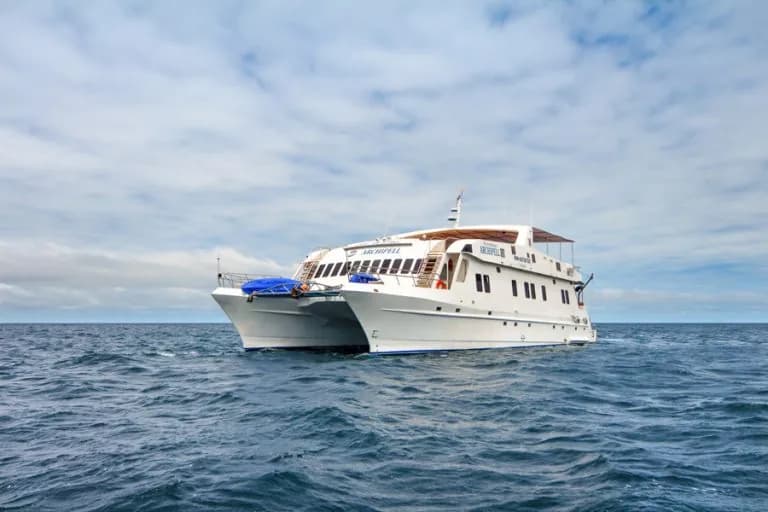
December 14, 2026 · Archipel I, 8-Day Western Islands: Urbina Bay's Coral Uplift
Likely: Black Turtle Cove, day 8. 2 spots
from US$5,295 per guest
Check availabilityDecember 17, 2026 · Archipel I, 5-Day Western Islands: Puerto Egas' Fur Seal Colony
Likely: Black Turtle Cove, day 5. 2 spots
from US$3,295 per guest
Check availability
January 14, 2027 · Galapagos Angel, 4-Day Southern Islands: Punta Suarez's Waved Albatross
Likely: Black Turtle Cove, day 4. 4 spots
from US$2,845 per guest
Check availability
2,646 departures
On every departure
Included
All meals on board · Two certified national park naturalist guides · All excursions and landings listed in the itinerary · Snorkelling gear and wetsuit · Kayaks and stand-up paddleboards on board · Coffee, tea and water at any time
How you see them
Landing at 5 sites · Snorkelling at 5 sites · Panga ride at 3 sites · Beach at 1 site · Diving at 1 site
Best chance
Nesting on the beach from December to December on Espumilla Beach.