Galápagos Land Iguana: Facts and Where to See It
The Galápagos land iguana (Conolophus subcristatus) is a large yellow lizard, about 1 metre long and up to 11.5 kg, that lives in the dry zone of several islands and feeds mainly on prickly pear cactus. It is one of three land iguana species found only in Galápagos. Naturalist guides' sighting records place it at 7 visitor sites on 6 islands, in every month of the year.
Good to know
| Scientific name | Conolophus subcristatus |
|---|---|
| Group | Reptiles |
| Endemic to Galápagos | Yes |
| Size | About 1 m, up to 1.5 m |
| Weight | Up to 11.5 kg |
| Lifespan | About 55 years, up to 60 |
| Diet | Mainly prickly pear pads and fruit |
| Eggs | About 20, hatching after 85 to 110 days |
| IUCN status | Vulnerable |
| In Galápagos | All year, at 7 sites on 6 islands (guide sighting records) |
- Galapagos Conservation Trust, Galápagos land iguana species page (all rows)
A cactus eater with a finch on its back
Land iguanas are yellow with white, black and brown blotches, a short head and strong hind legs with sharp claws. Despite the fierce look they are mainly plant eaters, living on the pads and fruit of the prickly pear cactus. Finches often sit on their backs and pick ticks from between the scales, a partnership that helps both.
- Long walks to nest. Females travel great distances to find a nesting spot, bury about 20 eggs and guard them from other females digging for space.
- Territorial males. Males bob their heads, thrash their tails and bite at rivals.
- Slow start. Hatchlings can take a week to dig out of the nest, are vulnerable for their first years and mature at 8 to 15 years.
- Galapagos Conservation Trust (look, diet, finches, nesting, males, hatchlings, maturity)
Where the land iguana lives
Land iguanas live in the arid zone, where prickly pear cactus grows, on Fernandina, Isabela, Santa Cruz, South Plaza, Baltra, Santiago and North Seymour. Their numbers have fallen sharply over the last 150 years. In 1976, feral dogs wiped out the last colonies on Santa Cruz, and the 60 survivors were rescued by the Charles Darwin Research Station. On Santiago they were locally extinct until 2019.
- Galapagos Conservation Trust (islands, decline, 1976 rescue, Santiago)
Where to see land iguanas in Galápagos
Guide sighting records list land iguanas at 7 sites. 3 are rated Likely: the trail on South Plaza, Urbina Bay on Isabela, and the North Seymour trail on North Seymour. Dragon Hill on Santa Cruz, Santa Fé Bay and Post Office Bay are rated Possible, and Tagus Cove Rare.
- Our guide sighting data
Likely
- North Seymour Trail, North Seymour.Landing. Seen all year.Likely
- South Plaza Trail, South Plaza.Landing. Seen all year.Likely
- Urbina Bay, Isabela.Landing. Seen all year.Likely
Possible
- Dragon Hill, Santa Cruz.Landing. Seen all year.Possible
- Post Office Bay, Floreana.Landing. Seen all year.Possible
- Santa Fé Bay, Santa Fé.Landing, snorkelling. Seen all year.Possible
Rare
- Tagus Cove, Isabela.Panga ride, hiking. Seen all year.Rare
How you see them: landing at 6 sites, snorkelling at 1 site, panga ride at 1 site, hiking at 1 site.
When to see them
Land iguanas can be seen all year round. In the next twelve months, 847 departures stop at a site where they are seen.
- Galapagos Conservation Trust
- our guide sighting and departure data
- 39
- departures in November 2026
Show the November 2026 departures - 54
- departures in December 2026
Show the December 2026 departures - 60
- departures in January 2027
Show the January 2027 departures - 55
- departures in February 2027
Show the February 2027 departures - 639
- departures in the other 8 months
Choose a month in the list - 847
- departures in the next twelve months stop where they are seen
Show all departures
Is the Galápagos land iguana endangered?
It is listed as Vulnerable. Introduced cats, dogs, pigs and rats compete for food and eat eggs and young; cats even take iguanas three or four years old, which natural predators cannot.
Recovery. In 2019, more than 1,000 land iguanas were returned to Santiago, and after they were found breeding, a further 1,500 followed in 2025. Also in 2025, all Galápagos iguanas were placed on CITES Appendix I, which bans international commercial trade. Park rules keep visitors at least 2 metres (6 feet) from wildlife.
- Galapagos Conservation Trust (status, threats, Santiago reintroductions, CITES 2025)
- Galápagos National Park Rules
Mistakes to avoid
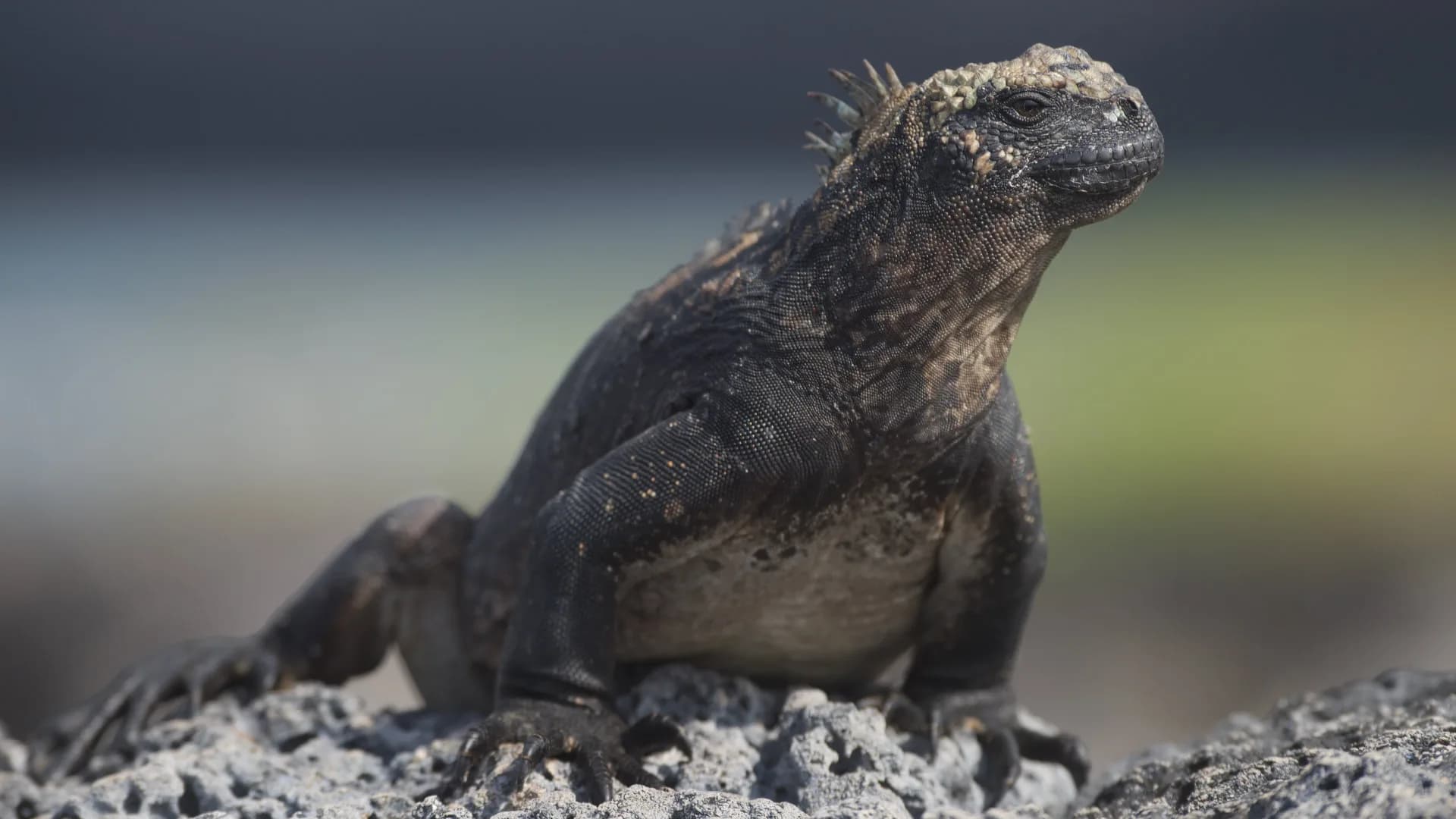
- Confusing them with marine iguanas. Land iguanas are yellow and live among cactus; marine iguanas are dark and live on the shore.
- Walking up to one under a cactus. Keep the 2-metre distance and stay on the trail.
- Skipping South Plaza and North Seymour. They are among the Likely sites.
- Galapagos Conservation Trust
- our guide sighting data
- Galápagos National Park Rules
Frequently asked questions
How were Galápagos land iguanas saved?
After a severe decline over 150 years, the last 60 iguanas on Santa Cruz were rescued in 1976, and more than 2,500 iguanas were returned to Santiago in 2019 and 2025.
What do Galapagos land iguanas eat?
Mainly the pads and fruit of the prickly pear cactus. They are plant eaters despite their fierce appearance.
Are Galápagos iguanas aggressive?
Not towards people. Males defend territory against other males, bobbing their heads, thrashing their tails and biting, and females guard their nests. Visitors keep at least 2 metres away under park rules.
What is special about the iguanas in the Galápagos Islands?
Galápagos has a marine iguana that feeds in the sea and three species of land iguana found nowhere else. The Galápagos land iguana lives on cactus, has finches pick ticks from its back, and can live to about 60.
Availability and prices updated
Departures that take you to them
Every Galápagos cruise in this list stops at least once at a site where our guides see the Galápagos Land Iguana. The best chances come first, and each departure shows the site and the day. Found one that suits you? Ask us about it. There is no booking and no payment: we check the departure and reply.
Next departures with a good chance

November 12, 2026 · Galaxy Sirius, 6-Day Western & Northern: Rabida's Red Sand Beach
Likely: North Seymour Trail, day 3. 6 spots
from US$5,680 per guest
Check availability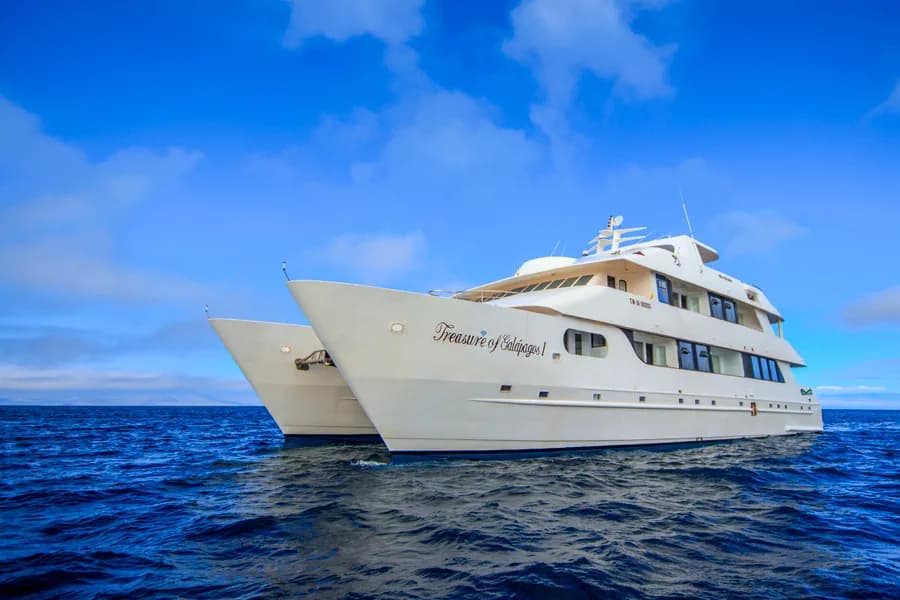
November 20, 2026 · Treasure, 5-Day Northern & Western: Punta Pitt's Triple Boobies
Likely: North Seymour Trail, day 3. 1 spot
from US$4,150 per guest
Check availability
November 24, 2026 · Galapagos Horizon, 5-Day Northern Islands: Bartolome's Pinnacle Rock View
Likely: North Seymour Trail, day 5. 2 spots
from US$5,845 per guest
Check availability
2,556 departures
On every departure
Included
All meals on board · Two certified national park naturalist guides · All excursions and landings listed in the itinerary · Snorkelling gear and wetsuit · Kayaks and stand-up paddleboards on board · Coffee, tea and water at any time
How you see them
Landing at 6 sites · Snorkelling at 1 site · Panga ride at 1 site · Hiking at 1 site
Best chance
North Seymour Trail · South Plaza Trail · Urbina Bay