Magnificent Frigatebird in Galápagos: Facts and Where to See It
The magnificent frigatebird (Fregata magnificens) has the largest wingspan for its body weight of any bird, about 2.15 metres on a bird of just over a kilogram. Males inflate a red throat pouch to court females, and both sexes steal food from other seabirds. Naturalist guides' sighting records place it at 6 visitor sites on 5 islands, with displaying males on North Seymour.
Good to know
| Scientific name | Fregata magnificens |
|---|---|
| Group | Seabirds |
| Endemic to Galápagos | No; tropical seas |
| Wingspan | About 2.15 m, up to 2.4 m |
| Weight | About 1.1 kg, up to 1.4 kg |
| Lifespan | 15 to 25 years |
| Diet | Fish, small crustaceans, newly hatched turtles, food stolen from other birds |
| In Galápagos | Possibly several thousand pairs |
| IUCN status | Least Concern |
- Galapagos Conservation Trust, magnificent frigatebird species page (all rows)
Red pouches and pirate habits
Darwin called the frigatebird the condor of the oceans: it can stay on the wing for days and nights, gliding on thermals. The male is all black with a purple sheen and a large red throat pouch; the slightly larger female has a white breast and a blue ring around the eye.
- The display. Several males surround a female, inflate their red pouches and give a shrill trill, before the chosen pair performs an aerial display.
- The pirate. Frigatebirds chase boobies and tropicbirds, grab their tail feathers and shake them until they drop their catch, then snatch it before it hits the water.
- No waterproofing. Their feathers soak through within a minute or two on the water, so they feed from the surface without landing.
- Galapagos Conservation Trust (Darwin, flight, plumage, display, piracy, feathers)
Nests and the longest parental care
Magnificent frigatebirds breed throughout the year, building a nest of a few twigs in low shrubs near the shore and laying a single egg. The male cares for the chick for up to three months, then leaves to breed again; the female feeds it for a further nine months. That is the longest parental care known among birds, and the only known case of a seabird whose males and females follow different breeding cycles.
Main colonies are on North Seymour, Floreana, San Cristóbal and Genovesa. Elsewhere they rest in mangroves and trees and forage over reefs and coasts, and they often follow cruise boats between landings.
- Galapagos Conservation Trust (breeding, nest, parental care, colonies, habitat, following boats)
Where to see magnificent frigatebirds in Galápagos
Guide sighting records list magnificent frigatebirds at 6 visitor sites. The North Seymour trail on North Seymour is rated Likely all year, and Possible for males with inflated red pouches from November to March. Punta Pitt on San Cristóbal and Black Turtle Cove on Santa Cruz are rated Possible; Kicker Rock, the Isabela Wetlands and Baroness Lookout on Floreana are rated Rare.
- Our guide sighting data
Males displaying inflated red throat pouches, November to December
North Seymour Trail
Likely
- North Seymour Trail, North Seymour.Landing. Males displaying inflated red throat pouches, November to December.Likely
Possible
- Black Turtle Cove, Santa Cruz.Panga ride. Seen all year.Possible
- Punta Pitt, San Cristóbal.Landing. Seen all year.Possible
Rare
- Baroness Lookout, Floreana.Landing. Seen all year.Rare
- Isabela Wetlands, Isabela.Landing. Seen all year.Rare
- Kicker Rock (León Dormido), San Cristóbal.Snorkelling, diving. Seen all year.Rare
How you see them: landing at 4 sites, panga ride at 1 site, snorkelling at 1 site, diving at 1 site.
When to see them
Frigatebirds are in Galápagos all year, and breeding times vary between islands with the climate. The guide records place males displaying their red pouches on North Seymour from November to March. In the next twelve months, 76 departures stop there in those months, and 685 stop at a site where frigatebirds are seen at all.
- Galapagos Conservation Trust (all year, varying breeding)
- our guide sighting and departure data
- 32
- departures in November 2026
Show the November 2026 departures - 44
- departures in December 2026
Show the December 2026 departures - 609
- departures in the other 10 months
Choose a month in the list - 685
- departures in the next twelve months stop where they are seen
Show all departures
Is the magnificent frigatebird endangered?
No, it is listed as Least Concern, and protected by the Galápagos National Park. Some populations worldwide are under pressure from habitat loss and from tourists entering breeding grounds. Frigatebirds also depend on dolphins and tuna that drive fish to the surface, so pressure on those species reaches them too, and marine plastic is a possible threat. On North Seymour, park rules keep visitors on the trail and at least 2 metres (6 feet) from the nests.
- Galapagos Conservation Trust (status, threats, protection)
- Galápagos National Park Rules
Mistakes to avoid when planning to see them
- Expecting red pouches all year. The guide records place displaying males on North Seymour from November to March.
- Leaving the trail for a better photo. Frigatebirds nest in low shrubs near the shore, and park rules keep visitors on marked trails.
- Looking only on land. Watch the sky behind the boat; frigatebirds often follow it.
- Our guide sighting data
- Galapagos Conservation Trust
- Galápagos National Park Rules
Frequently asked questions
What is special about the frigate bird?
It has the largest wingspan for its weight of any bird, can stay in the air for days, steals food from other seabirds, and gives its chick the longest parental care known among birds, up to a year.
Why can't frigatebirds get wet?
Their feathers have no waterproofing and become waterlogged if they stay on the water for more than a minute or two. So they pick food from the surface in flight or steal it from other birds.
Are Magnificent Frigatebirds rare?
No. They are listed as Least Concern, are found across the tropics, and Galápagos may hold several thousand pairs.
What are some interesting facts about the Magnificent Frigatebird?
Darwin called it the condor of the oceans; the Spanish called it a pirate bird. Males inflate a red throat pouch to court females, and the male raises the chick for three months before the female takes over for nine more.
Availability and prices updated
Departures that take you to them
Every Galápagos cruise in this list stops at least once at a site where our guides see the Magnificent Frigatebird. The best chances come first, and each departure shows the site and the day. Found one that suits you? Ask us about it. There is no booking and no payment: we check the departure and reply.
Next departures with a good chance

March 30, 2027 · Grand Ocean Spray, 5-Day Northern & Western: Prince Philip's Boobies
Likely: North Seymour Trail, day 4. 4 spots
from US$7,390 per guest
Check availability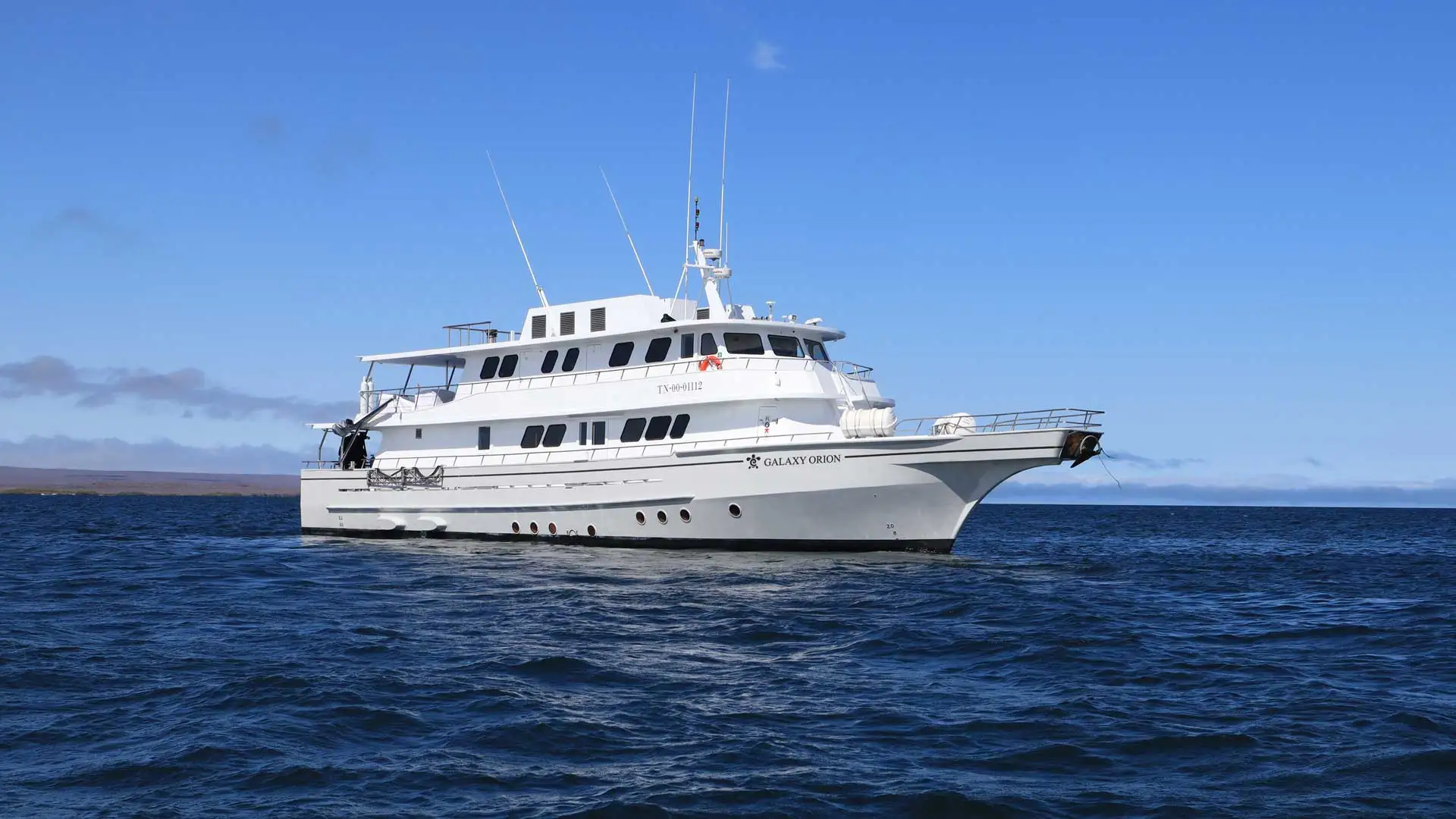
April 3, 2027 · Galaxy Orion, 8-Day Western Islands: Isabela's Tortoise Hatchery
Likely: North Seymour Trail, day 8. 5 spots
from US$4,600 per guest
Check availability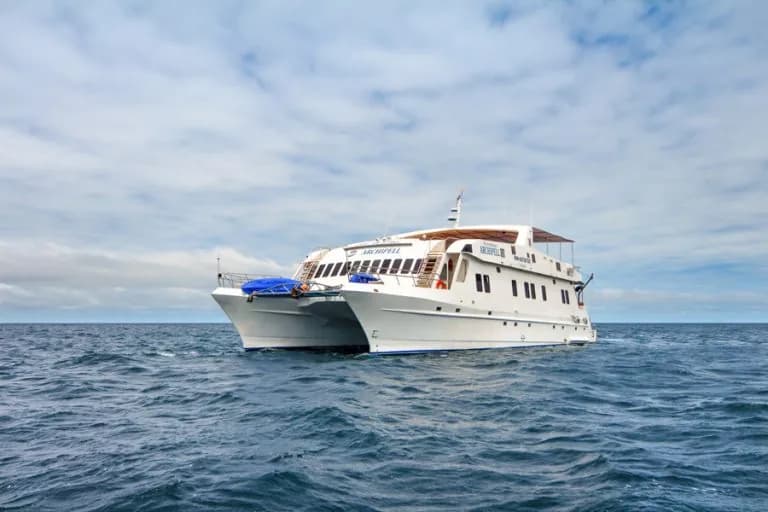
April 5, 2027 · Archipel I, 4-Day Southern & Northern: Chinese Hat's Shark Channel
Likely: North Seymour Trail, day 3. 2 spots
from US$2,450 per guest
Check availability
2,130 departures
On every departure
Included
All meals on board · Two certified national park naturalist guides · All excursions and landings listed in the itinerary · Snorkelling gear and wetsuit · Kayaks and stand-up paddleboards on board · Coffee, tea and water at any time
How you see them
Landing at 4 sites · Panga ride at 1 site · Snorkelling at 1 site · Diving at 1 site
Best chance
Males displaying inflated red throat pouches from November to December on North Seymour Trail.