Moray Eels in Galápagos: Facts and Where to See Them
Moray eels (family Muraenidae) are long, scaleless fish of rocky reefs and coral rubble, about 200 species worldwide. In Galápagos they live in the cracks of the rocky seafloor, among them the jewel moray and a grey-brown moray that reaches 1.3 metres. Naturalist guides' sighting records place them at 1 snorkelling site on 1 island, in every month of the year.
Good to know
| Scientific name | Muraenidae (family) |
|---|---|
| Group | Marine life |
| Endemic to Galápagos | No |
| Species worldwide | About 200, in 16 genera |
| In Galápagos, for example | Jewel moray (Muraena lentiginosa); Gymnothorax porphyreus, up to 1.3 m |
| Diet | Smaller fish, crabs and octopuses |
| Habitat | Cracks and holes in rocky reefs and coral rubble |
| IUCN status | Least Concern for the species recorded here |
| In Galápagos | All year, at 1 site (guide sighting records) |
- Wikipedia, Moray eel (species, genera, diet, habitat)
- Charles Darwin Foundation, Galápagos species checklist and collections (jewel moray, Gymnothorax porphyreus)
Two sets of jaws and an open mouth
A moray looks threatening with its mouth always opening and closing, but that is how it breathes. Its small, round gills sit far back on the flanks, so the eel has to keep gulping water through its mouth and over them.
- A second set of jaws. Further back in the throat sit pharyngeal jaws, complete with small teeth. When a moray bites, it launches them forward into the mouth, grips the prey and pulls it into the throat. Morays are the only animals known to catch and hold prey this way.
- Slime instead of scales. Their smooth skin has no scales and is covered in a protective mucus, which in some species contains a toxin.
- Hunting partners. Elsewhere in the world, groupers have been seen recruiting giant morays to hunt together, the moray reaching into crevices the grouper cannot.
- Wikipedia, Moray eel (gills and respiration, pharyngeal jaws, mucus, groupers)
Where moray eels live and what they eat
Moray eel habitat is the rocky reef: holes, cracks and rubble where a long body can hide with only the head showing. Most species live in warm salt water, from shallow inshore water down to deep slopes. Morays are opportunistic predators of smaller fish, crabs and octopuses; they work through the reef from hole to hole.
In Galápagos, the Charles Darwin Foundation describes the jewel moray as a carnivore of the rocky seafloor and Gymnothorax porphyreus as a yellowish to grey-brown moray of shallow rocky reefs that grows to 130 cm. During a snorkel, a moray is usually seen as a head looking out of a crack in the rock.
- Wikipedia, Moray eel (habitat, diet)
- Charles Darwin Foundation (Galápagos species)
Where to see moray eels in Galápagos
Guide sighting records list moray eels at 1 site: Darwin Bay on Genovesa, where the visit includes snorkelling along the rocky edge of the bay. The guides rate it Rare, so a moray there is a bonus rather than something to plan around. Because morays hide in crevices, the records likely understate them: they are easy to swim past.
- Our guide sighting data
Rare
- Darwin Bay, Genovesa.Landing, snorkelling. Seen all year.Rare
How you see them: landing at 1 site, snorkelling at 1 site.
When to see them
Moray eels live in Galápagos all year, so no month rules them out. In the next twelve months, 369 departures stop at the site where they are recorded.
- Our guide sighting and departure data
- 11
- departures in November 2026
Show the November 2026 departures - 22
- departures in December 2026
Show the December 2026 departures - 29
- departures in January 2027
Show the January 2027 departures - 28
- departures in February 2027
Show the February 2027 departures - 279
- departures in the other 8 months
Choose a month in the list - 369
- departures in the next twelve months stop where they are seen
Show all departures
Are moray eels dangerous?
Not if left alone. A moray's gaping mouth is breathing, not a threat, and they stay in their holes rather than chase swimmers. A bite happens when a hand goes into a crevice or near the head, and with two sets of jaws and backward-pointing grip, it is a bite to avoid. Some species carry a toxin in their skin mucus, and large reef morays such as the giant moray can build up ciguatoxin in their bodies, which poisons people who eat them.
The species recorded in Galápagos are listed as Least Concern. Galápagos National Park rules keep visitors at least 2 metres from wildlife, even when an animal comes closer.
- Wikipedia, Moray eel (breathing, jaws, mucus toxin, ciguatoxin)
- Galápagos Conservancy, Galápagos National Park Rules (distance)
Mistakes to avoid when snorkelling near them
- Reaching into cracks. Morays live in holes in the rock. Keep hands off the reef and out of crevices.
- Taking the open mouth as an attack. It is how a moray breathes; a calm look from a distance is fine.
- Expecting to see one on every snorkel. The guide records rate Darwin Bay Rare, and morays stay hidden most of the day.
- Diving down to the head. Keep your distance, as park rules ask for all wildlife.
- Wikipedia, Moray eel
- our guide sighting data
- Galápagos National Park Rules
Frequently asked questions
Are moray eels venomous?
They have no venom in their bite, but the protective mucus on the skin contains a toxin in some species. Large reef morays can also accumulate ciguatoxin, which causes ciguatera poisoning in people who eat them.
- Wikipedia, Moray eel
What happens if you get bit by a moray eel?
A moray grips with its front jaws and then pulls with a second set of jaws in its throat, so a bite can tear rather than just puncture. Bites are rare and almost always follow a hand placed near the head or into a crevice.
- Wikipedia, Moray eel (jaws)
Is the moray eel aggressive?
Not towards people who leave it alone. The constant opening and closing of the mouth looks aggressive but is breathing: the gills sit far back on the body, so water has to be pumped through the mouth. Morays stay in their holes rather than chase swimmers.
- Wikipedia, Moray eel
Is it safe to touch a moray eel?
No. Touching invites a bite, and the skin mucus of some species contains a toxin. In Galápagos, the national park rules ask for at least 2 metres of distance from all wildlife.
- Wikipedia, Moray eel
- Galápagos National Park Rules
Availability and prices updated
Departures that take you to them
Every Galápagos cruise in this list stops at least once at a site where our guides see the Moray Eel. The best chances come first, and each departure shows the site and the day. Found one that suits you? Ask us about it. There is no booking and no payment: we check the departure and reply.
Next departures with a good chance
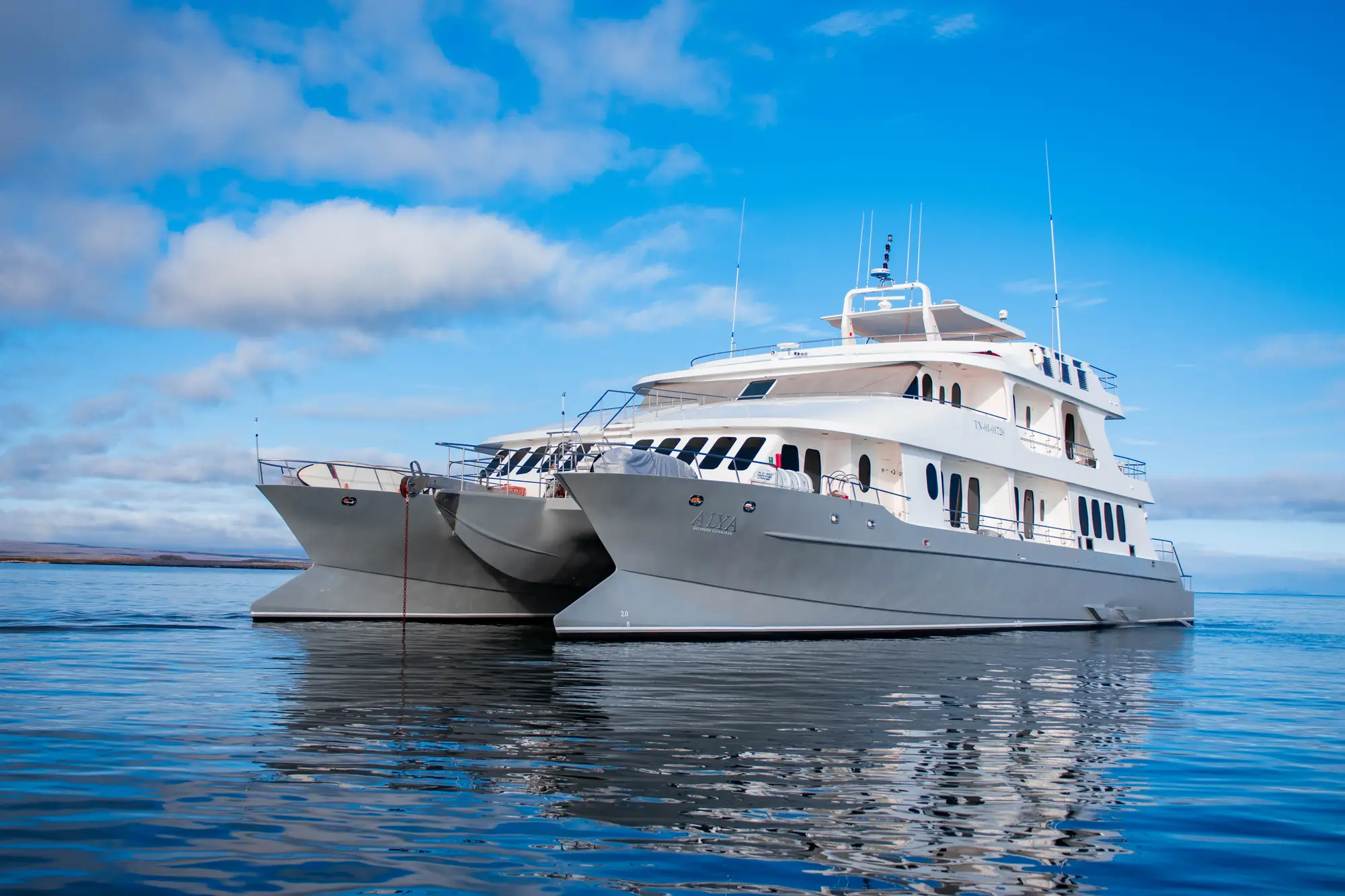
November 12, 2026 · Galaxy Sirius, 6-Day Western & Northern: Rabida's Red Sand Beach
Rare: Darwin Bay, day 5. 6 spots
from US$5,680 per guest
Check availability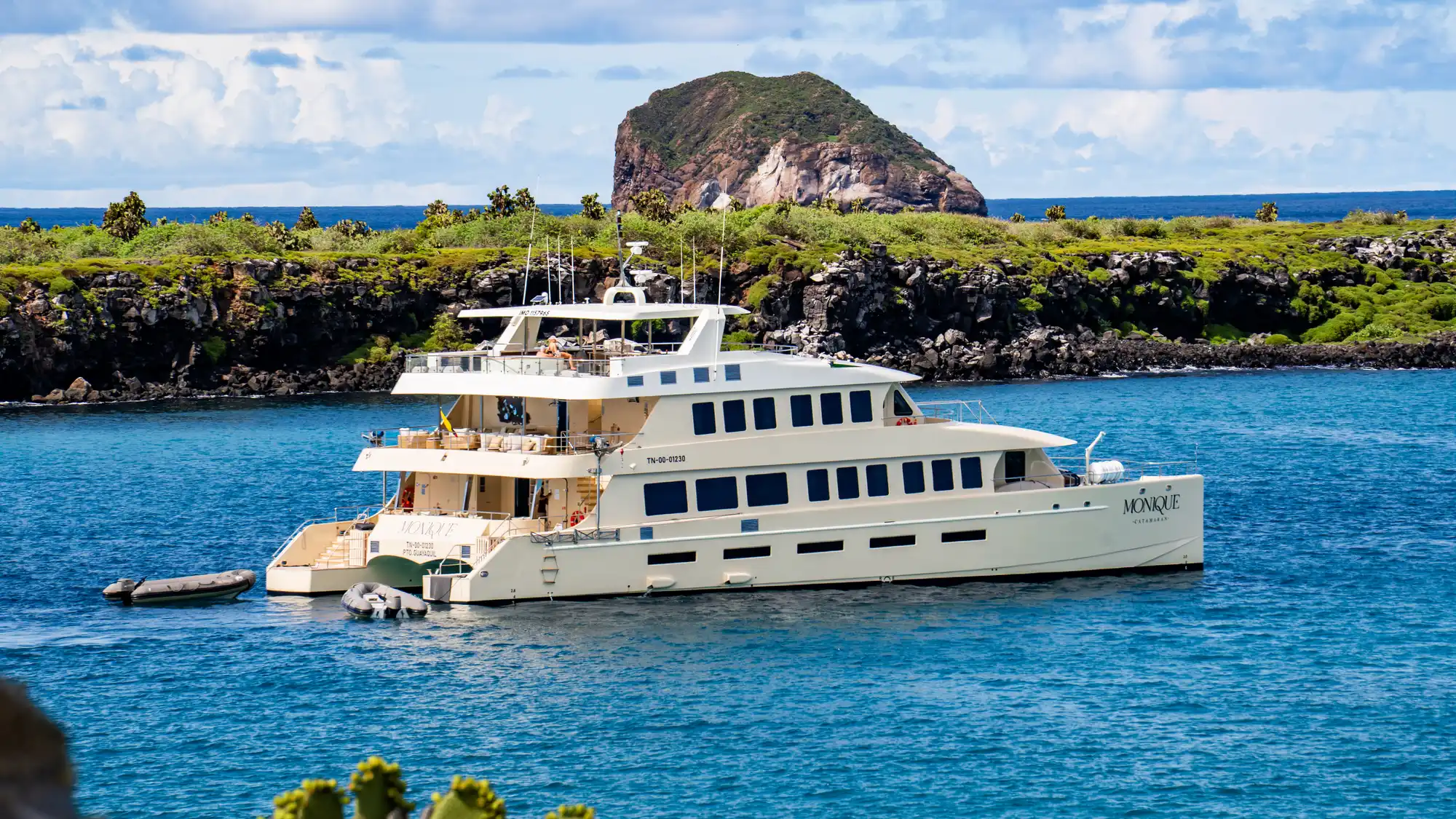
November 15, 2026 · Monique, 5-Day Southern & Western: Kicker Rock's Swim Channel
Rare: Darwin Bay, day 4. 1 spot
Check availability
November 18, 2026 · Galaxy Stella, 5-Day Northern Islands: Kicker Rock's Shark Channel
Rare: Darwin Bay, day 3. 4 spots
from US$4,080 per guest
Check availability
1,137 departures
On every departure
Included
All meals on board · Two certified national park naturalist guides · All excursions and landings listed in the itinerary · Snorkelling gear and wetsuit · Kayaks and stand-up paddleboards on board · Coffee, tea and water at any time
How you see them
Landing at 1 site · Snorkelling at 1 site