Nazca Booby in Galápagos: Facts and Where to See It
The Nazca booby (Sula granti) is the largest of the three boobies in Galápagos, a white seabird with a black tail, grey feet and an orange or yellow bill, 76 to 89 cm long. It was long thought to be a form of the masked booby and is now a species of its own. Naturalist guides' sighting records place it at 8 visitor sites on 7 islands, in every month of the year.
Good to know
| Scientific name | Sula granti |
|---|---|
| Group | Seabirds |
| Endemic to Galápagos | No; eastern Pacific |
| Size | 76 to 89 cm, up to 92 cm |
| Wingspan | About 1.55 m, up to 1.8 m |
| Weight | 1.3 to 2.3 kg |
| Lifespan | About 23 years |
| Diet | Sardines; flying fish, squid and anchovies in El Niño years |
| IUCN status | Least Concern |
| In Galápagos | All year, at 8 sites on 7 islands (guide sighting records) |
- Galapagos Conservation Trust, Nazca booby species page (all rows)
Two eggs, one chick
A female Nazca booby often lays two eggs, but only one chick survives. This is called obligate siblicide: one chick grows larger and stronger, and the smaller one is pushed out of the nest and dies. The death is not always caused directly by its sibling; often the weaker chick simply cannot fend for itself once the parents leave the nest.
- Plunge-diver. Nazca boobies dive for fish from up to 30 metres, usually in the coastal waters around the islands. Females dive deeper and catch slightly larger fish.
- Bill colour. Males have yellow or orange bills, females paler, pinkish ones.
- Grey feet. The quickest way to tell them from the blue-footed and red-footed boobies.
- Galapagos Conservation Trust (eggs, siblicide, diving, bill colour, feet)
Where the Nazca booby lives
Nazca boobies live along the eastern Pacific, from the coasts of South and Central America to Galápagos and Malpelo Island off Colombia, where they mainly breed. They are rarely seen far offshore. In Galápagos they are seen at sea between the islands and nest at colonies such as Punta Suárez and on Genovesa.
- Galapagos Conservation Trust (range, breeding, offshore, colonies)
Where to see Nazca boobies in Galápagos
Guide sighting records list Nazca boobies at 8 sites. 3 are rated Likely: Punta Suárez on Española, and Darwin Bay and Prince Philip's Steps on Genovesa. Punta Pitt on San Cristóbal, Punta Vicente Roca on Isabela and the dive sites at Wolf and Darwin are rated Possible, and South Plaza Rare.
- Our guide sighting data
Likely
- Darwin Bay, Genovesa.Landing, snorkelling. Seen all year.Likely
- Prince Philip's Steps, Genovesa.Landing. Seen all year.Likely
- Punta Suárez, Española.Landing. Seen all year.Likely
Possible
- Darwin Arch, Darwin.Diving. Seen all year.Possible
- Punta Pitt, San Cristóbal.Landing. Seen all year.Possible
- Punta Vicente Roca, Isabela.Panga ride, snorkelling. Seen all year.Possible
- Wolf Dive Site, Wolf.Diving. Seen all year.Possible
Rare
- South Plaza Trail, South Plaza.Landing. Seen all year.Rare
How you see them: landing at 5 sites, snorkelling at 2 sites, diving at 2 sites, panga ride at 1 site.
When to see them
Nazca boobies fly around the islands all year. Nesting is the best time for a close view: on Genovesa from August to November, and on Española, where eggs are laid from November to February. In the next twelve months, 864 departures stop at a site where they are seen.
- Galapagos Conservation Trust (nesting seasons, all year)
- our guide sighting and departure data
- 38
- departures in November 2026
Show the November 2026 departures - 56
- departures in December 2026
Show the December 2026 departures - 63
- departures in January 2027
Show the January 2027 departures - 58
- departures in February 2027
Show the February 2027 departures - 649
- departures in the other 8 months
Choose a month in the list - 864
- departures in the next twelve months stop where they are seen
Show all departures
Are Nazca boobies endangered?
No, they are listed as Least Concern. Introduced predators and human development disturb them, and introduced pigs have caused colonies to be abandoned. Long-line fishing is a further threat. Park rules keep visitors on the trail and at least 2 metres (6 feet) from wildlife.
- Galapagos Conservation Trust (status, threats)
- Galápagos National Park Rules
Mistakes to avoid
- Mixing them up with masked boobies. The orange bill of the male and the grey feet are the clues.
- Ignoring the nesting season. On Española it is November to February, on Genovesa August to November.
- Stepping off the trail. Park rules keep visitors on marked trails at every visitor site.
Frequently asked questions
Why is it called Nazca Booby?
"Booby" comes from the Spanish "bobo", meaning foolish or clown, after the birds' clumsy movement on land.
Are Nazca boobies endangered?
No, they are listed as Least Concern. Introduced pigs, human development and long-line fishing are the main threats in Galápagos.
What is the difference between a Nazca booby and a masked booby?
The Nazca booby was long treated as a form of the masked booby. It was split off because of its different bill colour, larger size and breeding range.
How do Nazca boobies catch fish?
They plunge-dive for fish from up to 30 metres, usually in the coastal waters around the islands. Females dive deeper than males.
Availability and prices updated
Departures that take you to them
Every Galápagos cruise in this list stops at least once at a site where our guides see the Nazca Booby. The best chances come first, and each departure shows the site and the day. Found one that suits you? Ask us about it. There is no booking and no payment: we check the departure and reply.
Next departures with a good chance
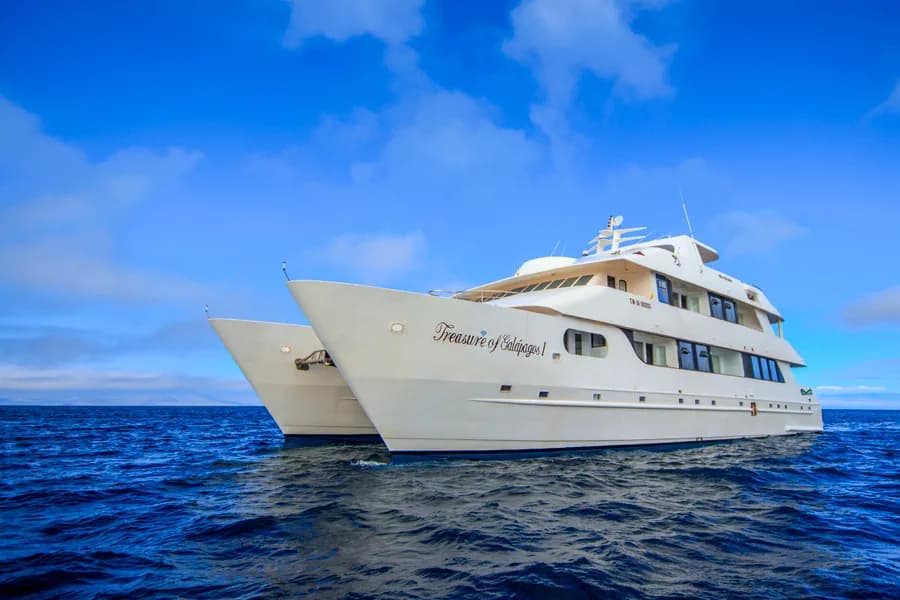
November 10, 2026 · Treasure, 5-Day Southern Islands: Los Gemelos' Daylight Owl
Likely: Punta Suárez, day 2. 16 spots
from US$4,150 per guest
Check availability
November 12, 2026 · Monique, 4-Day Southern Islands: Santa Cruz's Wild Tortoises
Likely: Punta Suárez, day 3. 6 spots
from US$3,352 per guest
Check availability
November 12, 2026 · Galaxy Sirius, 6-Day Western & Northern: Rabida's Red Sand Beach
Likely: Darwin Bay, day 5. 6 spots
from US$5,680 per guest
Check availability
2,575 departures
On every departure
Included
All meals on board · Two certified national park naturalist guides · All excursions and landings listed in the itinerary · Snorkelling gear and wetsuit · Kayaks and stand-up paddleboards on board · Coffee, tea and water at any time
How you see them
Landing at 5 sites · Snorkelling at 2 sites · Diving at 2 sites · Panga ride at 1 site
Best chance
Darwin Bay · Prince Philip's Steps · Punta Suárez