Red-Footed Booby in Galápagos: Facts and Where to See It
The red-footed booby (Sula sula) is the smallest of all boobies, about 70 cm long with a 1-metre wingspan, red legs and feet and a pale blue bill. Unlike the other boobies of Galápagos it nests in trees and shrubs, and it lives mainly on Genovesa and San Cristóbal. Naturalist guides' sighting records place it at 5 visitor sites on 4 islands, in every month of the year.
Good to know
| Scientific name | Sula sula |
|---|---|
| Group | Seabirds |
| Endemic to Galápagos | No; tropical Atlantic, Pacific and Indian Oceans |
| Size | About 70 cm, up to 76 cm; wingspan about 1 m |
| Weight | Up to 1 kg |
| Lifespan | About 22 years |
| Diet | Fish, especially flying fish; squid at night |
| IUCN status | Least Concern |
| In Galápagos | All year; nesting from late January to September |
- Galapagos Conservation Trust, red-footed booby species page (all rows)
Three colours and a nest in a tree
Red-footed boobies come in several colour forms. The brown form, the one seen most in Galápagos, is brown with a white belly, rump and tail. The white form is white with black flight feathers, and a black-tailed white form is easily confused with the Nazca and masked boobies. Young birds are brown or blackish-grey with a black bill and grey legs.
- Nests in trees. Unlike other boobies, they nest on top of shrubs and small trees, on twigs and sticks the male collects. Longer toes than other boobies help them grip the branches.
- Skypointing. A male courts a female by throwing back his head until the bill points straight up.
- One egg. Both parents incubate it for about 45 days, and the chick fledges at around three months. A pair usually lays only once every 15 months.
- Galapagos Conservation Trust (colour forms, juveniles, nests, toes, skypointing, egg, fledging, laying interval)
Where the red-footed booby lives and what it eats
Red-footed boobies are found across the tropical and subtropical Atlantic, Pacific and Indian Oceans. They are strong flyers and travel up to 90 miles, about 145 km, to forage. Long bills, streamlined bodies and wings that wrap around the body let them dive after fish spotted from above, flying fish above all, and they also dive at night for schooling squid. In Galápagos they nest mainly on Genovesa and San Cristóbal, in large, noisy colonies.
- Galapagos Conservation Trust (range, foraging distance, diving, diet, colonies, islands)
Where to see red-footed boobies in Galápagos
Guide sighting records list red-footed boobies at 5 visitor sites. 2 are rated Likely, both on Genovesa: Darwin Bay, where the guides note them nesting in trees, and Prince Philip's Steps. Punta Pitt on San Cristóbal and the waters off Wolf are rated Possible, and Baroness Lookout on Floreana Rare.
- Our guide sighting data
Likely
- Darwin Bay, Genovesa.Landing, snorkelling. Seen all year.Likely
- Prince Philip's Steps, Genovesa.Landing. Seen all year.Likely
Possible
- Punta Pitt, San Cristóbal.Landing. Seen all year.Possible
- Wolf Dive Site, Wolf.Diving. Seen all year.Possible
Rare
- Baroness Lookout, Floreana.Landing. Seen all year.Rare
How you see them: landing at 4 sites, snorkelling at 1 site, diving at 1 site.
When to see them
Red-footed boobies are in Galápagos all year. They are easiest to see while nesting, between late January and September, when the colonies are full. In the next twelve months, 504 departures stop at a site where they are seen.
- Galapagos Conservation Trust (nesting season)
- our guide sighting and departure data
- 21
- departures in November 2026
Show the November 2026 departures - 30
- departures in December 2026
Show the December 2026 departures - 37
- departures in January 2027
Show the January 2027 departures - 37
- departures in February 2027
Show the February 2027 departures - 379
- departures in the other 8 months
Choose a month in the list - 504
- departures in the next twelve months stop where they are seen
Show all departures
Is the red-footed booby endangered?
No, it is listed as Least Concern. In Galápagos, though, numbers have fallen in the past: the El Niño of 1998 cut their food supply and hit the population hard. Invasive species prey on eggs and chicks or damage the trees and shrubs they nest in. Park rules keep visitors at least 2 metres (6 feet) from wildlife and on marked trails.
- Galapagos Conservation Trust (status, El Niño 1998, invasive species)
- Galápagos National Park Rules
Mistakes to avoid when planning to see them
- Leaving out Genovesa. Both Likely sites are on Genovesa; most other routes see red-footed boobies only by chance.
- Looking on the ground. Unlike blue-footed and Nazca boobies, they nest in trees.
- Expecting red feet on every bird. Young birds have grey legs.
- Leaning into the bushes. Keep the 2-metre distance from nesting birds.
- Our guide sighting data
- Galapagos Conservation Trust
- Galápagos National Park Rules
Frequently asked questions
Where can I find a red-footed booby?
In Galápagos, mainly on Genovesa and San Cristóbal. The guide sighting records rate Darwin Bay and Prince Philip's Steps on Genovesa as Likely; at Darwin Bay the guides note them nesting in trees.
- Galapagos Conservation Trust
- our guide sighting data
Which boobies live in Galápagos?
The Galapagos Conservation Trust names three breeding boobies in Galápagos, the blue-footed, the Nazca and the red-footed booby, and notes that masked boobies also live in the archipelago; the white form of the red-footed booby is easily confused with them.
Are booby birds friendly?
They show little fear of people, which the Galapagos Conservation Trust links to their name: "bobo" in Spanish means foolish or clown. Park rules still ask for at least 2 metres of distance.
Where are red-footed boobies native to?
Tropical and subtropical regions of the Atlantic, Pacific and Indian Oceans. Galápagos is one of the places where they breed in large colonies.
Availability and prices updated
Departures that take you to them
Every Galápagos cruise in this list stops at least once at a site where our guides see the Red-footed Booby. The best chances come first, and each departure shows the site and the day. Found one that suits you? Ask us about it. There is no booking and no payment: we check the departure and reply.
Next departures with a good chance

November 12, 2026 · Galaxy Sirius, 6-Day Western & Northern: Rabida's Red Sand Beach
Likely: Darwin Bay, day 5. 6 spots
from US$5,680 per guest
Check availability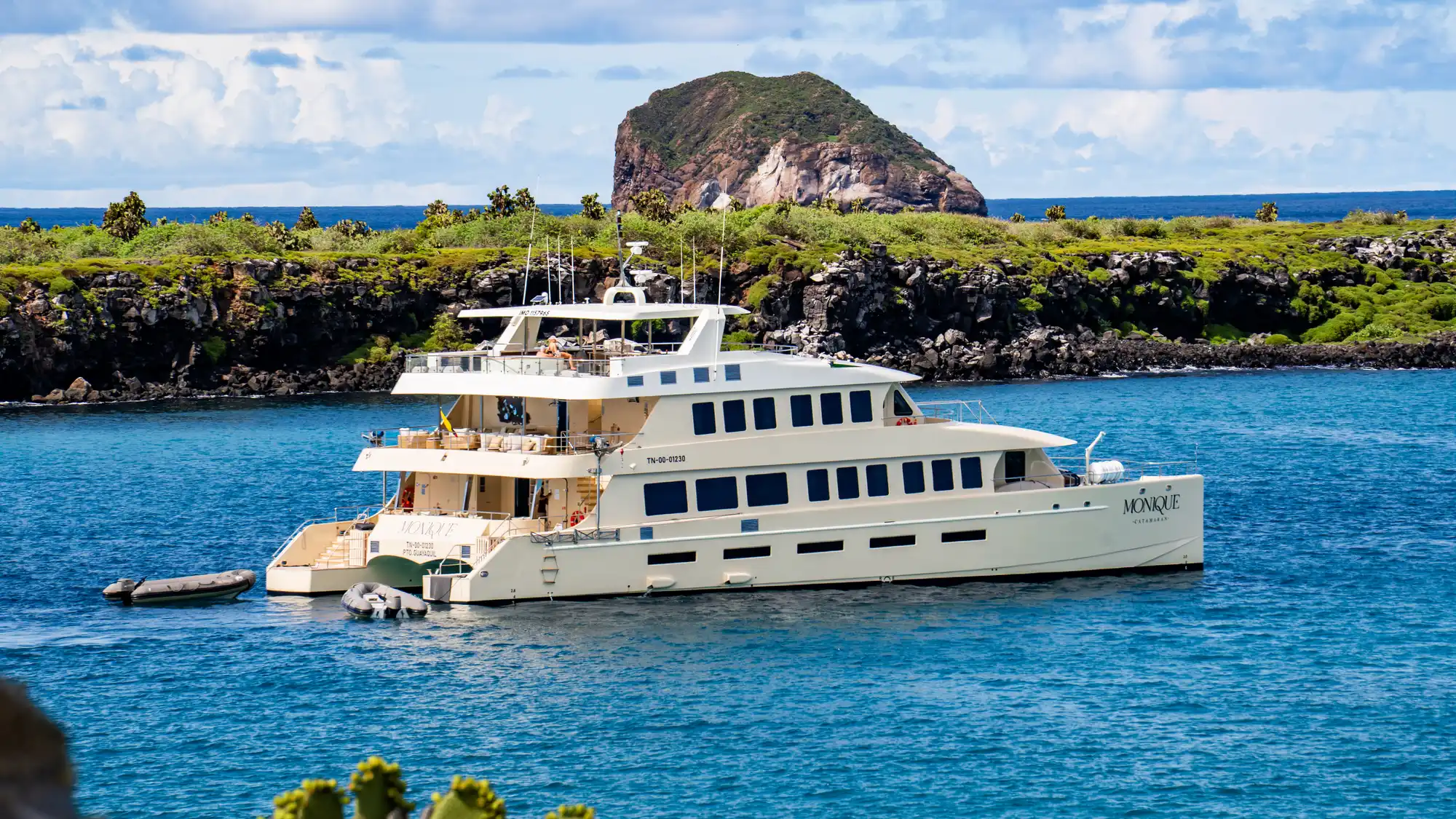
November 15, 2026 · Monique, 5-Day Southern & Western: Kicker Rock's Swim Channel
Likely: Darwin Bay, day 4. 1 spot
Check availability
November 18, 2026 · Galaxy Stella, 5-Day Northern Islands: Kicker Rock's Shark Channel
Likely: Darwin Bay, day 3. 4 spots
from US$4,080 per guest
Check availability
1,566 departures
On every departure
Included
All meals on board · Two certified national park naturalist guides · All excursions and landings listed in the itinerary · Snorkelling gear and wetsuit · Kayaks and stand-up paddleboards on board · Coffee, tea and water at any time
How you see them
Landing at 4 sites · Snorkelling at 1 site · Diving at 1 site
Best chance
Darwin Bay · Prince Philip's Steps