Scalloped Hammerhead in Galápagos: Facts and Where to See It
The scalloped hammerhead (Sphyrna lewini) is the most common hammerhead shark, 2.5 to 3 metres long, named for the scalloped front edge of its hammer-shaped head. The Galápagos Marine Reserve is one of the few places on Earth where it gathers in schools of several hundred. Naturalist guides' sighting records place it at 5 dive and snorkel sites, with the big schools at Wolf and Darwin.
Good to know
| Scientific name | Sphyrna lewini |
|---|---|
| Group | Sharks and rays |
| Endemic to Galápagos | No; warm seas of the Atlantic, Indian and Pacific Oceans |
| Size | 2.5 to 3 m, up to 4.2 m |
| Weight | 80 to 100 kg, up to 152 kg |
| Lifespan | 20 to 30 years |
| Diet | Schooling fish, stingrays, squid, crustaceans |
| Young | 12 to 40 pups, 30 to 55 cm at birth |
| IUCN status | Critically Endangered |
| In Galápagos | All year; most in January, fewest in May |
- Galapagos Conservation Trust, scalloped hammerhead species page (all rows)
Why the hammer, and why the schools
The flattened, hammer-shaped head is called a cephalofoil. It improves the shark's vision and gives room for more electroreceptors, the sensors hammerheads use to find prey on or under the seabed. The scalloped edge at the front tells this species apart from its relatives.
- Body. Slender, bronze-brown above and white below, with narrow, backward-pointing teeth for prey it swallows whole.
- Schools. In Galápagos they gather in schools of up to several hundred. Why they do so is still unknown.
- Live young. Pups are nourished through a placenta-like link for 9 to 12 months and born in shallow coastal water. In 2017, nursery sites were found inside the Galápagos Marine Reserve.
- Galapagos Conservation Trust (cephalofoil, body, teeth, schools, reproduction, nursery sites 2017)
Where the scalloped hammerhead lives and what it eats
Scalloped hammerheads migrate through warm temperate and tropical waters of the Atlantic, Indian and Pacific Oceans. They eat schooling fish such as sardines, herring and mackerel, as well as stingrays, squid and crustaceans. In Galápagos they gather along the current edges of the remote northern islands, Wolf and Darwin, and turn up occasionally at Kicker Rock off San Cristóbal.
- Galapagos Conservation Trust (range, diet, Wolf, Darwin, Kicker Rock)
- our guide sighting data (current edge)
Where to see scalloped hammerheads in Galápagos
Guide sighting records list hammerheads at 5 sites. 2 are rated Likely, both dive sites in the far north: Wolf and Darwin Arch, where they school along the current edge. Gordon Rocks off Santa Cruz and the channel at Kicker Rock off San Cristóbal are rated Possible, and Kicker Rock is the one site where snorkellers have a chance too. Devil's Crown off Floreana is rated Rare.
- Our guide sighting data
The largest schools of the year, June to November
Darwin Arch
Likely
- Darwin Arch, Darwin.Diving. The largest schools of the year, June to November.Likely
- Wolf Dive Site, Wolf.Diving. Seen all year.Likely
Possible
- Gordon Rocks, Santa Cruz.Diving. Seen all year.Possible
- Kicker Rock (León Dormido), San Cristóbal.Snorkelling, diving. Seen all year.Possible
Rare
- Devil's Crown, Floreana.Snorkelling. Seen all year.Rare
How you see them: diving at 4 sites, snorkelling at 2 sites.
When to see them
Hammerheads are in the marine reserve all year. The Galapagos Conservation Trust gives the highest numbers in January and the lowest in May, while the guide sighting records note the largest schools of the year at Darwin Arch from June to November. In the next twelve months, 154 departures stop at a site where they are seen.
- Galapagos Conservation Trust (all year, January high, May low)
- our guide sighting and departure data (June to November at Darwin Arch)
- 7
- departures in November 2026
Show the November 2026 departures - 13
- departures in June 2027
Show the June 2027 departures - 25
- departures in July 2027
Show the July 2027 departures - 24
- departures in August 2027
Show the August 2027 departures - 13
- departures in September 2027
Show the September 2027 departures - 21
- departures in October 2027
Show the October 2027 departures - 51
- departures in the other 6 months
Choose a month in the list - 154
- departures in the next twelve months stop where they are seen
Show all departures
Are scalloped hammerheads endangered?
Yes, they are listed as Critically Endangered. Commercial and illegal fisheries increasingly target them for their fins, which are valued for shark fin soup, and they die as bycatch in trawls, purse-seine nets, gillnets and longlines. Many pups are caught by small-scale coastal fishing.
Protection. Inside the Galápagos Marine Reserve they are protected by law, and Ecuador tightened controls with two decrees in 2007. Internationally, the species is on CITES Appendix II, so all trade must be registered.
- Galapagos Conservation Trust (status, threats, protection, 2007 decrees, CITES)
Mistakes to avoid when planning to see them
- Booking a route without Wolf and Darwin. Both Likely sites are there, and they are reached only on dive itineraries.
- Expecting schools on a snorkel. Kicker Rock offers a chance; the big schools are at depth on dives in the north.
- Ignoring the season. Numbers are highest in January and lowest in May.
- Our guide sighting data
- Galapagos Conservation Trust
Frequently asked questions
Where can you see schools of hammerhead sharks in Galápagos?
At Wolf and Darwin in the far north, where the guide sighting records rate them Likely and the sharks school along the current edge. The Galapagos Conservation Trust calls the marine reserve one of the few places on Earth with schools of several hundred.
- Our guide sighting data
- Galapagos Conservation Trust
Why do hammerhead sharks have a hammer-shaped head?
The head, called a cephalofoil, improves vision and carries more electroreceptors, the sensors hammerheads use to find prey hidden on or under the seabed.
When is the best time to see hammerheads in Galápagos?
They are present all year. The Galapagos Conservation Trust gives January as the month with the most and May with the fewest, while the guide records note the largest schools at Darwin Arch from June to November.
- Galapagos Conservation Trust
- our guide sighting data
Why are scalloped hammerheads endangered?
Mainly because of fishing for their fins and as bycatch in nets and longlines, including many pups. They are listed as Critically Endangered and protected inside the Galápagos Marine Reserve.
How rare are scalloped hammerhead sharks?
They are listed as Critically Endangered. In Galápagos they still gather in schools of up to several hundred along the current edges of Wolf and Darwin.
Availability and prices updated
Departures that take you to them
Every Galápagos cruise in this list stops at least once at a site where our guides see the Scalloped Hammerhead. The best chances come first, and each departure shows the site and the day. Found one that suits you? Ask us about it. There is no booking and no payment: we check the departure and reply.
Next departures with a good chance

November 14, 2026 · Bonita, 5-Day Southern Islands: Isla Lobos' Coastal Trail
Possible: Kicker Rock (León Dormido), day 4. 2 spots
from US$2,465 per guest
Check availability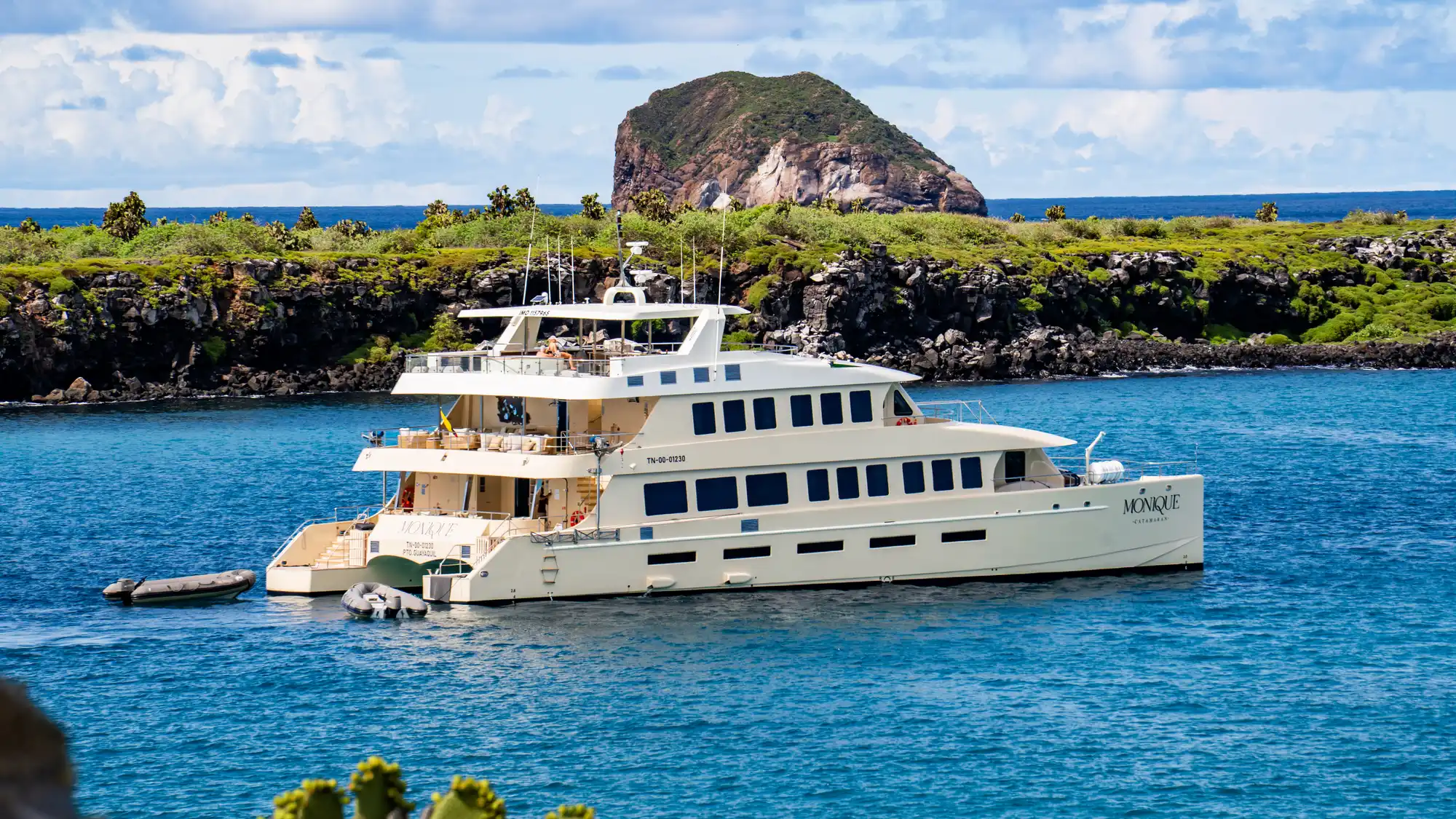
November 15, 2026 · Monique, 5-Day Southern & Western: Kicker Rock's Swim Channel
Possible: Kicker Rock (León Dormido), day 1. 1 spot
Check availability
November 18, 2026 · Galaxy Stella, 5-Day Northern Islands: Kicker Rock's Shark Channel
Possible: Kicker Rock (León Dormido), day 5. 4 spots
from US$4,080 per guest
Check availability
471 departures
On every departure
Included
All meals on board · Two certified national park naturalist guides · All excursions and landings listed in the itinerary · Snorkelling gear and wetsuit · Kayaks and stand-up paddleboards on board · Coffee, tea and water at any time
How you see them
Diving at 4 sites · Snorkelling at 2 sites
Best chance
The largest schools of the year from June to November on Darwin Arch.